

If you really want to understand and use cannabis, there's one term you can't ignore: decarboxylation. This chemical process transforms the inactive precursors THCA and CBDA into the active cannabinoids THC and CBD – only then does the plant unfold its full potential. In this article, you'll learn all about the science behind it, practical methods for the kitchen, and how modern vaporizers automatically take care of the activation process.
Key findings
- Decarboxylation is a chemical reaction in which cannabinoid acids (THCA, CBDA) are converted into the active ingredients THC and CBD through the separation of CO₂—without this step, cannabis remains largely ineffective.
- Heat and time are the key factors: typically, the optimal range is 105–115 °C for 30–60 minutes, depending on the method and moisture content of the flowers.
- When smoking and vaping, decarboxylation happens automatically, whereas when preparing edibles, cannabutter, oil, and tinctures, it must be done separately beforehand.
- Precise temperature control—for example, using high-quality vaporizers with digital controls—preserves cannabinoids and terpenes, which significantly improves aroma and effect.
- In the following sections, you will find detailed instructions for the oven, water bath, and sous vide, as well as recommendations for optimal vaporizer temperatures.
What is decarboxylation? (Basics explained simply)
The term decarboxylation describes a chemical reaction in which a carboxyl group (-COOH) is split off from a molecule, releasing carbon dioxide (CO₂). In the context of cannabis, this means that the cannabinoid acids in the fresh plant are converted into their active forms by heat.
What you should know about fresh cannabis flowers:
- In the living cannabis plant and freshly harvested flowers, the active ingredients are mainly present as acids: tetrahydrocannabinolic acid (THCA) and cannabidiolic acid (CBDA).
- These precursors have different properties than their decarboxylated counterparts.
- Only when heated does the psychoactive THC or the non-intoxicating CBD develop.
THC (tetrahydrocannabinol) is the psychoactive ingredient responsible for the typical high and can have relaxing and potentially pain-relieving effects. CBD (cannabidiol), on the other hand, has no intoxicating effect but is valued for its potential anti-inflammatory and calming properties.
The formula is very simple: THCA → THC + CO₂
Interestingly, humans have been unconsciously using this process for centuries. Whether in the traditional smoking of hemp plants or the brewing of cannabis teas, heat has always been involved in triggering decarboxylation. However, knowledge of the exact chemistry behind this process is relatively recent and now enables targeted optimization.
Why is decarboxylation so important for cannabis?
Imagine sprinkling raw, untreated cannabis flowers on your yogurt or in a smoothie—the result would be disappointing. Without prior activation by heat, THCA and CBDA remain largely inactive, and the desired effect is not achieved. This is why decarboxylation is essential for certain forms of consumption.
Decarboxylation is necessary beforehand for:
- Edibles (brownies, cookies, gummy bears, pasta sauces)
- Cannabutter and Canna Oil
- Alcohol-based tinctures
- Topical products (ointments, creams)
- Capsules to swallow
Decarboxylation is not necessary for:
- Joints, bongs, and pipes (combustion = immediate decarboxylation)
- Vaporizers (heating during inhalation)
- Pre-made extracts and concentrates for vape pens
With traditional smoking and vaping methods, the conversion of THCA to THC happens automatically—the heat from inhaling does the job in a fraction of a second. The situation is different when it comes to producing edibles: here, the cannabis must first be heated separately so that the active ingredients can actually be absorbed by the body when consumed.
Incidentally, cannabis-based finished medicinal products, which have been prescribed more frequently in Germany since 2017, are usually already decarboxylated or contain standardized extracts with defined THC and CBD contents.
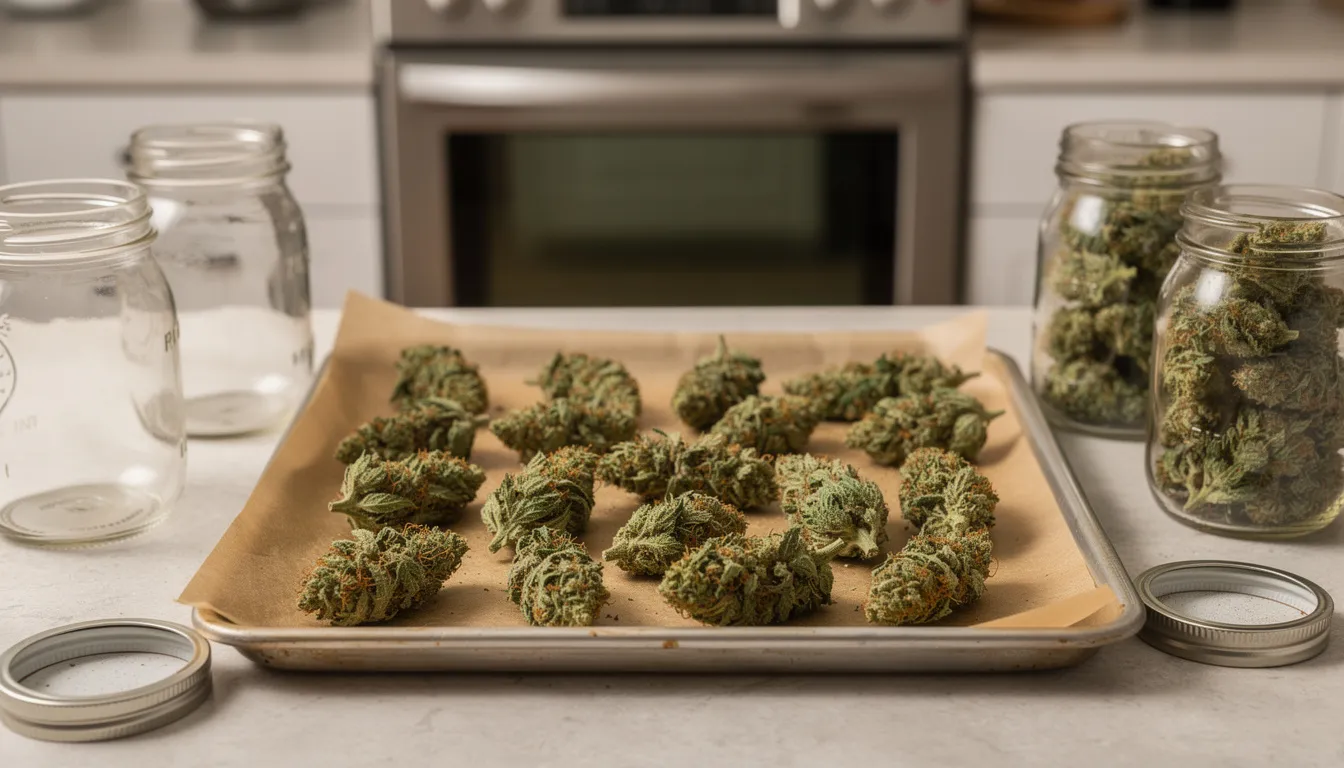
The chemistry behind decarboxylation: temperature and time
The art of successful decarboxylation lies in the precise interplay of moderate heat and sufficient duration. Too little of either leads to incomplete activation, too much destroys valuable cannabinoids and terpenes.
Optimal parameters for THCA → THC:
- Temperature range: approx. 220–230 °F
- Baking time: 30–45 minutes
- Critical limit: Cannabinoids and terpenes begin to suffer at temperatures above 140–150 °C.
Special features of CBD:
- CBD has similar but slightly different optimums.
- Tendency toward slightly longer times at comparable temperatures
- Adjust accordingly for CBD-rich strains
Terpenes—aromatic substances such as myrcene, limonene, and linalool—partially vaporize at temperatures as low as 150 °C. They are not only responsible for the characteristic smell and taste, but may also contribute to the so-called entourage effect, in which various plant substances work synergistically together.
This is precisely where the advantage of precise temperature control comes into play. Modern herbal vaporizers, such as the models from Norddampf digital temperature settings that make it easier to strike this balance between maximum cannabinoid activation and terpene preservation. The ability to set the temperature to the exact degree makes the difference between an average and an outstanding experience—especially when you're concerned with finding the perfect vaporizer temperature for your vaping experience.
Decarboxylation in the kitchen: oven, water bath, and sous vide
For anyone who wants to make edibles, cannabutter, oils, or tinctures, controlled decarboxylation in the kitchen is the first crucial step. The three main methods differ in terms of effort, precision, and discretion.
The three methods at a glance:
- Oven – classic, simple, possible in every household
- Water bath – gentler, slightly less odorous
- Sous-vide – maximum precision, very discreet, requires additional equipment
In the following sections, you will find specific temperature and time specifications for each method, as well as practical step-by-step instructions. An important criterion for comparison is the development of odor: while the oven can fill the entire house with the aroma of cannabis, sous vide and the glass-in-water-bath method are much more discreet – ideally complemented by clean curing of cannabis to optimize taste and effect.
The classic method: decarboxylating cannabis in the oven
The oven is the most common method of decarboxylation—after all, virtually every household has an electric or gas oven. The oven method is straightforward and requires no special equipment.
Step-by-step instructions:
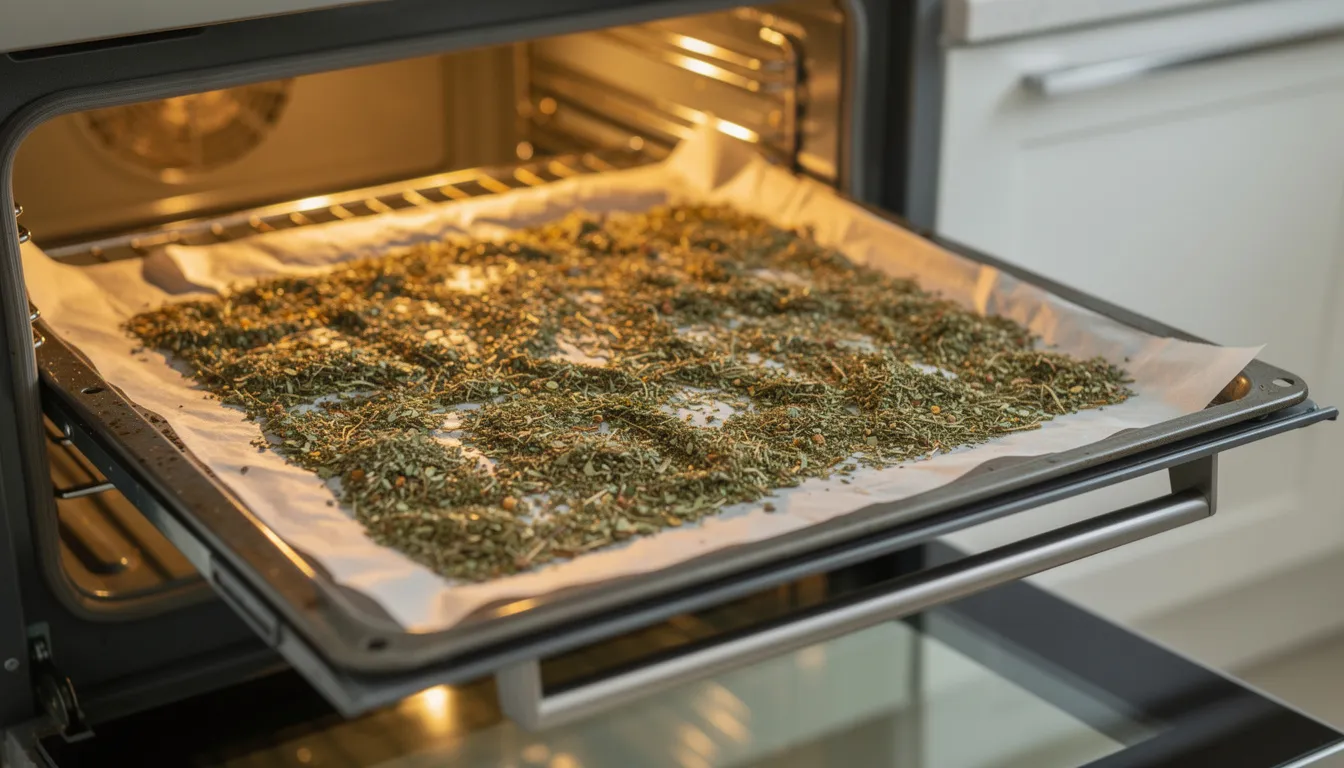
- Preheat the oven to approx. 105–115 °C top/bottom heat. Convection can distribute the temperature unevenly – it is better to avoid this or reduce the temperature slightly.
- Crush the flowers coarsely with your fingers or a grinder. Powder that is too fine increases the risk of burning.
- Spread the chopped material thinly and evenly on a baking sheet lined with parchment paper.
- Place the baking sheet in the preheated oven and set the timer: approx. 35–40 minutes for dry buds, up to 60 minutes for fresher, still slightly moist cannabis buds.
- Stir gently halfway through to ensure even heating.
- The finished material should be light golden brown and appear dry and crumbly.
Important information about the oven method:
- The odor is quite strong – be sure to ventilate well.
- An oven thermometer helps to check the actual temperature (many ovens are inaccurate).
- Optional: Install an activated carbon filter in the kitchen
Gentle & reasonably discreet: water bath (double boiler or preserving jar method)
The water bath method is gentler than the oven and produces significantly less odor, as the cannabis remains in a closed container. The method using a preserving jar in a water bath is particularly popular.
Step-by-step instructions:
- Coarsely grind the cannabis flowers and place them in a heat-resistant preserving jar or another sealable glass container.
- Place the lid loosely on top (do not close tightly so that pressure can escape).
- Fill a sufficiently large pot with water and place the jar inside. The water should reach about halfway up the jar.
- Heat the water slowly to approx. 95–100 °C. Use a kitchen thermometer to check the temperature.
- Let the glass simmer at this temperature for about 60 minutes. Check the water level regularly and add hot water if necessary.
- After the time has elapsed, carefully remove the glass and allow it to cool.
An additional lid on the pot further reduces the smell, but cannot eliminate it completely. This method is particularly suitable for smaller quantities and users who are looking for a more discreet alternative to the oven.
Precision for advanced users: decarboxylation with sous vide
The sous-vide technique originated in French haute cuisine and has been used since the 1970s for gentle cooking at a constant temperature. Today, it has also found its way into the cannabis community—and for good reason.
Step-by-step instructions:
- Grind your cannabis coarsely and place it in a vacuum-sealable bag or a sturdy zip-lock bag.
- Remove as much air as possible from the bag—ideally with a vacuum sealer, or alternatively using the water displacement method.
- Set your sous vide stick or precision cooker to approximately 90–95 °C and wait until the temperature is stable.
- Immerse the sealed bag completely in the water bath and weigh it down if necessary to prevent it from floating.
- Leave the bag in water at a constant temperature for 60–90 minutes.
- Remove the bag, allow it to cool, and store the decarboxylated material in a dry place.
Advantages of the sous-vide method:
- Highest temperature precision
- Extremely gentle on aromas (terpenes are preserved)
- Virtually odorless during the process
- Uniform heating of the entire material
The disadvantage: You need additional equipment in the form of a sous vide device and, ideally, a vacuum sealer.
Microwave: Why this quick method is usually not a good idea
At first glance, the microwave seems appealing—it's fast, easy, and found in every household. However, it is problematic for decarboxylation for several reasons.
Why the microwave fails:
- Uneven heating due to hot spots—some areas burn, others remain unactivated
- No precise temperature control possible
- Peaks above 150–180 °C can cause massive damage to sensitive terpenes and cannabinoids.
- The outcome is unpredictable and rarely optimal.
Conclusion: If you use a microwave at all, use it only for small test quantities and experiments. For high-quality edibles and complete, gentle decarboxylation, it is better to use an oven, water bath, or sous-vide.
Decarboxylation and vaporizers: Understanding activation when vaping
Modern herbal vaporizers have revolutionized the way cannabis is consumed. Unlike kitchen methods, decarboxylation takes place automatically during inhalation—the heat in the herb chamber activates the cannabinoids in real time. Our ultimate guide to cannabis vaporizers provides a comprehensive overview of device types, technology, and benefits.
What vaporizers mean for decarboxylation: You can find an overview of different models, designs, and areas of application in our compilation of herbal vaporizers from Norddampf.
- Temperature ranges between approx. 160–230 °C enable the gradual release of various cannabinoids and terpenes.
- You inhale THC or CBD that has already been activated – no pre-treatment necessary
- Vaporization avoids the combustion products that are produced when smoking.
Dual heating systems for optimal results: High-quality devices such as those from Norddampf conduction (contact heat) and convection (hot air). This dual heating ensures that the entire herb chamber is heated evenly, resulting in complete decarboxylation of the material—a principle that the Norddampf Relict with dual heating and Intellisense implements particularly consistently.
Intelligent temperature technology: Features such as Intellisense sensors automatically adjust the temperature and keep it stable—even if you inhale particularly strongly or gently. This prevents overheating and ensures that cannabinoids and terpenes are released optimally.
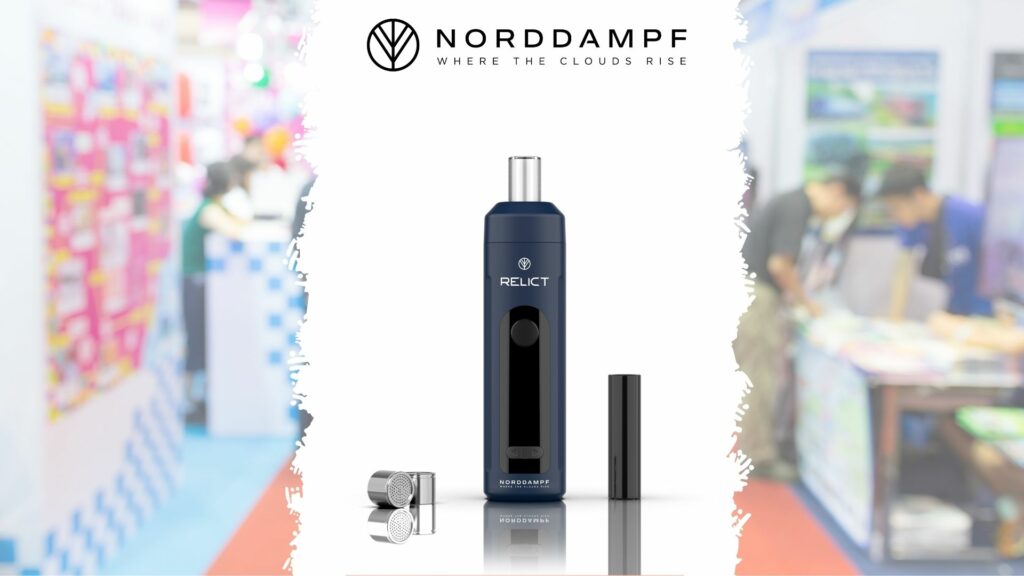
Optimal vape temperatures for THC, CBD, and terpenes
Different active ingredients have different boiling ranges. This means that by selecting the right temperature, you can influence which substances you prefer to inhale.
Overview of boiling ranges:
- THC: approx. 157–180 °C
- CBD: slightly higher, from approx. 170–185 °C
- Terpenes: variable, most between 150–190 °C
Recommendations for your sessions:
| temperature range | Effect & Character |
|---|---|
| 165–175 °C | Aroma Start: Full terpene bouquet, mild effect, ideal for beginners |
| 180–200 °C | Medium intensity: Stronger effect, good balance between taste and effect |
| 410–440 °F | Intensive Sessions: Maximum cannabinoid extraction, less aroma |
| Practical tips: If you want to gain a deeper understanding of how temperature profiles influence terpene release, take a look at our analysis of the effects of terpenes and their temperature profiles. |
- Start with lower temperatures (165–175 °C) and enjoy the full aroma.
- Increase the temperature gradually during the session.
- Norddampf such as Relict, Hammah Voity preset temperature levels or precise degree selection for exactly this purpose.
- Avoid temperatures above 220–230 °C – this is where combustion begins, and the advantage of vaping (fewer harmful substances) is lost.
Vape pen vs. herbal vaporizer: differences in decarboxylation
Not every vape device functions the same, and the differences have a direct impact on decarboxylation.
Vape pens (for liquids and concentrates):
- Designed for pre-filled cartridges or concentrates
- The material in THC/CBD cartridges is already decarboxylated (extract).
- No decarboxylation required in the device
- Examples from the Norddampf range: Dab Pen Mini, Terp Pen
Herbal vaporizer (for dried flowers):
- Heat dried cannabis flowers directly
- Decarboxylation takes place in the device during inhalation.
- Temperature control is crucial for the result
- Examples from the Norddampf range: Relict, Hammah, Voity
Practical tips for both device categories:
- For concentrates: Start low (approx. 150–175 °C), as the material is highly concentrated.
- For herbs: Use the temperature settings recommended above and increase gradually.
- Herbal vaporizers offer more control over the decarboxylation process and allow you to explore different temperature profiles.
Preparation & storage: How to get the most out of decarboxylated cannabis
Good preparation before decarboxylation and proper storage afterwards determine the quality and shelf life of your activated material.
Preparation before decarboxylating: For optimal results, the quality and preparation of the herbs play a key role; you can find detailed information on this in our guide to choosing and preparing herbs for your vaporizer.
- Ensure that your flowers are sufficiently dry (crispy consistency).
- Moist material prolongs the decarboxylation time, as energy is first used to evaporate the water.
- Otherwise, the temperature at the material itself remains too low.
Optimal grinding: Grinding and filling your device correctly has a significant impact on decarboxylation and extraction. Our guide to filling your vaporizer correctly for maximum efficiency shows you how to pack your device ideally.
- Chop coarsely to medium coarse for better heat distribution
- A high-quality grinder (e.g., from the Norddampf) delivers consistent results.
- Avoid powder that is too fine—it burns more easily and tends to crumble.
Storage of decarboxylated cannabis:
- Use dark, airtight glass containers.
- Cool place (not in the refrigerator, but away from heat sources)
- Optional: Boveda or silica gel packs for humidity control
- Shelf life: several months to over a year when stored correctly
Practical tip for vapers: Dosing capsules are ideal for preparation. You can fill the capsules with your ground herbs—whether decarboxylated for later use in edibles or fresh for vaping—and transport them conveniently. The Relict made of stainless steel are particularly practical here. Norddampf matching accessories that make everyday use easier.
Decarboxylated—and then what? Typical uses of activated cannabis
Decarboxylated cannabis is a versatile base for numerous applications. Once activation is complete, many doors are open to you.
Popular applications: Many users also combine activated material with alternative forms of consumption such as oral intake or reused plant material—you can find detailed strategies for this in our guide to vaporizing with expert tips and alternative methods.
- Cannabutter: A classic base for all kinds of baked goods
- Canna oil: Infusion in olive oil, coconut oil, or other carrier oils
- Honey infusions: a sweet alternative for teas or as a spread
- Alcohol tinctures: With high-proof ethanol (70–96%)
- Topical products: Ointments and creams for external use
- Supplies for vaping: Yes, decarboxylated material can also be used in vaporizers.
Important information about dosage for edibles:
- Start with small amounts (approx. 2.5–5 mg THC per serving)
- Wait at least 1–2 hours for the effect before taking another dose.
- The effects of edibles are significantly slower to kick in than with vaping, but they last longer and can be more intense.
Classic homemade recipes such as brownies, cookies, pasta sauces, or tincture drops under the tongue offer something to suit every taste.
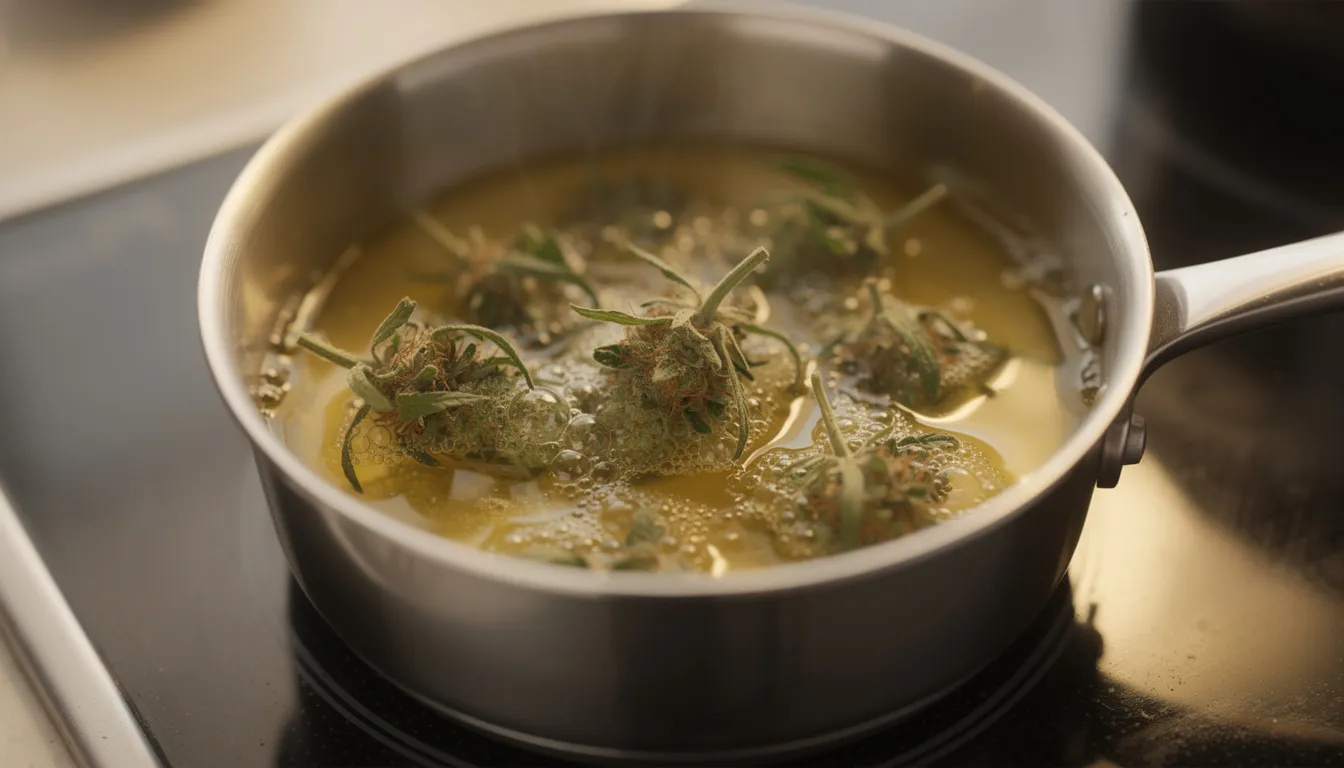
Basic recipe: Cannabutter or cannabis oil with decarboxylated flowers
Cannabutter has been the standard base for cannabis edibles for decades—think of the hash cookie culture of the 1960s and 70s. It is easy to make.
Simple step-by-step instructions:
- Melt butter or heat oil over low heat in a saucepan or double boiler.
- Add the decarboxylated flowers and stir.
- Let the mixture simmer gently for 1–2 hours at approx. 80–95 °C. Do not let it boil!
- Stir occasionally to prevent burning.
- Strain the finished butter/oil through a fine sieve or cheesecloth to remove any plant material.
- Allow the cannabis butter to cool and harden in the refrigerator.
Important information:
- Do not exceed the original decarboxylation temperature to avoid the risk of losing active ingredients.
- Write down the exact amount used (e.g., 5 g of cannabis to 250 g of butter) so that you can calculate the dosage per serving later.
- Store the finished cannabutter in the refrigerator or freezer.
Discreet application: Tinctures & capsules with decarboxylated material
Alcohol-based tinctures and self-filled capsules are discreet, easy-to-dose forms of consumption—ideal for on the go or when smoking/vaping is not an option.
Making tinctures: If you want to explore other herbal infusions besides alcohol tinctures, our tips on vaporizer herbs, optimal use, and temperature will help you.
- Add decarboxylated flowers to high-proof alcohol (70–96%)
- Leave to stand in a dark place for several weeks.
- Shake occasionally to improve extraction.
- After the time has elapsed, filter and pour into amber glass bottles.
- Application: A few drops under the tongue
Filling capsules yourself:
- Finely grind decarboxylated cannabis
- Optionally mix with filling material such as MCT powder
- Fill empty capsules (available at pharmacies or online)
- Onset of effect similar to edibles (delayed but long-lasting)
Legal notice: The production and use of cannabis products is subject to different legal regulations in each country. Please check the current legal situation in your place of residence. If you Relict specifically Relict the Relict , you can find further information on its use in RELICT FAQ, which contains all the important functions and tips.
FAQs about decarboxylation of cannabis
The following questions are frequently asked and supplement the information provided in the main section of this article. Please note that the answers are general in nature and do not replace medical or legal advice.
Can I reuse cannabis that has already been vaped or decarboxylated once?
Already vaped material—often referred to as AVB (Already Vaped Bud) or ABV—contains significantly less cannabinoids than fresh cannabis, but it is not worthless. The material has already been decarboxylated by the vaping process, so no further heat treatment is necessary.
AVB is suitable for mild edibles, capsules, or as an addition to high-fat foods. However, expect a weaker effect and approach the dosage slowly. It is best to collect your AVB in a separate container and experiment with small test quantities.
What can I do if I accidentally overheat my cannabis?
Slightly browned material is usually still usable—the decarboxylation may have been a little more intense than planned, but the active ingredients are still present. Strong dark brown to black cannabis, on the other hand, has suffered significant losses of active ingredients and tastes unpleasant.
If the material is overheated but not burnt, we recommend using it in edibles with strong flavors (chocolate, spices, strong coffee) to mask the taste. It is best to dispose of burnt material with a strong odor. For next time: Use an oven thermometer and work at a lower temperature for a longer period of time.
Does it make sense to decarboxylate cannabis simply by storing it for a long time?
Theoretically, slow, natural decarboxylation takes place over months and years. In practice, however, this method is problematic: the process is uncontrollable, and parallel to the breakdown of THCA, THC is converted into CBN—a cannabinoid with significantly different, more sedative properties.
Old, long-stored grass therefore often appears tired and less clear. Its potency decreases overall. Recommendation: Decarboxylate specifically with heat instead of hoping for years of storage. Good storage conditions (dark, cool, airtight) at least slow down the undesirable degradation.
How do I choose the right temperature on my vaporizer for beginners?
As a beginner, you should start at around 170–180 °C. At this temperature range, you will get a full aroma from the terpenes and a mild, easily controllable effect. After a few puffs, you can gradually increase the temperature to 190–200 °C to activate the remaining cannabinoids.
Norddampf with preset levels and clear LED or display indicators make it much easier to get started. Read the manufacturer's instructions for information on the respective temperature levels. Important: Subjective tolerance and the strain profile always play a role – approach it slowly instead of starting directly at the highest level.
Does the strain (Indica, Sativa, Hybrid) play a role in decarboxylation?
The chemical decarboxylation process is the same for all strains—it primarily involves the conversion of THCA and CBDA into THC and CBD. The strain does not influence how or at what temperature this reaction takes place.
The differences between Indica, Sativa, and hybrids lie more in their cannabinoid and terpene profiles, i.e., in the type of effect and aroma they produce. For particularly terpene-rich strains with an intense aroma, it is worth maintaining moderate temperatures in order to preserve the desired bouquet. Over time, you will discover your personal favorite temperatures for different strains – particularly relevant if you use a precisely adjustable vaporizer.
Conclusion: Decarboxylation is the key to unlocking the full potential of cannabis. Whether you're preparing your buds in the oven for edibles or enjoying automatic activation when vaping with a high-quality device, understanding this process makes the difference between mediocre and outstanding results.
With the right knowledge about temperature and time, combined with precise technology such as Norddampf vaporizers, you can get the most out of your cannabis flowers. Discover the possibilities on our website and find the right device for your perfect experience—for example, in our overview if you want Norddampf a Norddampf vaporizer.