

Rosin is one of the most exciting cannabis extracts of recent years – not because it is complicated, but because it is exactly the opposite: a solvent-free extraction method that uses heat and pressure to extract the valuable cannabinoids and terpenes from the plant. Whether you are interested in cannabis rosin, hash rosin, or particularly terpene-rich live rosin: the end product can be extremely aromatic, potent, and clean. To achieve this, it is important to understand what matters when it comes to quality, purity, and material. In this article, you will get a clear overview of how rosin is basically made, why it is so popular, and what factors make the difference between "okay" and "wow."
What is rosin?
Rosin is a solvent-free cannabis concentrate. It is produced when resin components from the cannabis plant are extracted from the source material under heat and pressure. This can be done using cannabis flowers, hash (i.e., hash rosin), or fresh material. The latter is often referred to as live rosin.
The big difference to many other extracts: no solvents are used in the production of rosin. No butane, no ethanol, no CO₂. This means that the end product is free of solvent residues, which is a key quality and safety argument for many users.
In short:
- Rosin = cannabis resin concentrate obtained through mechanical extraction
- solvent-free
- with a focus on purity, terpenes, and natural terpene profile
Why is cannabis rosin so popular?
Cannabis rosin has become a favorite among many people in recent years, across the board. Both DIY enthusiasts and commercial manufacturers celebrate the stuff because it not only seems straightforward, but also really delivers. When producing rosin, you end up with a strong, aromatic product that many find significantly "cleaner" than a cannabis extract from a classic cannabis extraction using solvents. The idea that no chemical residues or residues remain in the cannabis extract is reason enough for many to try rosin in the first place. In addition, depending on the source material, rosin can have a fairly high cannabinoid content, for example, a very potent THC or CBD profile. For many, this makes the effect not only stronger but also clearer.
What also makes rosin so attractive is its terpene profile. Good rosins retain many terpenes, which are ultimately responsible for the aroma and taste. That's why cannabis rosin often tastes really intense and variety-specific, just more concentrated. Since the extraction process is relatively quick, rosin can be used immediately after production without having to wait long or clean anything. This has given it something of a craft image in the cannabis community: for many, rosin is the concentrate that prioritizes quality, purity, and authentic plant aroma. That's exactly what makes it so popular with many cannabis enthusiasts.
How does rosin differ from other cannabis extracts?
Rosin isn't the only cannabis extract out there. You can also find things like BHO, live resin, CO₂ oils, distillates, and many other concentrates on the market. However, the big difference almost always lies in the extraction method. While many processes use solvents, rosin relies entirely on heat and pressure. This results in a cannabis extract that does not involve any chemicals and therefore poses no risk of solvent residues.
Rosin also places a strong focus on aroma and terpenes. Many find that this gives it a more natural and true-to-variety taste than some industrially produced concentrates.
Although other methods can often deliver higher yields, they are more technical, more expensive, and, depending on the process, also riskier to produce. That's why many see rosin as a pretty smart middle ground: very good quality and purity without the chemical overkill.
How important are cannabinoids and terpenes in rosin?
Rosin is particularly exciting because it captures the plant's natural cannabinoids and terpenes in concentrated form. Cannabinoids, such as THC, CBD, or CBG, primarily determine the effect. Terpenes, on the other hand, are more responsible for the taste and aroma, and they also influence the so-called entourage effect. This means that cannabinoids and terpenes often have a more "rounded" effect when combined than when isolated.
When rosin is made cleanly, this combination remains fairly close to the original strain. That's why many people say that rosin tastes like the plant itself, only more intense.
What types of rosin are there?
Not all rosin is the same. Depending on the raw material used and how it is processed, there are a few common categories.
Flower Rosin
Flower rosin is extracted directly from dried flowers or cannabis buds. It often feels somewhat "lighter" in texture, i.e., softer or creamier, and it strongly reflects the character of the original strain. If good flowers were used, you will also get a very clear terpene profile typical of the strain.
Hash Rosin
Hash rosin is made from hash or kief. Because this material is already pre-filtered and consists mainly of trichomes, hash rosin is usually much more concentrated and has a very high purity. Many people like it because it often has a more potent effect while still remaining extremely aromatic.
Live Rosin
Live Rosin is considered by many to be the premium variety. It is made from freshly harvested, deep-frozen material, which preserves a particularly high amount of terpenes. This ensures a very intense, fresh aroma and a full terpene profile. At the same time, Live Rosin is usually more expensive because the raw material and the process are more complex.
These differences clearly show why Rosin is so diverse: there are options for beginners, but also genuine high-end products for people who want the maximum in terms of taste and effect.
How is rosin made?
Rosin basically involves dissolving the resinous components of the plant in such a way that a concentrated, sticky extract remains at the end. This is done by means of a pressing process in which the raw material is placed between heated plates and "squeezed" under pressure. The result varies depending on the material used: classic cannabis flowers produce flower rosin, hash or kief produce a denser hash rosin, and live rosin is obtained from particularly fresh, frozen material and is often more aromatic.
What's important to note is that rosin isn't a product that only comes in one solid form. Depending on the variety and how it's processed, it can be soft and creamy, chewy, or even glassy. That's why many people talk about rosin not only in terms of "production," but also in terms of style and result. Even small differences in the process can lead to different textures and flavors.
What determines the quality of rosin pressing?
Whether Rosin really becomes top-class is not decided by a single factor, but by a combination of several variables.
A key factor is the source material. Flowers or hash with lots of intact trichomes simply yield more and better extract. If, on the other hand, the material is old, too dry, or has been stored poorly, this has a direct impact on the color, aroma, and yield.
Then there is the interplay between temperature and pressure. Temperature primarily influences how many aromatic substances are retained and how "light" or "dark" the end product appears. Pressure, in turn, controls how effectively the resins are extracted. Too little pressure can reduce the yield, while too much can make the rosin "dirtier" because plant particles slip through.
Time is also a factor. Pressing cycles that are too short or too long can alter the result. Either potential remains in the material, or the extract takes on an unnecessarily heavy, "cooked" note. This is precisely why many experienced users test until they find their sweet spot.
What equipment and materials are needed to make rosin?
If you want to press rosin, the rosin press is the heart of the process. The difference between simple and better models lies primarily in how precisely you can control the temperature and pressure. Home devices are often compact and simple, while professional press units work more accurately and evenly. This is exactly what you notice in the end product.
As a "basic" requirement, you will also need baking paper, as it is heat-resistant and prevents the freshly pressed rosin from sticking to the plates or being lost. In practice, this is simply the standard substrate for the extract.
You will also need your material: cannabis flowers or buds, hash, or particularly fresh raw material for live rosin. Many people also use fine filter bags or sieves to keep the extract cleaner, especially if they value high purity and a clear terpene profile.
Bottom line: good press + clean accessories + strong material = the basis on which Rosin can show its full potential.
What are the typical quality characteristics of good cannabis rosin?
When buying or evaluating rosin, a few simple criteria will help you.
Color
High-quality rosin is often golden yellow to amber in color. Very dark rosin may indicate excessive heat, old material, or impurities.
Consistency or texture
Rosin can look different:
- creamy
- tough and sticky
- glassy
- depending on the strain, also more crumbly
It is important that the texture appears uniform and does not smell extremely "burnt."
Smell and taste
An intense aroma typical of the strain is a good sign. If it smells weak or flat, it often lacks terpene depth.
purity
Rosin should be as free as possible from visible plant particles. The cleaner it is, the better its purity.
What are the advantages of the Rosin technique in everyday life?
Many users see rosin as the ideal middle ground: strong, aromatic, but without chemical extraction.
The advantages at a glance:
- Solvent-free and no residues
- High purity
- Natural terpene profile
- Strong effect thanks to concentrated cannabinoids
- Relatively simple technology compared to other methods
- Attractive for beginners because the process involves less risk than, for example, BHO extraction.
It is precisely this combination that makes Rosin so popular with people who want quality but don't want laboratory chemicals in the process.
Are there any disadvantages or limitations to rosin?
As good as Rosin may sound, there are actually some disadvantages.
Yield varies
Rosin depends heavily on the source material. If the flowers or hash are only mediocre, the result will rarely be really good. The yield will vary, and so will the quality.
Equipment costs
If you really want consistently good results, sooner or later you'll end up with a decent Rosin press, and those aren't exactly cheap. Of course, this also increases the price per gram when you calculate it.
learning curve
Although rosin is often described as "simple," there is a learning curve. If you want premium rosin, you need to have a feel for the most important adjustments. Otherwise, the result may quickly turn out differently than hoped for.
Legal framework
Concentrates containing THC are heavily regulated depending on the country. This is not a minor detail, but a real issue that must be taken seriously.
What legal and safety considerations should be taken into account?
Rosin is a cannabis extract, which is precisely why it may be classified differently than normal flowers depending on the country. In Austria, Germany, and Switzerland, or in countries such as the USA, the rules differ significantly in some cases.
The current situation in Germany is as follows: The Cannabis Act (CanG/KCanG) allows adults to possess and grow cannabis for personal use within clear quantity limits. At the same time, the law expressly prohibits the "extraction of cannabinoids" from the plant.
However, many lawyers and specialist sources classify rosin pressing as mechanical extraction without solvents (similar to hashish) and say that it is not explicitly prohibited as long as it comes from legal material and remains for personal use.
In plain English: It is considered a gray area with good arguments in favor of Rosin, but not a crystal-clear free pass.
In terms of safety, rosin is much less risky than solvent-based cannabis extraction because no flammable substances are involved. Nevertheless, you are working with heat and pressure. So: place the device on a stable surface, don't rush, and be careful with hot plates. Don't panic, but a little caution will protect your fingers and your kitchen.
How is rosin typically used?
Rosin is a concentrate and therefore significantly stronger than normal cannabis flowers. That's why most people use it in one of three ways. Regardless of which method you choose, it's important to start slowly because the concentration of active ingredients is high.
dabbing
When dabbing, rosin is vaporized on a hot surface and inhaled directly. Many people use a dab rig for this. This is the classic concentrate method: very fast, very intense, and if the terpene profile is good, really strong in flavor.
Vaporize
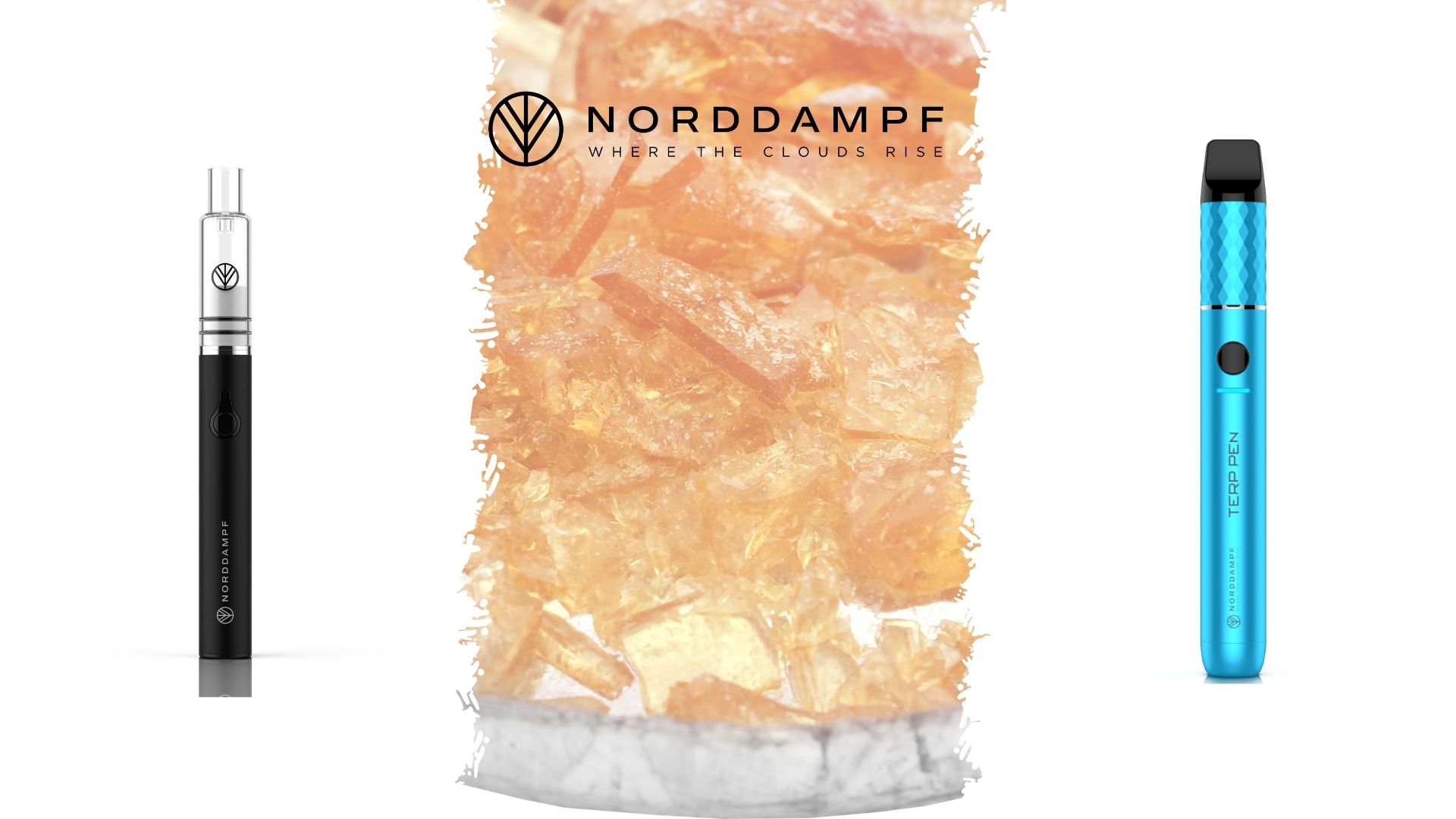
Some prefer to vaporize rosin in vaporizers designed for concentrates. This is often gentler than dabbing and brings out the aroma really well, because you can vaporize at a lower temperature and in a more controlled manner. This is a convenient solution, especially for people who already have a suitable vaporizer.
Combination with flowers
Some people use rosin together with flowers, for example as a little "boost" in a joint or vaporizer head. This makes the session significantly more potent and aromatic, but also more intense more quickly. So start sparingly.
What is the best way to store rosin to preserve its quality and terpene profile?
Rosin likes it cool, dark, and airtight. This protects terpenes, prevents oxidation, and preserves consistency and flavor.
Simple storage tips:
- Pack in an airtight container (glass is best).
- protect from light
- Do not leave in warm rooms.
- For longer storage, keep in a cool place to stabilize the terpene profile.
The less oxygen, heat, and light, the longer the end product will remain high quality.
Who in particular would benefit from cannabis rosin?
Rosin isn't just a trendy toy. It's simply a great fit for people who want more than "just buds."
Typically, Rosin is exciting for:
- People who pay close attention to taste and strain aroma
- Fans of solvent-free extracts
- Users seeking a clear, powerful effect
- Anyone who likes to measure out concentrates precisely
- People who celebrate the maximum depth of terpenes at Live Rosin
If someone only consumes occasionally, flowers are often sufficient. But those who want to combine potency and aroma will sooner or later end up with rosin.