

Is your grinder sticking when you turn it? Is the screen clogged? Are the results of grinding uneven? Then it's time for a thorough cleaning. Over time, impurities such as resin residue and other deposits accumulate inside the grinder, which can significantly impair the functionality and taste of your herbs.
Boiling is one of the most effective methods for removing stubborn resin, residue, and deposits from a metal grinder. This cleaning method is particularly suitable for metal grinders, as it effectively removes impurities and restores your metal grinder to full functionality. In this article, you will learn which grinders you can boil, how the method works, and why high-quality, multi-piece grinders are more efficient in the long run.
Boiling grinders – quick overview

With regular use, a sticky film of resin, pollen, and fine particles builds up in the grinder. These residues:
- make turning difficult
- close the sieve
- worsen the cleaning result
- increase material loss
Boiling is a chemical-free method of deep cleaning—provided your grinder is made of heat-resistant material.
Suitable for boiling are:
- stainless steel
- Hard anodized aluminum
- titanium
- ceramics
Metal grinders are particularly suitable for boiling, as they can easily withstand high temperatures.
Not suitable are:
- plastic
- acrylic
- wood
- Cheap zinc alloys
Plastic grinders should not be boiled, as many plastics are not heat-resistant and could deform due to the heat. An effective cleaning method for plastic grinders is to place them in the freezer so that the residue hardens and becomes easier to remove.
Wooden grinders should also not be boiled, as they react to moisture and can warp. To clean wooden grinders, it is recommended to use a soft brush or cotton swab and then allow them to dry thoroughly. Harsh cleaning agents and hard brushes should be avoided to prevent scratches and damage. An alternative method is to place the wooden grinder in the freezer overnight to make the residue brittle.
Acrylic grinders should also not be boiled, as they can deform when exposed to heat. One method for cleaning acrylic grinders is to soak them in warm water to soften the sticky residue before gently scrubbing them.
Boiling is a very effective cleaning method, but it requires some effort. Depending on the material, there are various cleaning methods and alternatives that may be more suitable.
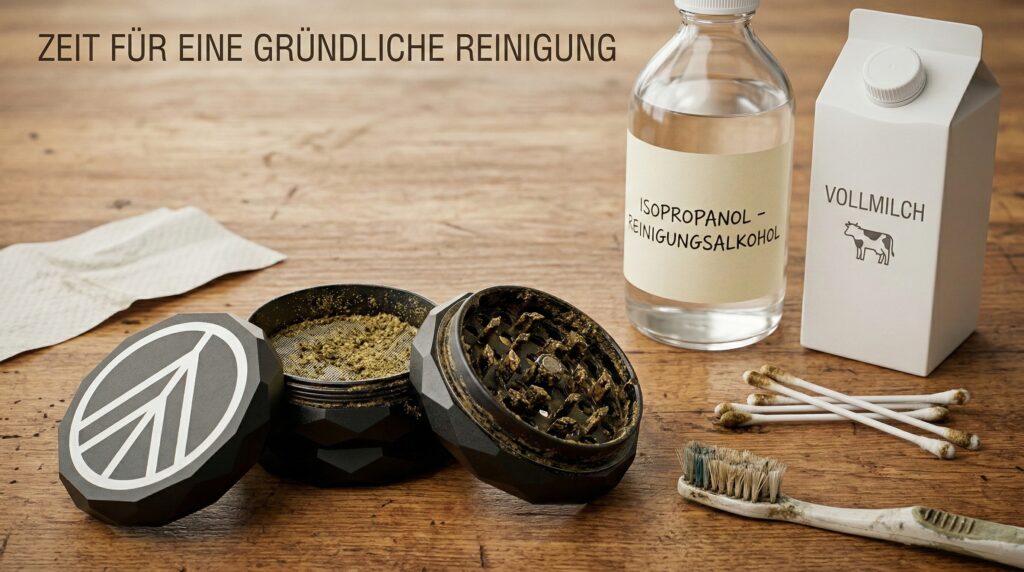
Why should you boil your grinder regularly?
A dirty grinder not only impairs its function, but also its efficiency.
Over time, the following accumulate:
- Resin residue on the teeth
- Fine particles in the sieve
- Sticky deposits in the thread
- Kief in the collection compartment
A sticky grinder grinds less effectively, clogs more quickly, and wastes material.
A clean grinder not only maintains its functionality and efficiency when grinding herbs, but also ensures better taste and hygiene, as old residues can spoil the enjoyment. Regular cleaning removes bacteria and germs, minimizing health risks.
Regular boiling:
- restores smooth operation
- removes stubborn resins
- cleans the screen
- improves material yield
- extends the service life
Tip: Boiling is a particularly effective cleaning method when maximum disinfection is required, for example once or twice a year, or if the grinder has been damp for a long period of time.
This care is particularly worthwhile for high-quality metal grinders.
2-, 3-, or 4-piece grinder—which design makes sense?
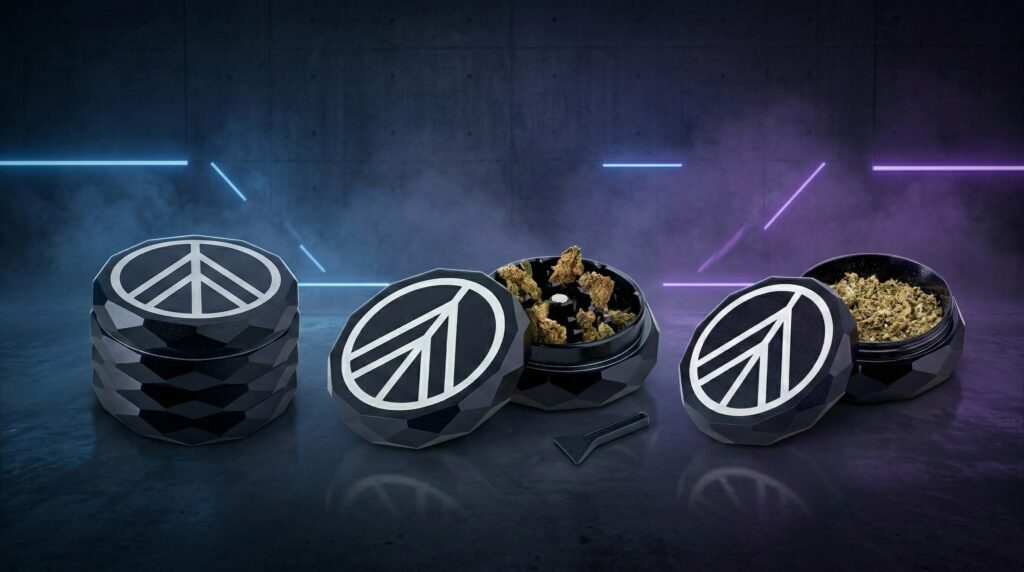
In addition to the material, the construction method also plays an important role.
Norddampf Grinders are available in 2-, 3-, and 4-piece versions and are made of precision-milled metal with sharp pyramid teeth for consistent grinding results.
To maintain the functionality and longevity of the grinder, it is important to thoroughly clean all individual parts and components on a regular basis.
2-piece grinder
- Compact grinding chamber, ideal for a high-quality 2-piece Norddampf
- No separate collection compartment
- Perfect for on the go
3-piece grinder
- Additional collection compartment as with the Norddampf with 3-part design
- Better separation of coarse and fine material
- Less material loss
4-piece grinder
- Integrated pollen screen for models such as the 4-piece Norddampf with pollen screen
- Separate, removable pollen compartment
- Maximum yield
The advantage of 3- and 4-part grinders lies in the additional collection system. Fine particles collect in the pollen compartment instead of sticking to the grinding mechanism.
A removable pollen compartment makes it easier to:
- Cleaning
- The extraction
- Separate storage
- Material inspection
In the long term, this means greater efficiency and less waste.
Boiling grinders in water: step-by-step instructions
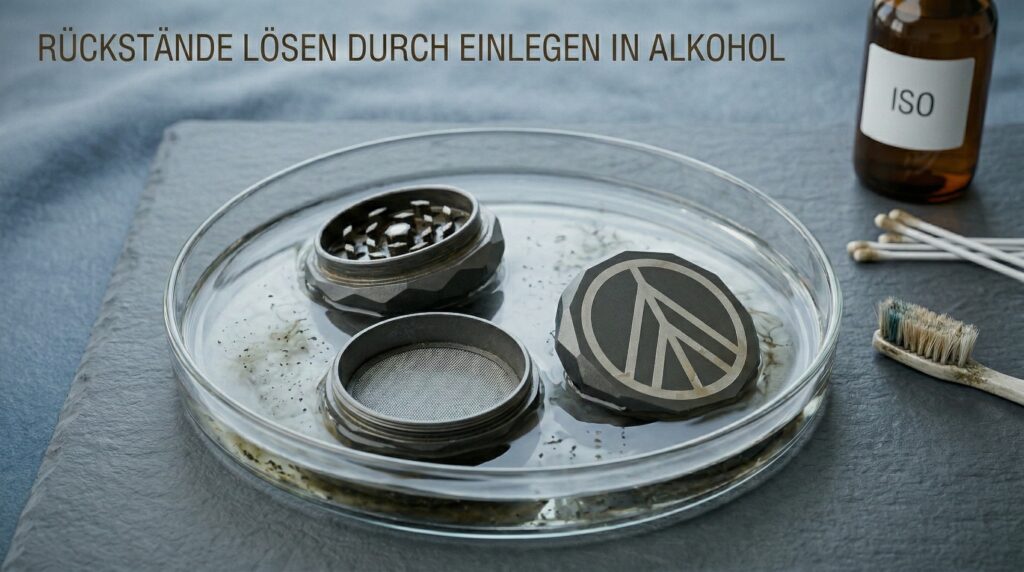
Boiling in water is suitable for thorough cleaning and disinfection. To do this, disassemble the individual parts of the grinder that are suitable for this cleaning method according to the manufacturer. Place the parts in a pot of boiling water and let them boil for a few minutes. After boiling, allow the parts to dry thoroughly before reassembling them.
Caution: When using isopropanol for cleaning, ensure good ventilation and exercise caution, as it is a highly flammable liquid.
Tip: Cotton swabs can be used as a tool for hard-to-reach areas in the grinder.
Here's what you'll need:
- cooking pot
- water
- Optionally, a drop of mild dishwashing liquid
- Toothbrush or paintbrush
- pliers
- kitchen towel
Instructions:
- Completely disassemble the grinder (lid, grinding chamber, sieve, base).
- Remove O-rings or seals.
- Bring the water in the pot to a boil.
- Reduce the heat so that the water is only simmering gently.
- Leave metal parts in water for 10–15 minutes.
- Remove with pliers.
- Clean again with a brush.
- Rinse thoroughly.
- Allow to dry completely for at least 24 hours.
Important: Do not rinse with cold water—this can cause material stress.
Boil grinder in milk: Cleaning & resin solution
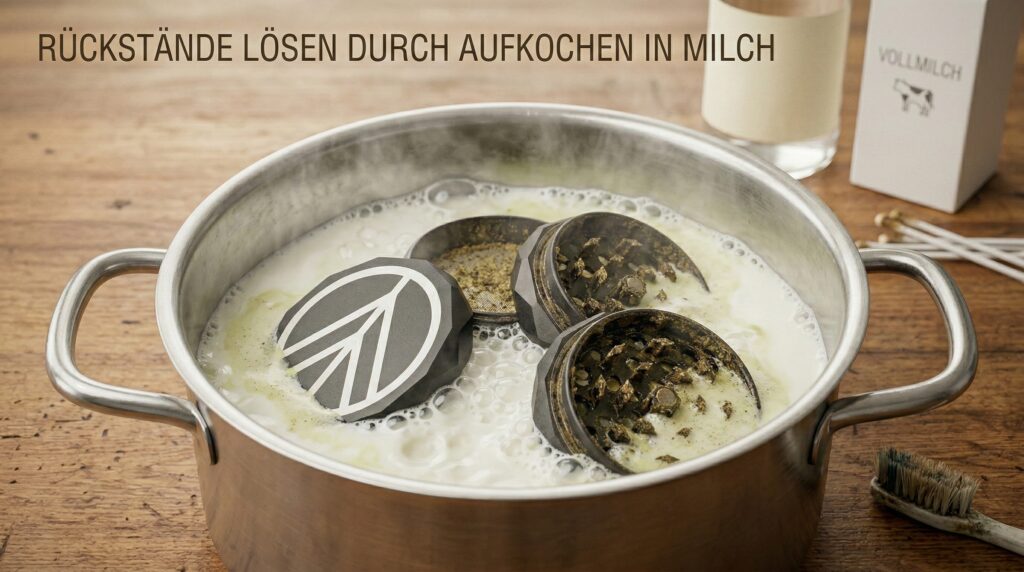
Boiling the grinder in milk—also known as the milk method—is an effective cleaning method for metal grinders to remove sticky resin and pollen residue. Milk contains fat, which can dissolve fat-soluble residues such as THC better than water.
After boiling: Stainless steel grinders, stone grinders, and ceramic grinders are excellent examples of grinders that are suitable for boiling in milk. These materials can withstand the heat and do not absorb moisture. Plastic grinders, wooden grinders, and acrylic grinders, on the other hand, should not be boiled, as they can deform, swell, or release harmful substances. Caution: The milk should not be brought to a boil during boiling, but only heated gently to loosen the residues.
The milk method is particularly well suited for removing fat-soluble residues such as THC from the grinder. Boiling a grinder in milk can produce a mild effect if THC residues are transferred to the milk. The effect of the milk depends heavily on the degree of contamination and the THC content of the residues. Tip: The milk can be drunk after boiling, provided that the grinder was clean and no harmful residues were heated.
Question: Is boiling in milk really a cleaning method? Answer: Chemically speaking, it is more of a recycling method, as the residues are not only removed but dissolved in the milk and can be reused.
Procedure:
- Disassemble the grinder
- Place metal parts in milk
- Heat slowly to 80–90 °C.
- Leave to steep gently for 15–20 minutes.
- Then clean thoroughly and dry.
The milk often turns brownish in color—a sign that resin residues are dissolving.
Note: This method is only suitable for clean metal parts without plastic seals.
Cleaning plastic or wooden grinders
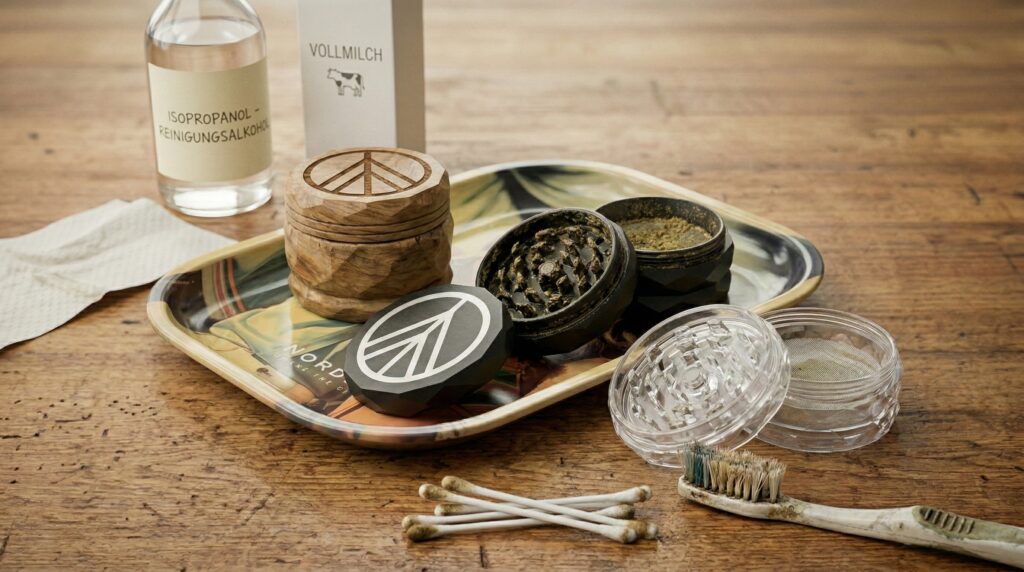
Not every grinder can be boiled. Particular care should be taken with wooden grinders, as they are sensitive to moisture and can warp. For wooden grinders, it is recommended to use a soft brush or cotton swab for cleaning and to allow them to dry thoroughly after cleaning. Harsh cleaning agents and hard brushes should be avoided with this type of grinder to prevent scratches and damage to the material. An alternative cleaning method for wooden grinders is to place them in the freezer overnight so that the residue becomes brittle and easier to remove.
Plastic grinders should also not be boiled, as many plastics are not heat-resistant and could deform. One tip for cleaning plastic grinders is to place them in the freezer to harden the residue and then carefully remove it.
Acrylic grinders should also not be boiled, as they can deform when exposed to heat. An effective cleaning method for acrylic grinders is to soak them in warm water to soften the sticky residue before cleaning them with a soft brush.
Please note: The best cleaning method always depends on the materials used. If you want to be on the safe side, you can use alternatives such as isopropanol or the methods mentioned above for all types of grinders to minimize effort and protect the material.
Plastic & Acrylic
- Do not heat above 80 °C
- Apply freezing method
- Carefully tap out any residue.
- Clean with lukewarm water
wood grinder
- Do not soak
- Brush dry only
- Do not use alcohol
Why high-quality grinders pay off in the long run
A precisely manufactured metal grinder—such as the Norddampf Grinder—offers several advantages:
- CNC-milled teeth
- Clean threads
- Robust construction
- Easy to clean
- Durable
Four-piece models with removable pollen compartments significantly increase material efficiency.
A clean grinder:
- grinds more evenly
- settles less
- works more efficiently
- uses less material
Brief comparison of efficiency: combustion vs. vaporization
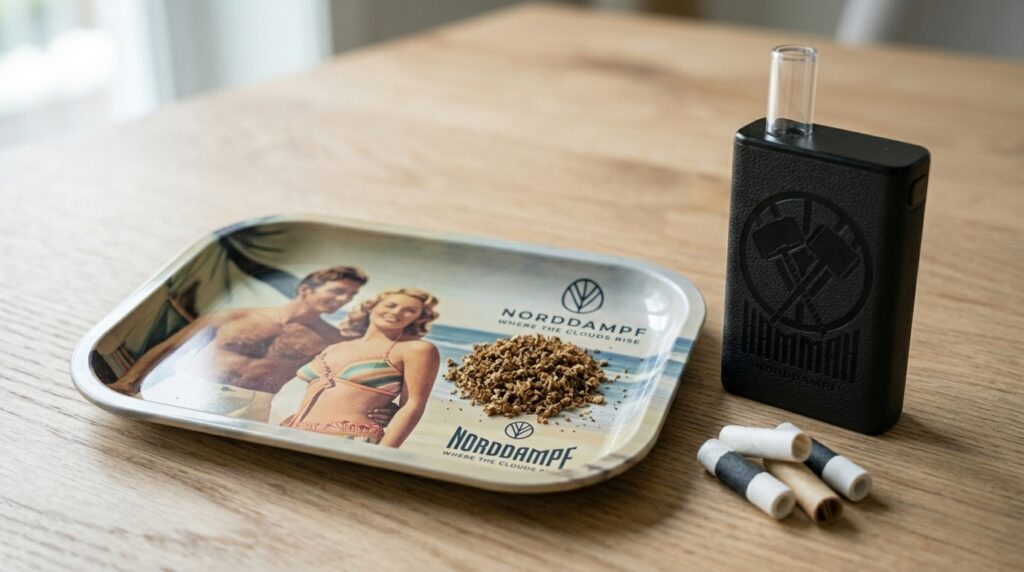
While conventional combustion completely destroys most of the material, temperature-controlled vaporization leaves behind what is known as AVB (Already Vaped Bud) – plant material that has already been heated and contains residual active ingredients, as is the case when using a vaporizer instead of smoking.
Depending on the legal situation, this may be further processed.
Devices such as the RELICT, HAMMAH or VOITY work with controlled heat instead of open flames. This allows the material to be used more efficiently.
Unlike incineration, the material remains usable—an efficiency advantage that traditional methods do not offer.
This aspect complements the topic of material efficiency, but is not the focus of this article.
How often should you clean your grinder?
Recommended intervals:
- Daily use: every 2–4 weeks
- Several times a week: every 4–8 weeks
- Occasional use: as needed
The sooner you clean, the easier the process will be.
Common mistakes when boiling the grinder
- Boil plastic or acrylic
- Cooking with painted surfaces
- Forgot the gaskets in the pot
- Do not allow grinder to dry completely
- Boiling too vigorously
Conclusion: A clean grinder pays off
A grinder is more than just an accessory. It determines:
- The quality of the ground material
- The efficiency of use
- The material yield
- The longevity of your equipment
Those who opt for high-quality metal grinders with a well-designed construction—especially those with a 3- or 4-piece design and removable pollen compartment—will benefit in the long term from better performance and less material loss.
Regular boiling is a simple, chemical-free method of maintaining functionality in the long term.
Important note
This article is for general information purposes only and does not constitute medical or legal advice. It does not replace individual consultation with qualified professionals or competent authorities.