

If you are interested in cannabis strains, sooner or later you will come across the terms Sativa and Indica. These terms are among the oldest classifications within cannabis plants and still shape the classification of modern strains today. But what is behind the distinction between Sativa and Indica, and are the differences really as clear-cut as is often claimed?
The botanical history dates back to the 18th century. In 1753, Swedish botanist and naturalist Carolus Linnaeus first described the hemp species Cannabis Sativa L., known as "common hemp." At that time, he studied hemp plants cultivated in Europe, which were mainly used for the production of fibers, seeds, and hemp oil.
Click on the image to watch the whole video!
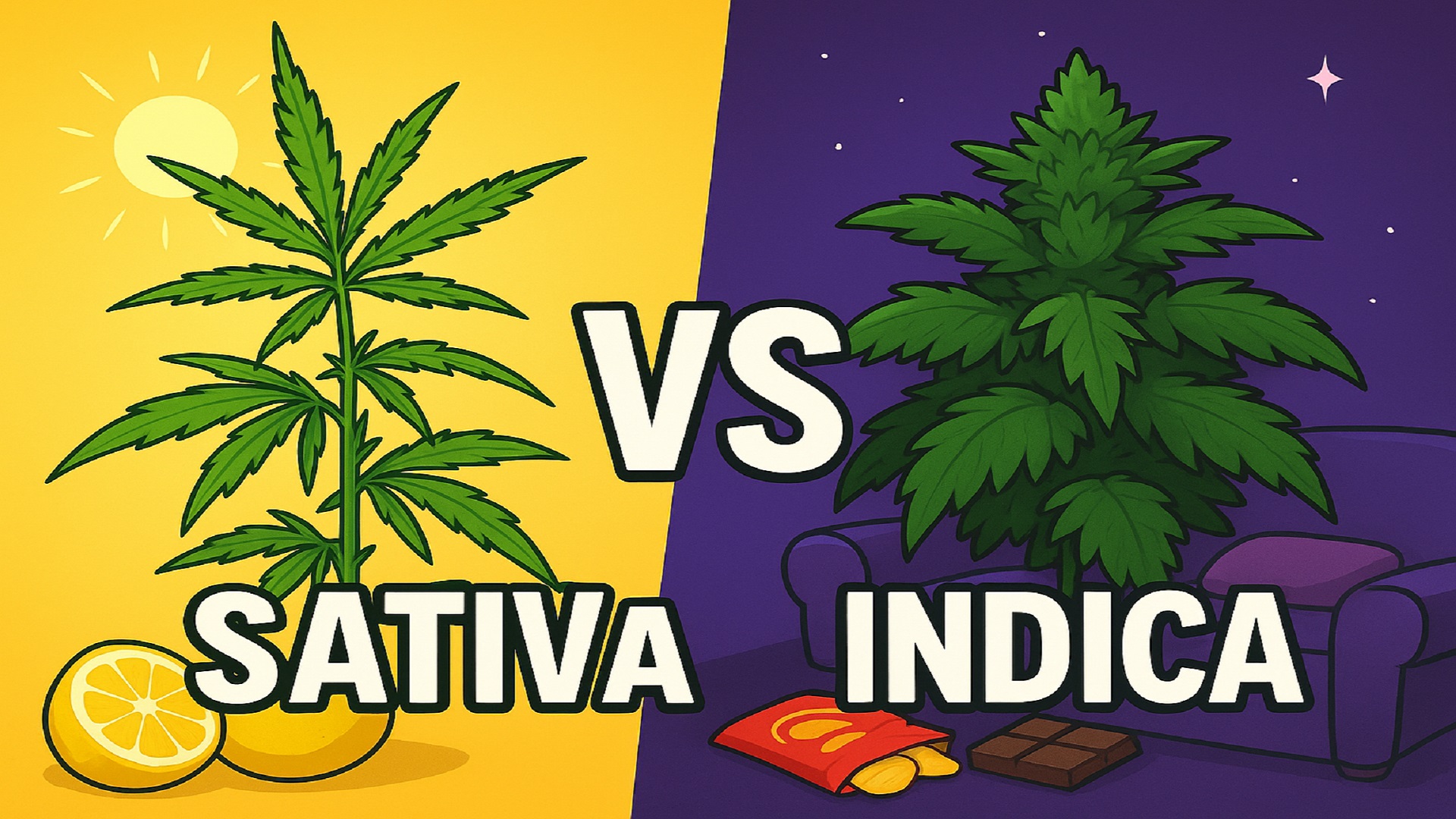
About 30 years later, French biologist Jean Baptiste de Lamarck discovered another type of cannabis in India that differed significantly from the European variety. He named it Cannabis Indica, meaning "Indian hemp." Lamarck noticed that these Cannabis Indica strains were smaller, bushier, and more resinous, and had a completely different effect than the familiar Cannabis Sativa plants.
This laid the foundation for the classic classification into sativa and indica. This distinction continues to influence cannabis cultivation today and affects how consumers perceive the different cannabis strains.
Save big on premium vaporizers this Black Friday!
Our BLACK WEEKS start on November 17 —get exclusive bundles, great discounts, and limited extras. Don't miss our BLACK FRIDAY VAPORIZER DEALS —first come, first served.
Sign up for the newsletter now so you don't miss out on EXCLUSIVE offers.
What is Cannabis Sativa?
Cannabis Sativa plants originate from tropical regions such as Thailand, Jamaica, Colombia, and Mexico. They prefer a warm, sunny climate with long growing seasons. In the wild, Sativa plants can grow up to five meters tall and appear airy and elegant with their narrow, light green leaves.
Sativa strains are characterized by their long flowering period, which can last up to 16 weeks on average. These plants develop loose, resin-rich buds and are particularly suitable for outdoor cultivation. Due to their size, they are often referred to as "cannabis trees."
One of the most famous Cannabis Sativa strains is the legendary Haze. It is considered a masterpiece of cannabis breeding and symbolizes the classic characteristics of Sativas: stimulating, clear-headed, and creativity-enhancing. Sativa plants generally have a higher THC content and a lower cannabidiol (CBD) content. This chemical composition increases the activity of the central nervous system and can promote energy, alertness, and motivation.
What is Cannabis Indica?
Cannabis Indica was first discovered in India in the 18th century, hence its name. Today, typical Indica strains originate from regions such as Afghanistan, Pakistan, Morocco, and Lebanon. Particularly famous is the Hindu Kush, a mountain range that is considered the birthplace of many traditional Indica plants.
Indica plants grow much more compactly than sativa plants. They rarely grow taller than two meters, but they form dense, strong buds and grow bushy. Their flowering period is usually between six and nine weeks, which is significantly shorter than that of sativas. This makes them particularly interesting for indoor cultivation, as they can be harvested more quickly and deliver stable yields.
Northern Lights is a classic among Indica strains. This plant is considered robust, flowers quickly, and often contains over 17 percent THC. Its aroma is fruity to sweet, and it is also valued in medicine for its relaxing Indica effect, for example to relieve sleep problems or muscle tension.
How do the effects of sativa and indica differ?
One of the most well-known differences between Indica and Sativa concerns their effects. Both types of cannabis contain cannabinoids such as THC and CBD, but they differ in their ratio and in their terpene profile, i.e., the aromatic compounds that influence smell and effects.
Sativa strains typically contain more THC (tetrahydrocannabinol) and terpenes such as limonene, which provide citrus-like aromas and an activating Sativa effect. These strains promote creativity, concentration, and mental alertness—a more "head-heavy high."
Indica strains, on the other hand, usually contain more CBD and terpenes such as myrcene, which are responsible for earthy, calming aromas and a relaxing Indica effect. They have a physical effect, relieve stress, and promote sleep—a "body-heavy high."
In summary, the most important differences in effect are listed here again:
Sativa effect:
- Stimulating, energetic
- Promotes creativity and focus
- Perfect for daytime wear
- Citrusy, fruity aromas
Indica effect:
- Calming, relaxing
- Promotes sleep and relaxation
- Perfect for the evening
- Earthy, woody aromas
How do the origins and cultivation practices of Sativa and Indica differ?
If you want to understand why Cannabis Sativa and Cannabis Indica behave so differently, it is worth taking a look at their origins. The environmental conditions in which these two cannabis strains developed continue to shape their characteristics, appearance, and effects to this day. Both the climate and geographical location have influenced the development of the plants over thousands of years and determine how they are cultivated, cared for, and bred.
Where does Cannabis sativa come from?
The roots of Cannabis sativa plants lie in tropical regions around the equator. The plant found ideal conditions in countries such as Colombia, Mexico, Thailand, Jamaica, and parts of Southeast Asia. These regions are characterized by long sunny days, high humidity, and consistently warm temperatures. In this environment, the Sativa plant developed into a tall, resilient hemp plant that is optimally adapted to the tropical climate.
In order to get enough sunlight in dense vegetation zones, Cannabis sativa grows quickly upwards. It forms long, narrow leaves that support photosynthesis under intense sunlight without evaporating too much water. This ensures that the plants survive well even in warm, humid areas. Typical are airy inflorescences that allow good air circulation and prevent mold growth.
The flowering period of Sativa strains is significantly longer than that of other cannabis varieties. It lasts between ten and sixteen weeks on average. During this time, the plants develop into impressively large specimens that can grow up to five meters tall. For cultivation, this means that Sativa plants require a lot of space, light, and patience. In return, they reward the grower with voluminous, resin-rich flowers and a high THC content.
How does Cannabis Indica differ in terms of origin and cultivation?
While Sativa plants thrive in tropical regions, Cannabis Indica originates from cooler and drier areas of Central Asia. Particularly in the mountainous regions of Afghanistan, Pakistan, Nepal, and northern India, the Indica plant developed into a robust and resilient cannabis plant that can withstand the harsh conditions in the mountains.
Indica strains are superbly adapted to life in these harsh climates. They grow much more compactly and usually remain under two meters tall. Their broad, dark green leaves enable efficient light absorption, even in low sunlight. Their dense structure allows the plants to store moisture and heat, which helps them survive drought and cold.
A key advantage of Indica plants is their short flowering time. With only six to eight weeks, they mature significantly faster than Sativa plants. This makes them particularly suitable for regions with shorter growing seasons and they are often cultivated indoors. Their compact, resin-rich flowers make them very popular with growers, as they enable high yields in a comparatively short time.
What visual characteristics distinguish Indica and Sativa?
The external appearance also reveals clear differences between Indica and Sativa. Sativa plants are tall, slender, and characterized by their long, narrow leaves, which glow in a lighter green. They appear more airy and graceful overall. Indica plants, on the other hand, are more compact, bushy, and have broad, dark green leaves that are closer together. Their growth is more stable and robust, making them more resistant to wind and cold.
These visual differences reflect their adaptation to their respective climate zones. Sativas strive toward the light, while Indicas have learned to store energy and adapt to harsh environmental conditions.
How have breeding and hybrids changed cannabis strains?
Over time, the cultivation of Cannabis sativa and Cannabis indica has evolved significantly. Targeted crossbreeding has resulted in numerous hybrids that combine the best characteristics of both plant species. The aim of these breeds is to create strains that are either balanced or specialized for specific effects, such as sativa-dominant hybrids for creative energy or indica-dominant hybrids for physical relaxation.
This is a major advantage for breeders, as genetic combinations can be used to influence not only the effect, but also the THC content, flowering time, and resistance to mold or cold. This allows a strain to be specifically adapted to the climatic conditions of the growing location.
For consumers, hybrids offer greater choice and individually tailored effects. They can combine the stimulating, mental properties of sativa with the calming, physical effects of indica. That is why hybrids are now the most widely used form of cannabis strain.
What distinguishes Cannabis Ruderalis?
In addition to Cannabis sativa and Cannabis indica, there is a third type of cannabis called Cannabis ruderalis or ruderal hemp. This rather inconspicuous plant originates from the steppes of Russia, Kazakhstan, and Mongolia. It is considered particularly hardy, as it can thrive even in extreme climatic conditions.
Ruderalis plants remain small, are robust, and are characterized above all by their ability to flower automatically. Unlike Sativa and Indica, their flowering does not depend on the light cycle. Instead, they begin to flower automatically after a certain growth phase. However, their THC content is very low, which is why they have hardly any psychoactive effect.
Nevertheless, Cannabis Ruderalis plays an important role in modern cannabis breeding. It is often crossed with Sativa or Indica to produce so-called "autoflowering" strains, which are easier to grow and thrive regardless of light conditions. In this way, Ruderalis indirectlycontributes to making breeding more versatile and efficient.
Which variety suits you best?
Whether you choose Cannabis Sativa, Cannabis Indica, or a hybrid strain depends largely on your personal needs. If you are looking for energy, creativity, and mental clarity, Sativa strains are usually the better choice. If, on the other hand, you prefer relaxation, physical calm, and a sleep-promoting effect, you will be happier with Indica strains.
Many consumers try different cannabis strains to find out which one best suits their mood or time of day. Modern breeding offers almost unlimited possibilities, as new hybrids are constantly being developed to combine the best of both worlds.