

Want to optimize your cannabis grow and achieve the best yields? Then you need to understand VPD—the vapor pressure deficit. This is the invisible force that determines how much water your plants absorb and how fast they grow. This guide shows you how to use VPD to keep your plants in the perfect climate zone.
What is VPD (vapor pressure deficit)?
VPD is the difference between the water vapor pressure that warm air can hold and the water vapor pressure currently present in your grow room. Imagine your plants are like a fine sponge: the drier the environment, the more actively the sponge absorbs water. The more humid it is, the less it can absorb.
When the air is dry (low VPD), the plant absorbs water and nutrients like crazy. But be careful: air that is too dry leads to thickened cell walls and stress. If the air is too humid (high VPD), the plant can barely absorb any more water—growth stagnates, and mold becomes a risk.
The ideal VPD depends on the growth stage: Young plants need slightly more moisture (low VPD), while flowering plants prefer drier conditions (medium to high VPD).
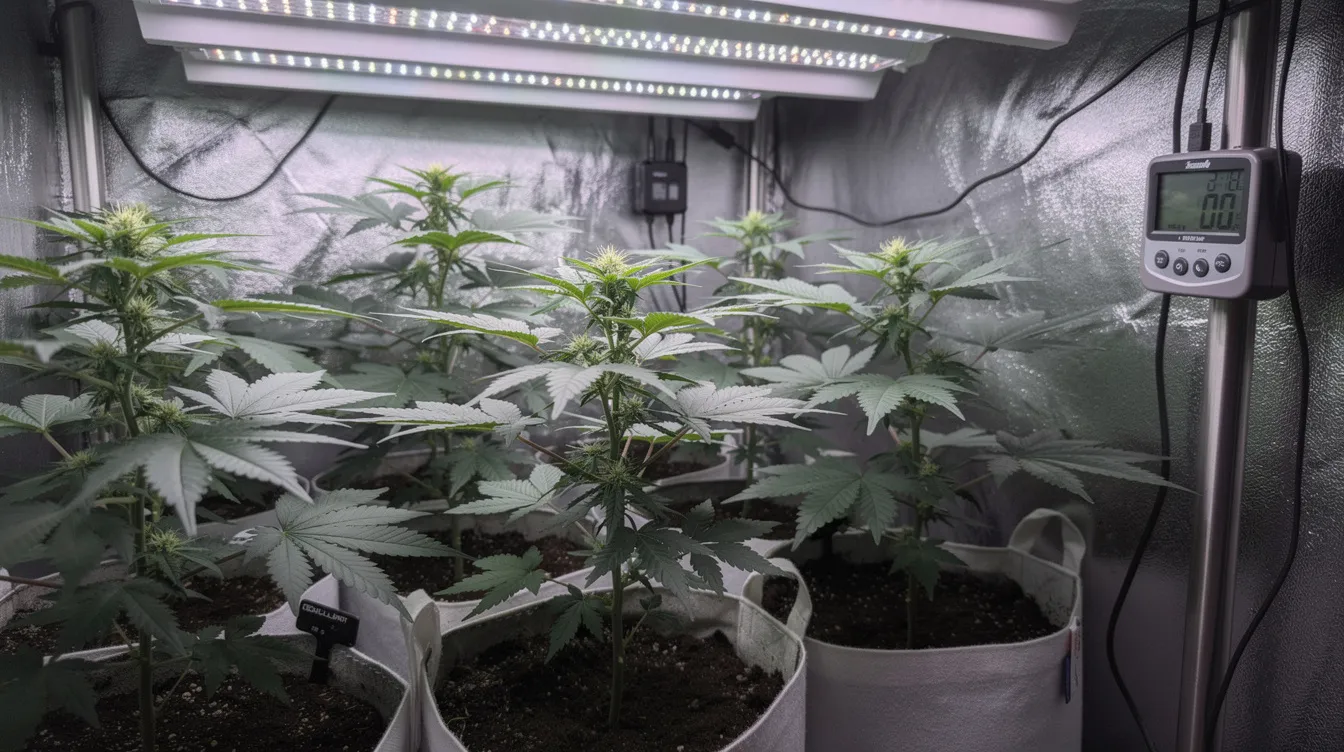
Calculating VPD — The Formula Explained
VPD [kPa] = (SVP at ambient temperature – (RH% ÷ 100) × SVP at ambient temperature)
In simple terms: VPD shows you how dry your grow air is in kilopascals (kPa). 0.5 kPa = slightly dry. 2.0 kPa = very dry.
Use the interactive calculator:

Our Best Sellers
Discover the most popular Norddampf products
VPD & Humidity Calculator
Calculate the optimal vapor pressure deficit for your growth stage—accurately, reliably, and tailored to your needs.
Climate-related submissions
growth phase
VPD Gauge
VPD Heatmap
Recommendations
VPD Chart for Cannabis — Optimal Values
This table shows you at a glance what VPD values result from different combinations of temperature and humidity. The colors help you quickly see if you're within the safe range.
| Temp (°C) | Relative humidity (%) | ||||||||
|---|---|---|---|---|---|---|---|---|---|
| — | 40 % | 50 % | 60 % | 70 % | 80 % | 85 % | 90 % | ||
| 20 °C | 0,93 | 0,78 | 0,62 | 0,47 | 0,31 | 0,23 | 0,15 | ||
| 22 °C | 1,03 | 0,87 | 0,70 | 0,53 | 0,36 | 0,27 | 0,18 | ||
| 24 °C | 1,14 | 0,96 | 0,78 | 0,60 | 0,41 | 0,31 | 0,21 | ||
| 26 °C | 1,26 | 1,06 | 0,87 | 0,67 | 0,47 | 0,36 | 0,24 | ||
| 28 °C | 1,39 | 1,17 | 0,96 | 0,75 | 0,53 | 0,41 | 0,28 | ||
| 30 °C | 1,53 | 1,29 | 1,06 | 0,83 | 0,60 | 0,46 | 0,31 | ||
VPD values by growth stage
Seedling — VPD 0.4–0.8 kPa
Young plants need a moist environment. Low VPD promotes rapid leaf growth and prevents drought stress.
| Air temp | Humidity | VPD |
|---|---|---|
| 20 °C | 80 % | 0.31 kPa |
| 22 °C | 75 % | 0.35 kPa |
| 24 °C | 70 % | 0.39 kPa |
Vegetative phase — VPD 0.8–1.2 kPa
During the growing season, your plants can tolerate slightly drier conditions. This promotes healthy leaf growth and strong roots.
| Air temp | Humidity | VPD |
|---|---|---|
| 22 °C | 60 % | 0.70 kPa |
| 24 °C | 55 % | 0.80 kPa |
| 26 °C | 50 % | 1.06 kPa |
Flowering stage — VPD 1.0–1.5 kPa
Flowering plants require a moderate VPD. This optimizes terpene production and prevents mold growth.
| Air temp | Humidity | VPD |
|---|---|---|
| 24 °C | 45 % | 1.14 kPa |
| 26 °C | 40 % | 1.26 kPa |
| 28 °C | 40 % | 1.39 kPa |
Late flowering / harvest — VPD 1.2–1.6 kPa
In the weeks leading up to harvest, you can increase the VPD. This strengthens the plant and reduces moisture damage.
| Air temp | Humidity | VPD |
|---|---|---|
| 26 °C | 35 % | 1.53 kPa |
| 28 °C | 35 % | 1.68 kPa |
| 30 °C | 30 % | 1.89 kPa |
Our Best Sellers
Discover the most popular Norddampf products
Controlling VPD in the Grow Room — Practical Tips
VPD too low (below 0.4 kPa)
Risks:
- Plants cannot absorb water and nutrients
- There is a risk of waterlogging and root rot
- Fungal diseases (Botrytis, powdery mildew)
- Weak, slow growth
Countermeasures:
- Reduce relative humidity (dehumidifier, air conditioning, ventilation)
- Increase the temperature (warmer air holds more moisture)
- Reduce watering
- Improve ventilation and air circulation
VPD too high (above 2.0 kPa)
Risks:
- Plants are losing moisture too quickly; the leaves are drying out
- Thicker cell walls, less efficient nutrient uptake
- Higher water demand
- Stress and reduced yield
Countermeasures:
- Increase relative humidity (humidifier, closed system)
- Lower the temperature (air conditioning, windows, ventilation)
- Foliar spraying with distilled water (reduces drought stress)
- Increase watering
Equipment Basics
- Digital Hygrometer + Thermometer: Measures humidity and temperature (reliable models starting at 10 EUR)
- Infrared thermometer: For accurate leaf temperatures (approx. 15 EUR)
- Humidifiers / Dehumidifiers: For actively controlling humidity
- Fan: For good air circulation and gas exchange
- Thermostat / Smart Plug: For automatically controlling devices
Note: Day/Night
VPD changes over a 24-hour period. During the day, it is often warmer and drier (higher VPD). At night, the temperature drops and humidity rises (lower VPD).
Pro tip: Monitor VPD over a 24-hour period. Many problems arise when the night is too humid (mold) or the day is too dry (stress).
VPD and other growth parameters
VPD + Light (PPFD)
The stronger the light, the higher the VPD should be. Under strong light, plants can evaporate more water and need a drier environment. Read more in our guide to cannabis and lighting technology.
VPD + CO₂
Additional CO₂ allows for higher VPD values because plants operate more efficiently. In a CO₂-enriched system (1000+ ppm), VPD values above 1.5 kPa may be appropriate. For more information, see our Temperature Profile Guide.
VPD + Irrigation
Higher VPD means higher water requirements. Monitor your plants closely to avoid over- or under-watering. Soaking in water is safer than continuous drip irrigation in dry air.
VPD + Nutrients
VPD affects nutrient uptake. When VPD is optimal, plants are more efficient. When VPD is poor (too dry or too wet), they utilize nutrients less effectively—even when there is enough available. Read more in our guide to nutrients and supplements.
Common Mistakes in VPD Management
| Error | problem | solution |
|---|---|---|
| VPD not measured | You're flying blind—no control over growth | Buy a hygrometer and thermometer; check the readings daily |
| Only air temperature is taken into account | Leaf temperature may be 2–5 °C lower – incorrect VPD | Use an infrared thermometer or account for the offset (-2 °C) |
| Monitor VPD only during the day | The biggest problems happen at night (mold, root rot) | 24-hour monitoring with digital loggers |
| Adjusting too aggressively | Sudden temperature changes stress plants | Adjust slowly and gradually (max. 0.3 kPa per day) |
| Ignore ventilation | Stagnant air = poor circulation = uneven VPD | Keep the fan on at all times, but don't point it directly at the plants |
Frequently Asked Questions About VPD
Here are the most important questions—answered concisely and clearly.
What is the optimal VPD value for cannabis?
General guidelines by stage: Seedling: 0.4–0.8 kPa. Vegetative: 0.8–1.2 kPa. Flowering: 1.0–1.5 kPa. Late flowering: 1.2–1.6 kPa. Use the calculator above to find the optimal VPD for your specific temperature and humidity levels.
How do I calculate the VPD?
Formula: VPD [kPa] = (SVP at air temp. – (RH% ÷ 100) × SVP at air temp.). SVP (vapor pressure of saturation) is a physical constant that depends on temperature. The interactive calculator does this for you. Enter the air temperature, humidity, and growth stage—the VPD is calculated immediately.
What happens if the VPD is too high?
A VPD that is too high (above 2.0 kPa) leads to: leaves drying out despite water in the soil, plants being unable to absorb nutrients, thicker cell walls reducing efficiency, and increased water requirements. Remedies: increase humidity, lower the temperature, and mist the leaves with distilled water.
What happens if the VPD is too low?
If the VPD is too low (below 0.4 kPa), this can lead to: plants being unable to absorb water, waterlogging and root rot, a risk of fungal infestation (mold), and stunted growth. Remedies: Reduce humidity (dehumidifier, ventilation), raise the temperature, and reduce watering.
Do I need special equipment to measure VPD?
Yes. At a minimum, you’ll need: a digital hygrometer and thermometer (starting at 10 EUR). Also recommended: an infrared thermometer for accurate leaf temperature readings (approx. 15 EUR). With these two measuring devices and the calculator here, you can precisely control VPD.
How do I measure the leaf temperature?
Best method: Point the infrared thermometer directly at the leaf (at a distance of about 10 cm) and take a quick reading. The leaf temperature is typically 2–5 °C lower than the air temperature (due to evapotranspiration). Simplified method: If you don’t have an IR thermometer, you can enter a leaf temperature offset of -2 °C in the calculator above.
With the VPD calculator and the right measuring tools, you can now monitor the most important parameters in your grow. Start by taking measurements, record your values, and make adjustments step by step. Your yield will thank you for it.
Legal Notice & Disclaimer
This calculator is intended solely for informational and educational purposes. The calculated VPD values are approximate and based on physical formulas; they are not a substitute for professional advice.
The actual optimal VPD values can vary significantly depending on the variety, light, CO₂, watering, and other factors. We recommend that you always monitor conditions carefully and adjust the values based on the plants’ condition.
Important: Cannabis and its cultivation are subject to legal restrictions in many countries and regions. Please check the applicable laws in your area. Use of this calculator does not constitute an invitation to engage in illegal activity.
VapoClouds / Norddampf no liability for the use of the calculated results. Use is at your own risk. If you have questions about growing, please consult experienced growers or specialized forums.