
Delta-8, Delta-10, and the well-known, reliable THC are treated online and on imported labels as if they were one and the same. They are not.
The difference between Delta-9, Delta-8, and Delta-10 THC boils down to a single detail in the molecule—a seemingly trivial detail that actually affects how they work and how they’re produced. There are also legal differences depending on where you live.
This is a chemistry-focused explanation of what distinguishes these three THC isomers, written for the European market, not the American one. It is definitely not a buying guide based on U.S. cannabis laws, because the situation in the EU is a very different (and significantly more confusing) story.
Key Points
Delta-8, delta-9, and delta-10 THC are isomers: they have the same atoms and the same formula, but differ by a single structural difference.
This difference lies in the position of a single double bond in the carbon chain—at the 8th, 9th, or 10th carbon atom.
Delta-9 is the well-known form of THC that the plant produces in large quantities. Delta-8 and delta-10 THC occur only in trace amounts and are typically produced semisynthetically from CBD or other cannabinoid-containing starting materials.
The isomers bind to CB1 receptors with varying degrees of affinity, which is why their reported effects differ.
In Germany, Delta-8-THC and Delta-10-THC are listed in Schedule I of the Narcotics Act and are therefore generally classified as narcotics that may not be sold.
The manufacture, sale, purchase, and possession of delta-8-THC and delta-10-THC are prohibited, except in cases expressly provided for by law. Other European countries have different national regulations.
Since they are manufactured, neither product quality nor labeling accuracy can be guaranteed.
The Science: What “Delta” Really Means
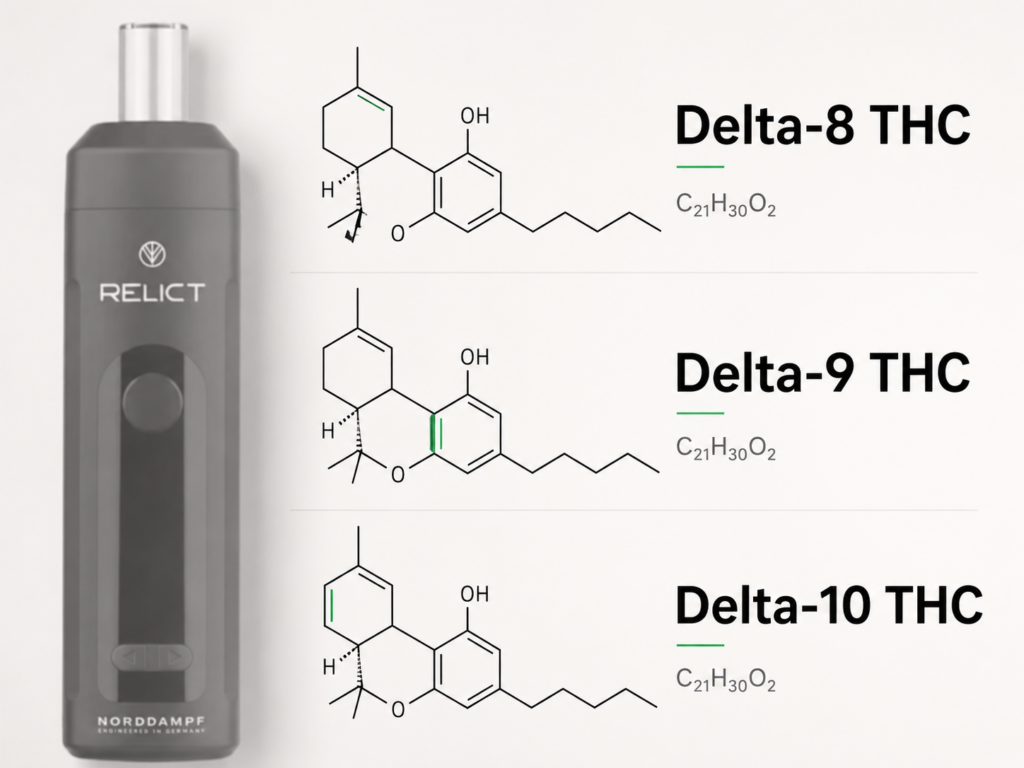
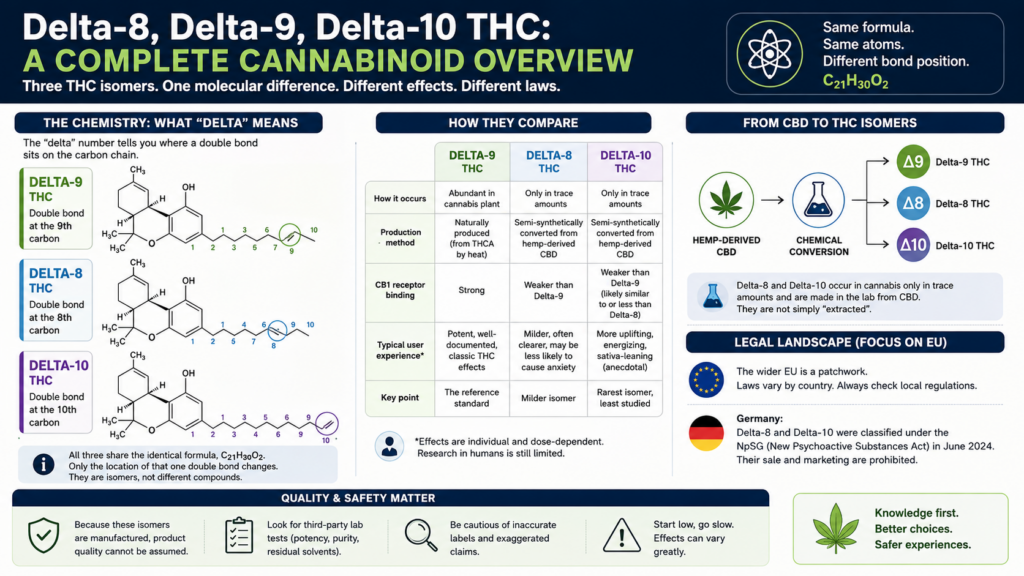
The “delta” number indicates the position of a double bond along the molecule’s carbon chain:
Delta-9-THC has its double bond on the ninth carbon atom
Delta-8-THC at the eighth carbon atom
Delta-10-THC at the tenth carbon atom
All three share the same molecular formula, C21H30O2, consisting of the same atoms in the same proportions. Only the position of this one bond changes, which makes them isomers rather than different compounds.
But why is such a tiny change important? Because at this level, form is everything. The molecule’s geometry determines how precisely it fits into the CB1 receptors of the endocannabinoid system and how strongly it activates them. CB1 activation drives the psychoactive effect, so a binding site shifted by just one position changes how the compound binds and how it feels.

Our Best Sellers
Discover the most popular Norddampf products


Delta-9-THC: The Reference Point
Delta-9 is the THC that everyone thinks of when they say “THC.” What the cannabis plant primarily produces is THCA, the acidic precursor. Heat drives out a carbon dioxide molecule and converts THCA into delta-9-THC, the active form. This heating step— decarboxylation—turns raw flower into something psychoactive.
It binds strongly to CB1 receptors, which is why its effects are pronounced and well-documented. Virtually all clinical research and virtually all cannabis legislation revolve around delta-9. When a regulation sets a THC limit, it almost always refers to this molecule.
Delta-8-THC: The Milder Isomer
Delta-8 is present only in trace amounts in raw cannabis —too little to extract it economically. Commercial delta-8 is therefore produced by chemically converting CBD or another cannabinoid-containing raw material into this isomer. The exact process varies by manufacturer, but the underlying principle remains the same: a laboratory conversion rather than a harvest.
Users tend to describe its effects as milder than those of Delta-9, sometimes clearer or less likely to trigger anxiety. This is consistent with research suggesting weaker CB1 binding, although direct human studies remain limited. Since it is synthesized rather than extracted, product quality depends entirely on the manufacturing process—something no label can guarantee.
Delta-10-THC: The newer, less-studied isomer
Delta-10 is similar, only even more pronounced. Naturally, it, too, occurs only in trace amounts, and commercial Delta-10-THC is also produced semi-synthetically from hemp-derived material. What sets it apart is how little is known about it.
Direct data on its binding affinity for CB1 remain limited, which is why any description of it as weaker than delta-9 should be regarded as a working hypothesis rather than a confirmed finding.
User reports often describe it as more stimulating—a daytime counterpart to the relaxing effects of Delta-8—but there are few controlled studies to confirm this, and these reports are anecdotal rather than factual. The caveat regarding quality applies even more strongly here, as Delta-10 is newer and far less standardized.
Direct Comparison
It’s probably easier to understand the three isomers if they’re all listed in one place rather than spread across three sections. That’s why we think it makes sense to have a table that compares delta-9, delta-8, and delta-10 THC side by side and covers the details that actually distinguish them: how much of each occurs naturally, how they’re produced, how strongly they bind to the CB1 receptor, and what users report feeling.
Viewed this way, the differences are hard to miss, with Delta-9 serving as the benchmark for research and the other two falling short in terms of both evidence and predictability.
| Connection | Natural occurrence | Manufacturing | CB1 receptor | Reported Character |
| Delta-9-THC | Significant | Plant Biosynthesis | Strong | Standard, well-studied noise |
| Delta-8-THC | Just Traces | Semi-synthetic from CBD | Moderate | Anecdotally milder, “clearer” |
| Delta-10-THC | Just Traces | Semi-synthetic from CBD | Weaker (limited data) | Inspiring (anecdotal) |
Legal Status in the EU
This is where the EU differs. Unlike some cannabinoids, which are heading toward a uniform EU-wide ban, the delta isomers are subject to a patchwork of national regulations, and the situation remains unclear.
Germany draws a clear line: Delta-8-THC and Delta-10-THC are listed in Schedule I of the Narcotics Act and are therefore generally classified as narcotics that may not be sold.
Manufacture, trade, acquisition, and possession are prohibited, except as expressly provided for.
Elsewhere in Europe, the legal situation varies considerably. Some countries prohibit these cannabinoids under national narcotics or analog laws, while others take a different regulatory approach.
Since the legal framework varies from one jurisdiction to another and is constantly evolving, you should always check the applicable national laws before purchasing or possessing these products.
Regulatory interest has also increased in the area of food safety, with the EFSA having evaluated Delta-8 in the context of food safety. It is worth noting that a food-related assessment does not automatically extend to inhalation and does not clarify the broader legal classification of these substances. The practical implication is that the status varies from country to country and continues to evolve, so you should check your own national regulations rather than relying on a single European answer. Keep in mind that none of this constitutes legal advice.
Bottom Line
Delta-8, Delta-9, and Delta-10 are close chemical relatives, distinguished by a single structural detail; yet this detail results in real differences in their natural occurrence, in production methods, and in how much is actually known about them. Delta-9 is the well-studied, plant-derived benchmark; the other two are semisynthetic newcomers with significantly less evidence to support them.
The most important thing to keep in mind is the issue of quality control. Since Delta-8 and Delta-10 are manufactured rather than grown, neither purity nor accurate labeling can be taken for granted.
For more on the chemistry behind it, you might find the THCP overview interesting.
Ready to experience cannabinoids without combustion? Discover Norddampf's collection of vaporizers for herbs and concentrates.
FAQs
What is the actual difference between Delta-8, Delta-9, and Delta-10 THC?
A double bond in a slightly different position. All three share the formula C21H30O2 and differ only in whether this bond is located at the 8th, 9th, or 10th carbon atom. This single shift alters how each one binds to CB1 receptors and how it feels.
Are Delta-8 and Delta-10 THC natural or synthetic?
Of course, both are present only in trace amounts, which is why commercial versions are semi-synthetic and produced by converting hemp-derived CBD in the laboratory. They are derived from a plant compound but are not simply extracted from cannabis.
Is Delta-8-THC legal in the EU?
That depends on the country. In Germany, Delta-8-THC and Delta-10-THC are listed in Schedule I of the Narcotics Act and are generally classified as narcotics that may not be placed on the market, which means that their manufacture, sale, purchase, and possession are prohibited except under expressly stipulated exceptions.
Other European countries apply different national regulations, so there is no uniform EU-wide legal position.
Why does the quality of Delta-8 and Delta-10 THC products vary so much?
Since they are synthesized rather than extracted, the final product reflects the manufacturing process. An inadequate conversion process can result in undesirable byproducts, and the accuracy of the labeling cannot be assumed, which is why independent laboratory testing is important.
Is Delta-8-THC weaker than regular THC?
Generally speaking, yes. Delta-8 binds less strongly to CB1 receptors than delta-9, and users typically report a milder, clearer effect with less anxiety. Direct research on humans is limited, so this is based in part on anecdotal evidence, but the pattern of weaker binding is fairly consistent.
Does Delta-10-THC really feel more stimulating than Delta-8?
This is the typical user report, but it is anecdotal. Controlled research on Delta-10 is scarce, so while many describe it as energizing or suitable for daytime use, there is no solid clinical evidence of a reliable difference between the two.
How can you tell if a Delta-8 or Delta-10 product is good?
Most of the time, you can’t tell by looking at it, and that’s exactly the problem. Since both are semi-synthetic, the most useful indicator available is a batch-specific certificate of analysis from an independent, qualified laboratory that lists the cannabinoid content and tests for residual byproducts of the conversion process. It’s worth keeping in mind that even a good certificate is a snapshot of quality and not a complete guarantee of safety, but without one, there’s no basis for trusting the product at all.
Sources
Baker Institute for Public Policy, "Breaking Down Popular Cannabis Compounds." https://www.bakerinstitute.org/research/breaking-down-popular-cannabis-compounds
Illinois Department of Public Instruction, "Know Your Deltas: The Difference Between 8, 9, and 10." https://dpi.illinois.edu/news/know-your-deltas-the-difference-between-8-9-and-10
Kruger, D. J. & Kruger, J. S. (2022), “Delta-8-THC: Delta-9-THC’s nicer younger sibling?” Journal of Cannabis Research. https://www.ncbi.nlm.nih.gov/pmc/articles/PMC8796651/
European Food Safety Authority (EFSA), scientific assessment of Delta-8-THC in food. https://www.efsa.europa.eu/
Federal Institute for Drugs and Medical Devices (BfArM), New Psychoactive Substances Act (NpSG). https://www.bfarm.de/
*Note: This article is intended solely for general informational purposes. It does not constitute medical or legal advice, nor is it a recommendation to purchase or consume these products. The legal status of Delta-8, Delta-10, and related compounds is subject to change and should always be verified against current local regulations.*