

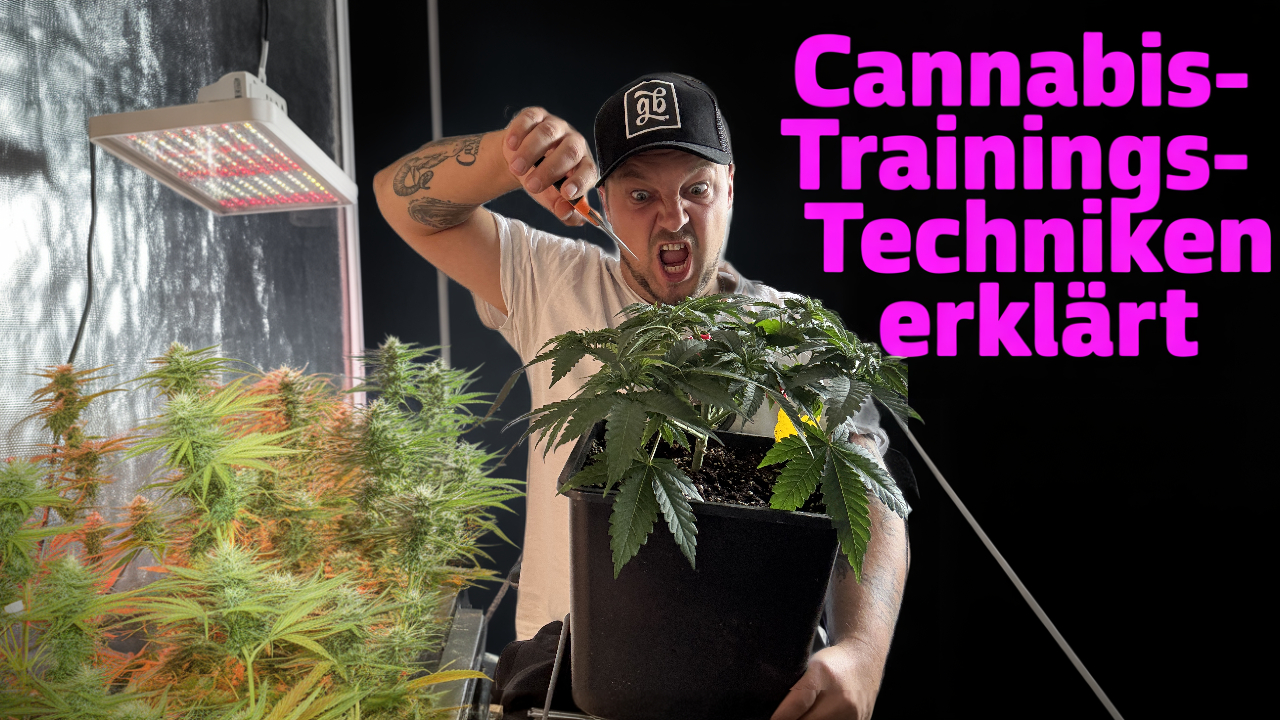
Cannabis training techniques? Click on the video!
If you want to improve the yield and quality of your cannabis plants, it's worth taking a look at various training techniques. Training refers to simple methods that you can use to specifically influence the growth of your plants. This ensures that each flower receives sufficient light and air, resulting in stronger, more uniform buds. Whether you're growing indoors in your own grow room or outdoors in your garden, with the right techniques you can get the most out of your plants and create optimal conditions for healthy growth.
What are cannabis training techniques?
Cannabis training techniques are methods used to control the shape and height of your plants. The aim is to ensure that all parts of the plant receive the same amount of light. The principle is similar to pruning fruit trees. You guide the natural growth by bending, tying, or cutting branches in specific ways. This encourages the plants to grow not only in height but also in width, which distributes the light better and allows the plant to put more energy into large, dense buds.
Why is it worth training your cannabis plants?
Training does not mean torturing the plant, but rather guiding its growth so that it can reach its full potential. If you arrange the branches skillfully, light will reach the lower branches, which otherwise often remain in the shade. This allows flowers to develop evenly throughout, the aroma to unfold better, and the entire plant to become stronger. At the same time, you make use of the available space in the indoor cultivation because the plant grows not only upwards but also outwards. The result is more stable plants and a noticeably larger harvest.
What is Low Stress Training (LST)?
Low Stress Training, or LST for short, is the gentlest form of cannabis training. This involvescarefully bending the young shoots and securing them with soft ties, plastic-coated garden wire, or special plant clips so that they grow horizontally. This ensures that light reaches all areas of the plant and the canopy remains even.
It is best to start with LST when the plant is still young and flexible, usually in the early vegetative phase. It is best to choose a time shortly after watering, as the branches will be more elastic then. Slowly bend each shoot outward and attach it to the edge of the pot or to small hooks in the substrate. Be careful not to kink the shoots and readjust them regularly as they continue to grow. Since LST puts very little strain on the plant, this technique is perfect for beginners who want to increase their yield without taking a big risk.
What is High Stress Training (HST)?
High Stress Training, or HST for short, goes one step further. Here, you intervene more significantly in the growth process, for example by carefully bending branches (supercropping) or pruning them in a targeted manner. These interventions stimulate the plant to form new shoots and develop more flowers.
If you use HST, you should also start in the vegetative phase when the plant still has enough time to recover. For supercropping, select strong but still flexible branches and gently squeeze them between your fingers until you feel a slight crack. This makes the branch more flexible and allows it to be bent in the desired direction. When pruning, remove individual branches or leaves to allow more light into the interior of the plant. After each HST measure, the plant needs a few days to recover, so patience and careful observation are important.
What does topping mean in relation to cannabis plants?
Topping is a special technique that is often used in high-stress training. It involves cutting off the tip of the main stem. The plant responds by forming two new main shoots. This makes it grow bushier, distributes the light better, and allows it to form more flowers.
It is best to perform topping when your plant has developed four to six healthy nodes and is in the early growth phase. Use a clean, sharp tool, such as disinfected scissors or a scalpel. Make the cut just above a node and make sure that the plant does not experience too much stress afterwards. After topping, allow the plant a few days to recover before planning further training steps.
What are the advantages and potential disadvantages of these techniques?
benefits
- Better light and air distribution within the plant
- Uniform growth, resulting in more aromatic, higher-quality flowers
- Potentially higher yield because the energy is distributed across more buds
- More compact shape, ideal for indoor cultivation or small spaces
disadvantages
- Require patience and regular monitoring
- HST or unclean topping increases the risk of stress and delayed growth.
Careful work and a good sense of timing help to fully exploit the advantages.
Who are LST, HST, and topping suitable for?
Low Stress Training is ideal for beginners because the method is gentle and puts little stress on the plant. If you are just starting out with growing and want to try out how training affects growth, LST is a good choice.
Topping requires a little more practice. You need to be able to observe your plants closely to recognize the right time to cut. However, topping is a very rewarding technique for growers who want to increase their yield and achieve a broader, bushier plant.
High Stress Training is aimed at advanced growers. Here, you intervene more heavily in the growth process and need to be able to accurately assess how your cannabis plants will react. Those who already know their plants' needs well and work carefully can achieve impressive results with HST.
How are light and training related?
Whether you're indoors with artificial lighting or legally growing your plants on the balcony: training techniques always aim to provide each flower with an even supply of light. By bending, cutting, or fixing the branches, you create an even canopy. This prevents shadow zones, ensures better air circulation, and allows the plants to distribute their energy evenly. The result is stronger buds, a more intense aroma, and even ripening, without the need for additional lamp power.
Training is the key to quality and yield
Whether low stress training, high stress training, or topping: with these methods, you can actively shape the growth of your cannabis plants and improve the quality of the harvest . If you plan carefully, observe regularly, and remain patient, you will achieve a harmonious canopy and optimal light distribution. This will help you develop buds with full aroma and achieve a higher yield. A clear win for any legal indoor or outdoor grow. With a little experience, you can guide each plant to its best possible result.