

Cannabis cultivation and EC value: What you need to know
When it comes to growing cannabis, many people talk about light, strains, and fertilizers, but the EC value often gets left behind. Yet it is precisely this value that determines how concentrated your nutrient solution is and how much salt your roots actually have to tolerate. Together with the pH value, it determines whether your plants are actually absorbing nutrients or whether you are slowly overloading them. If you understand what the EC value means and how to measure it, you have one of the most important tools at your disposal to avoid deficiencies, overfertilization, and burnt tips.
What does the EC value actually mean in cannabis cultivation?
When growing cannabis, sooner or later you will encounter two important figures: pH value and EC value. The pH value determines whether nutrients are chemically available. The EC value shows you how strong your nutrient solution actually is. Together, these two factors determine whether your plants will grow happily or suffer in silence.
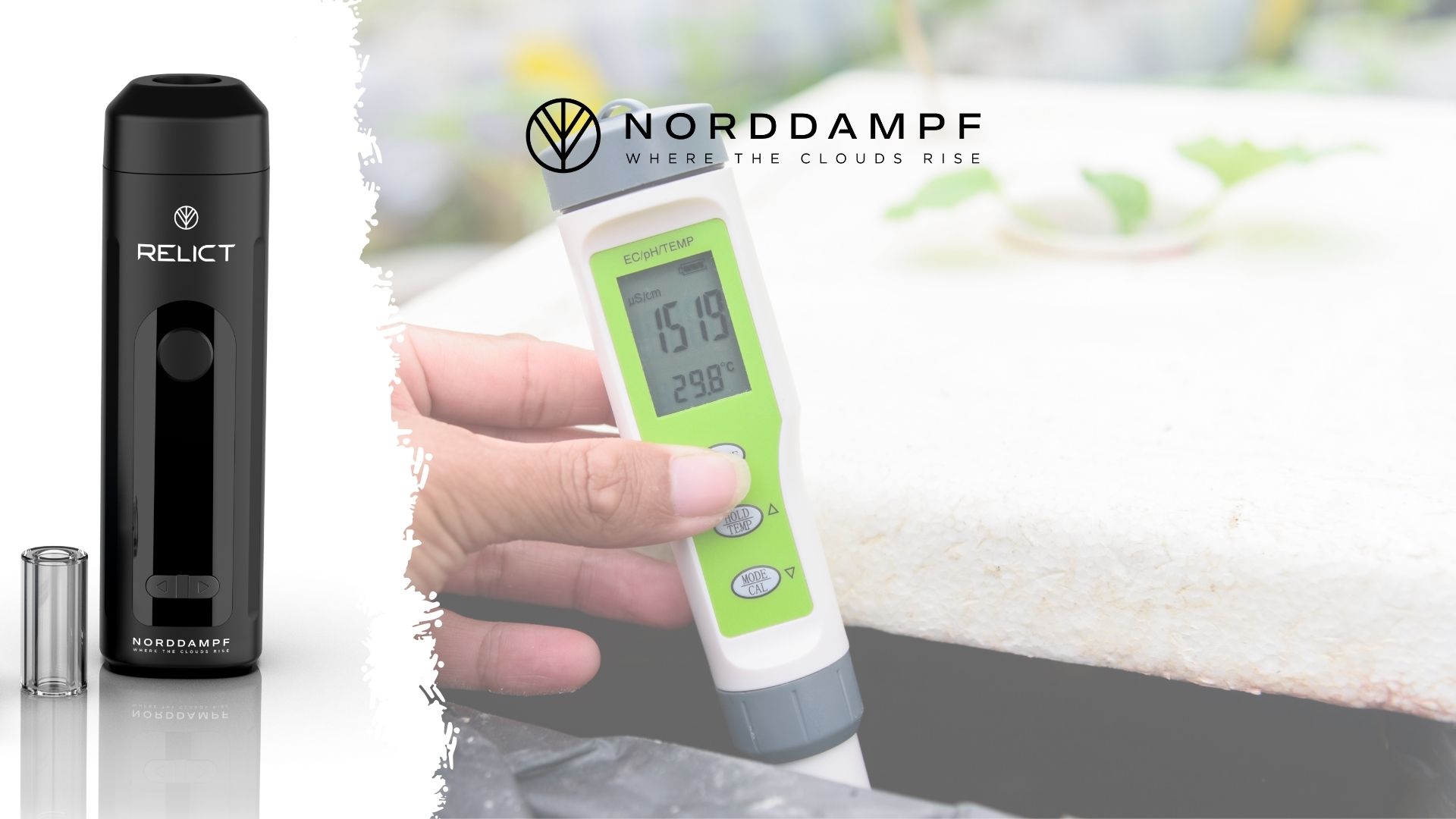
EC stands for electrical conductivity. It is usually measured in millisiemens per centimeter. The more dissolved salts and nutrients there are in water, the better it conducts electricity and the higher the EC value. In cannabis cultivation, a higher EC corresponds to a more concentrated nutrient solution.
Instead of adding more fertilizer based on guesswork, you can use an EC meter to see exactly what you are giving your plants. Especially with high-quality fertilizers, strong light, and limited root space, this makes the difference between stable plants and burnt tips.
How is the EC value related to water, fertilizer, and substrate?
The EC value should never be viewed in isolation. It is composed of several parts.
First, there is your source water. Tap water can be very soft with an EC well below 0.3 or quite hard with over 0.8 millisiemens. Soft water contains few salts of its own, while hard water contains a lot of calcium, magnesium, and often sodium or other substances.
Then the nutrients are added, usually in the form of liquid fertilizer. Each application of fertilizer increases the EC value of the mixture. Very soft water and a small amount of fertilizer quickly produce a moderate nutrient solution. Hard water and the same amount of fertilizer produce a solution that is too strong. Without measuring, you often only notice this when the leaves react.
The substrate also plays a role. Soil acts as a buffer. Organic components, clay minerals, and microorganisms absorb fluctuations. In coconut or hydroponics, the roots react more directly to changes in the EC value because there is hardly any buffer. Therefore, clean EC values are more important there than in an organically managed soil grow.
Which EC ranges are appropriate for cannabis cultivation?
There is no single figure that always applies. Plants have different needs at different stages. The following ranges are rough guidelines and should be understood as a framework rather than a rigid rule.
In soil or soil/coconut mixtures:
- Young plants and cuttings: approximately 0.6 to 0.9
- early growth: approximately 0.8 to 1.2
- Late growth and early flowering: approximately 1.2 to 1.6
- Strong flowering phase in hungry varieties: up to approx. 1.8
In coconut or simple hydro systems:
- Young plants: approximately 0.5 to 0.8
- Growth: approximately 0.8 to 1.3
- Flowering: approximately 1.3 to 1.8, higher in intensive systems
The exact number is less important than the trend. Start low and increase slowly. The plant will show you whether it can tolerate more or whether you have already reached the limit. Slight lightening in the lower part of the plant may indicate a slight deficiency. Dark green, hard leaves and burnt tips are more likely to indicate excessive levels.
How do you measure the EC value?
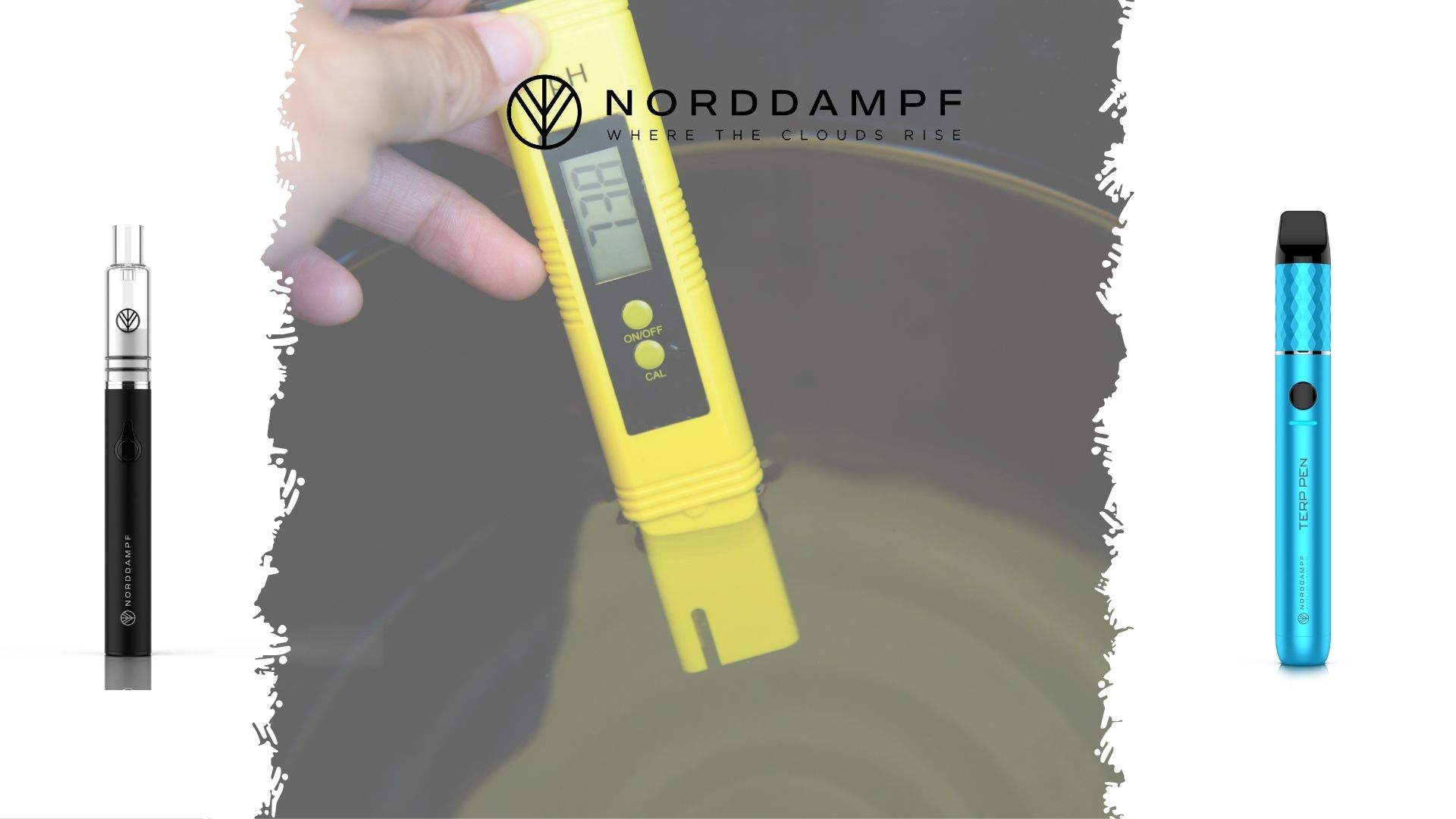
In practice, there are two useful measuring points. One is directly in the watering or nutrient solution, and the other is in the drainage water that runs out of the pot.
Before watering, dip the EC meter into your ready-mixed nutrient solution. This will tell you how much to water today. If you are using tap water, it is also worth measuring the pure water without fertilizer. Then you will know your starting value.
After watering, you can measure the water that drains out of the bottom of the pot. This will show you what is happening in the substrate. If the EC in the drain is significantly higher than in the freshly mixed nutrient solution, a lot of salts have already accumulated in the substrate. In this case, you are closer to the upper limit and should proceed with caution.
In hydroponic systems or with coconut coir and tank irrigation, it is worth installing a permanent measuring device in the reservoir. There you can see in real time how the EC value changes over time as water evaporates and plants absorb nutrients.
How can you tell that the EC value is not right?
Plants react quite clearly to EC values that are too low or too high. You just have to learn to read the signs.
If the EC value is too low, the plants will have insufficient nutrients. Typical signs are:
- slow growth
- paler green, especially on older leaves
- soft, thin leaves
- weakly developed shoots
If the EC value is too high, you have over-fertilized or salt accumulation. This can be recognized by the following points:
- Leaf tips turn brown and dry out
- Leaves curl downward and appear hard
- The plant appears stressed despite being in a nutrient-rich solution.
- The substrate dries unevenly, the roots work less efficiently.
EC and pH influence each other. Many symptoms of over-fertilization and pH problems look similar. That's why a measuring device is so helpful. You get a number and don't have to guess.
How do you reduce an excessively high EC value in the substrate?
Excessive EC is more harmful to plants than a slight deficiency. Therefore, if you suspect a problem, it is better to intervene early.
One simple method is to rinse with water with a low EC. In soil, this means giving the plant a generous amount of water without any additional fertilizer, letting the water run out of the pot, and measuring the EC in the drain. The aim is for the value to be close to the EC of your watering water.
In coconut or hydroponics, you can partially or completely replace the nutrient solution in the tank and start again with a weaker mixture. Especially in small systems, the EC increases over time because water evaporates and salts remain. Regular partial water changes are essential here.
It is important not to overwhelm the plant with high fertilizer concentrations immediately after such a correction. Give it a few days to recover.
How do you increase an EC value that is too low?
An EC that is too low is usually less dramatic, but does not deliver the full potential of the strain. If you notice that your plants remain rather pale and slow despite a healthy root zone, you can gradually increase the fertilizer concentration.
In practice, this means:
- Prepare the nutrient solution as usual.
- Measure EC
- Add a small amount of fertilizer, then measure again.
- increase carefully until you are in the desired range
Small steps are worthwhile. There is no point in jumping from 0.9 to 2.0 just because the bottle says a high value. It is better to make small adjustments of, for example, 0.2 millisiemens and then observe a few watering cycles.
Why is pH always part of the EC discussion?
EC and pH go together like gas and clutch. The EC value shows how much is in the water, while the pH value determines whether the plant can actually use it.
If the pH value is incorrect, certain nutrients can become chemically bound and are no longer available to the roots. So you can have a perfect EC value and still see deficiency symptoms if the pH is off.
The following pH ranges have become established in cannabis cultivation:
- in soil approximately 6.0 to 7.0
- in coconut and hydro approximately 5.5 to 6.2
So, for example, if you add a lot of phosphorus and calcium but the pH is too high or too low, the plant will still show signs of deficiency. In such a situation, it would be wrong to simply continue increasing the EC. It is better to measure both the pH and EC and bring both values into a reasonable range.
How relevant is water quality really when it comes to EC values?
Many problems in growing start with tap water. If your water already has a high EC when it comes out of the tap, you cannot simply use the same amounts of fertilizer as someone with very soft water.
Very soft water has a low EC and hardly any dissolved minerals. This allows you to precisely control the nutrient mix, but often requires the addition of calcium and magnesium. Very hard water contains calcium and magnesium, but also substances you don't need, such as sodium. In this case, it may be useful to filter part of the water using reverse osmosis and mix the filtrate with hard water until you achieve a moderate initial EC.
In practical terms, this means that you first measure your water and then dose your fertilizer so that the total amount is correct. Instead of blindly following the dosage instructions on the bottle, you use your starting value and the desired target concentration as a guide.

Do hobby growers really need an EC meter?
For your very first grow in simple soil with moderate fertilizer and tap water, you can get by without an EC meter. However, as soon as you want to get more out of your plants or start working with coconut, stronger lamps, and more precise fertilization, an EC meter becomes very useful.
Without measuring, you're left guessing. Symptoms can be over-fertilization or deficiency. With a simple device, you can see whether you are giving too much or too little. The investment is low compared to lamps, exhaust air, and fertilizer, but the benefits are high.
It is important to handle them with reasonable care. Measuring devices must be calibrated regularly, and the probe should remain clean and not be left permanently immersed in dirty solutions. Then they will deliver reliable values over several runs.
How can you pragmatically incorporate the EC value into your everyday life?
Theory is one thing, everyday life in the grow room is another. A sensible and straightforward procedure could look like this, for example.
First, measure your pure water and note down the EC value. Then mix your nutrient solution for the current phase, measure again, and see where you are in the range. If the value is significantly outside the recommended range, adjust the amount of fertilizer.
Every few watering cycles, measure the EC of some drain water from a pot. If the EC in the drain water is significantly higher than in your fresh solution, you know that salts are accumulating in the substrate. You can then counteract this with a slightly weaker solution or a well-planned rinsing cycle.
Together with a pH meter, this gives you a very clear picture of what is happening in the root zone. You can move beyond rough estimates and provide your plants with targeted support. In the end, you will reap the rewards in the form of more stable growth, less stress, and a better harvest.