
Moldy cannabis. Two words that are, when used together, capable of absolutely ruining a lovely evening on the sofa with some good tunes or a great movie. But at some point, most people who handle their own flower have held up a bud and thought, “Hang on… is that meant to be there?”
Moldy cannabis and great cannabis are easily confused, though. That frosty, gray-white dusting on a nice bud is usually a very good sign. It's cannabis trichomes, the tiny resin factories where most of the good stuff resides
Not always trichomes
Occasionally, though, it isn't trichomes at all. It's moldy cannabis, and that isn't a good thing. Confusing the two might not just ruin your evening chill but could lead to serious medical drama. At least, potentially.
To that end, learning to spot moldy cannabis is a fairly useful skill to possess, and not at all difficult once you know the difference between a healthy, sparkly bud from a fuzzy, musty imposter.
This guide shows you how to do that, initially covering how to tell them apart by sight and smell. We then explain what actually happens to your body if you get it wrong, and (the bit most articles neglect, in our opinion) how proper drying, curing, and storage stop mold before it takes hold.
Before we commence, a quick, sensible, common-sense note: this is general safety information, not medical advice.
Key Points
- Trichomes look glassy and crystalline, catching the light; moldy cannabis looks woefully dull, bereft of life, powdery, or fuzzy.
- Smell is the fastest tell. Moldy cannabis smells musty (like wet hay, a damp basement, or even ammonia), not like its terpenes.
- Mold often takes hold inside dense buds, so a clean-looking surface doesn't guarantee a clean core.
- For most healthy adults, moldy weed causes unpleasant symptoms, but for people with asthma, allergies, or weakened immune systems, it can actually be quite dangerous.
- Vaporizing weed does not make moldy flower safe. Mycotoxins are heat-stable, and spores can survive the heat.
- Most mold stems from moisture and airflow, which means drying, curing, and storage are your best defense, so aim for 59–63% relative humidity.
Mold vs. Trichomes: How to Tell the Difference
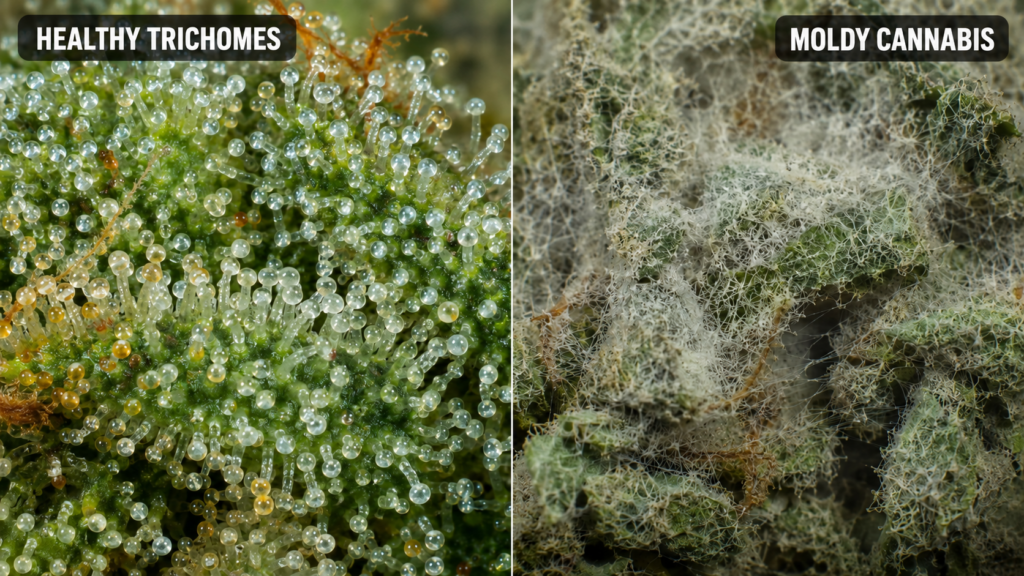
To the naked or untrained eye, a heavily frosted bud and an early patch of mold look alarmingly similar, with a pale, dusty coating over the flower. Look closer, though, and the two are nothing alike.
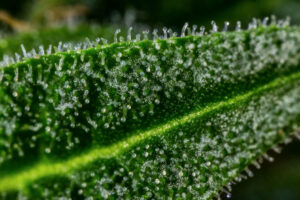
Trichomes are tiny, glassy stalks with bulbous heads, almost like microscopic mushrooms made of glass. Depending on maturity, they run clear, milky white, or amber, and (crucially) catch the light and have a wonderful, reassuring sparkle. They cluster over the buds and sugar leaves, coating them fairly evenly. That sparkle is the thing to be cognizant of. Healthy resin always glitters.
Whatever the opposite of ‘glutters’ is, cannabis mold does it. It's hard to explain with mere words, but it takes on a dull, powdery, fuzzy, or web-like appearance. It reveals itself in shades of gray, white, brown, or black, and reflects no light at all.
It tends to spread unevenly and often takes hold deep inside dense bud cores before it ever reaches the surface. And therein lies part of the problem; bud can look perfectly fine on the outside while rotting within.
The Smell Test
If your eyes aren't sure, your nose usually is. Smell is the fastest and most reliable way to tell if you have a problem, as moldy cannabis smells musty and off. Again, think wet hay, damp basement, or whiff of ammonia. Not pleasant, either way.
A healthy flower smells like its terpene profile: citrus, pine, diesel, earth, whatever the strain is meant to be, and all quite wonderful. If a bud smells like the inside of a forgotten gym bag or a wet alsatian, trust that instinct.
| ℹ️Pro Growers Tip: A jeweler's loupe or a phone macro lens will show you what your naked eye can't, for the price of a few euros. Cheap insurance, basically. |
The Usual Suspects
Now, a few molds turn up more than others. Powdery mildew coats the surface in a white, flour-like dust. Bud rot (botrytis) is the nastier one, starting inside dense colas and working outward, so it's often well established before you spot it. Less commonly, sooty mold appears as a dark, dusty film. You don't need to identify the exact species, though. If it's fuzzy, dull, and musty, that's all the diagnosis required.
| 👉Need a proper explanation on reading trichomes as they ripen? See our Trichome Maturity Guide for some valuable pointers. |

Our Best Sellers
Discover the most popular Norddampf products
Why Cannabis Gets Moldy
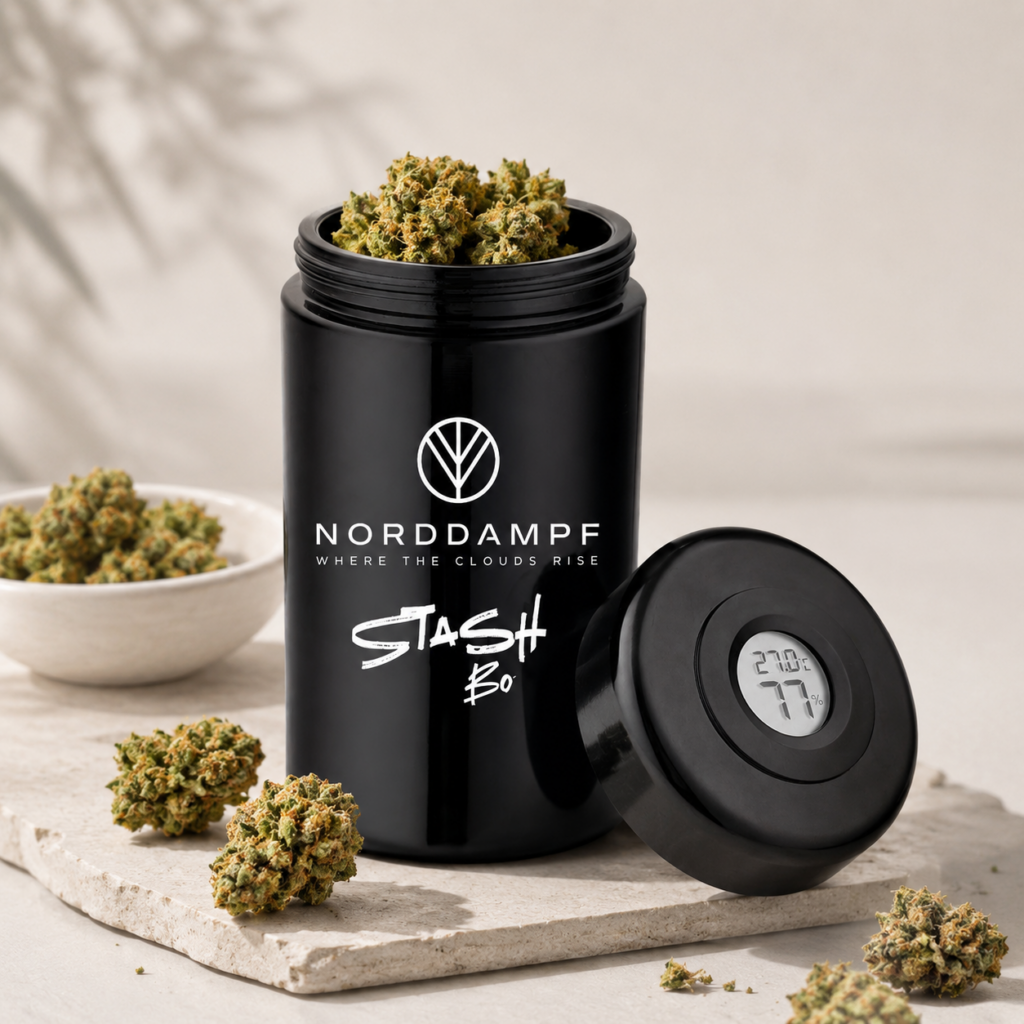
But why does this happen? Why does this strange natural phenomenon seem to make it its mission to take over your precious lawn and ruin your day?
Mold isn't bad luck, although it certainly feels that way. It's a basic chemistry meeting opportunity. Mold spores are already everywhere in life, drifting through the air of every room, and they stay harmless until they find somewhere to settle and grow.
What they need to thrive is moisture and stagnant air. Give them both these things, and cannabis makes an excellent, welcoming host. That's why most moldy weed traces back to one of a handful of entirely avoidable mistakes, such as:
⚠️ Flowers dried too fast or too slow, leaving moisture trapped inside the bud.
⚠️ Cannabis cured or stored at too high a humidity.
⚠️ Dense, chunky buds that hold water at the core, where air can't reach.
⚠️ Poor airflow during drying.
⚠️ Storage in a container that isn't truly airtight, or in a room where humidity swings around.
For home growers, which is an increasingly large group in Germany since CanG legalized personal cultivation, there are a few extra traps. Harvesting a touch too early while the plant is still wet, rushing or skipping the cure, and stashing jars in a humid bathroom or a steamy kitchen are all reliable, common ways to invite mold in.
| 👉Getting the cure right is the single biggest lever here. Our drying and curing cannabis guide covers the technique in full. |
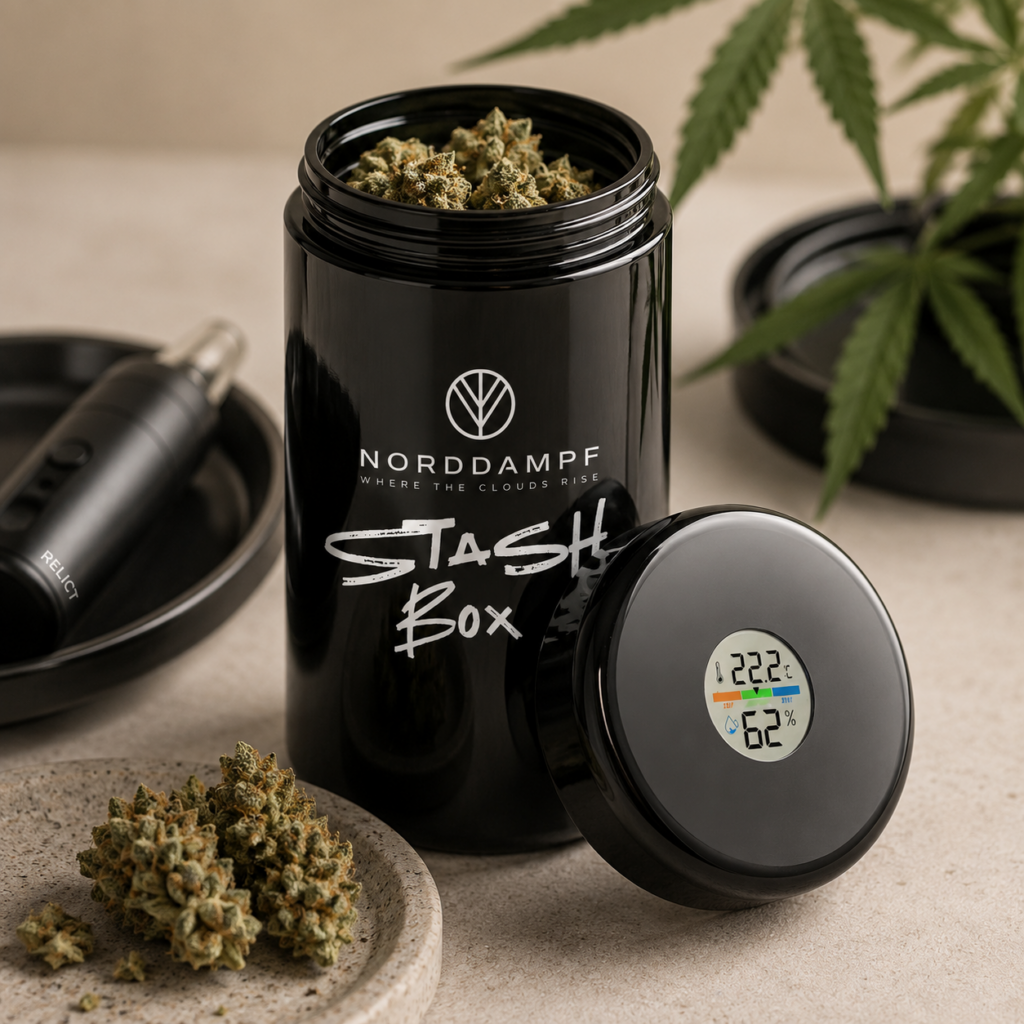
Health Risks: What Happens If You Consume Moldy Cannabis
For most healthy adults, a bit of moldy cannabis is more grim than dangerous, leading to coughing, nausea, maybe a sketchy throat or something equally discomforting, but ultimately survivable. By the same token, if you are allergic to mold, you might expect worse symptoms, such as blocked sinuses and wheezing.
The ones who really can't risk it are people with weakened immune systems, asthma, or serious lung conditions. Certain fungi on cannabis (usually Aspergillus) have been tied in medical reports to nasty lung infections that, in the most vulnerable patients, can spread further still. Rare? Yes. Worth gambling on? Definitely not.
And no, unfortunately, vaping doesn't fix moldy weed. Mycotoxins are stubborn, pesky little entities that shrug off vaping temperatures, and some spores and toxins can survive being set on fire, so even a lovely dry-herb vaporizer simply delivers the same exact problem, albeit wrapped with a lovely bow.
Our point is quite simple. If you suspect mold, don't smoke it and don't try to save the "good" half, as the stuff grows right through the bud. As heartbreaking as it is, you have no option but to bin the lot.
🚨If you experience ongoing respiratory symptoms after cannabis use, or you have a compromised immune system or a chronic lung condition, consult a doctor before continuing use!
How to Prevent Moldy Cannabis: Drying, Curing, and Storage
As with many things in life, nearly every mold problem is preventable because it comes down to moisture you can control. The issue is that most guides stop at "use a glass jar," which is a bit like saying the secret to driving is "use a car." Pointless, in other words, and deeply unhelpful.
Here are some better ways to prevent moldy cannabis.
Dry slowly and evenly
Drying is where mold prevention begins. Rushing it with heat or a fan on full blast dries the outside while moisture stays locked in the core, which, as you may have guessed, is the worst possible combination. Slow, controlled drying in a cool, dark, ventilated space pulls that moisture out gradually, before the flower ever reaches a jar.
Cure with patience, and burp your jars
Curing is the step many people rush, and mold loves an impatient grower. During the early cure, "burping" your jars (opening them for a few minutes each day) lets trapped moisture escape and fresh air in. It's a few seconds of effort that dramatically lowers your mold risk over the weeks that follow.
Store it airtight, at the right humidity
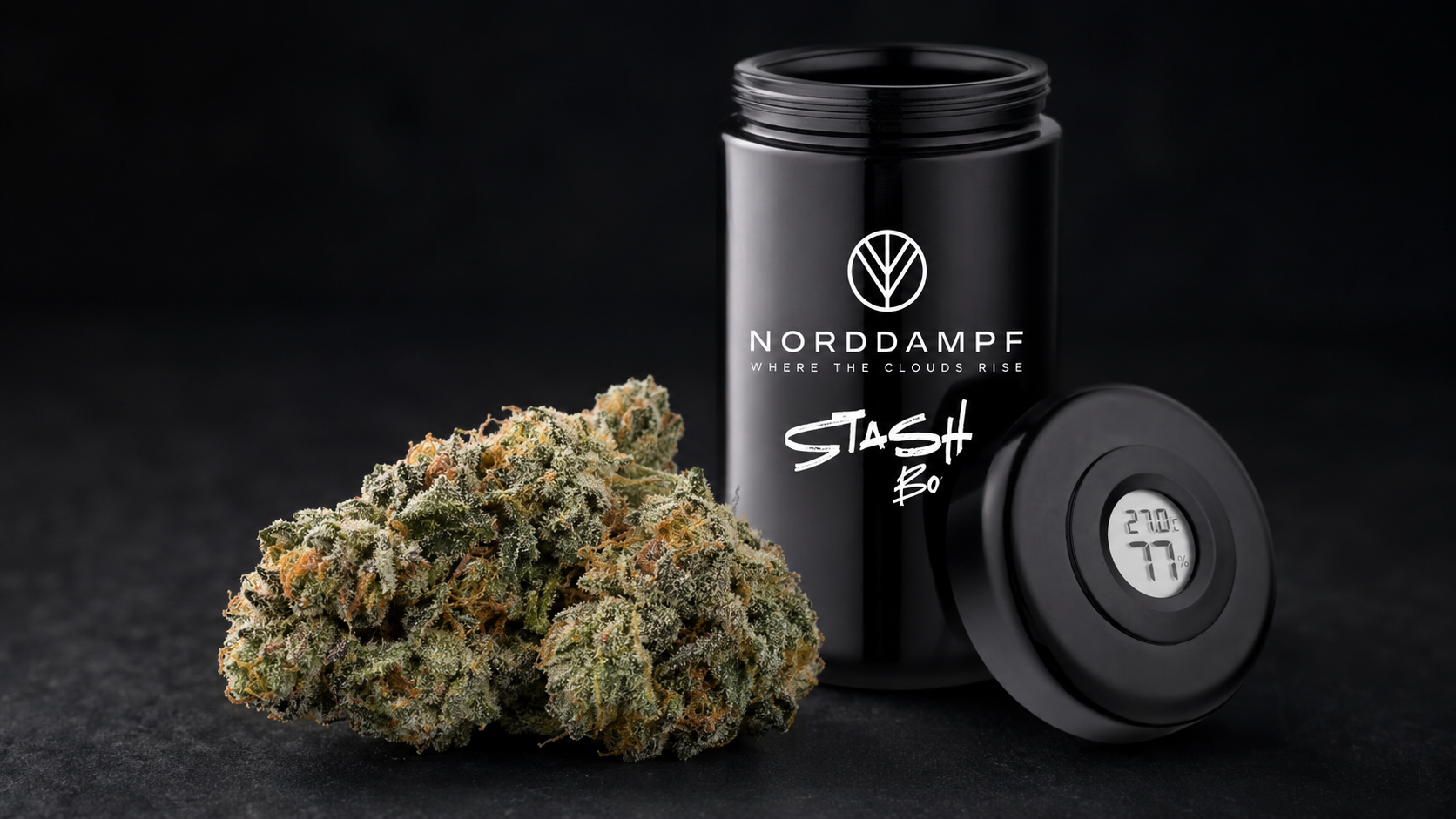
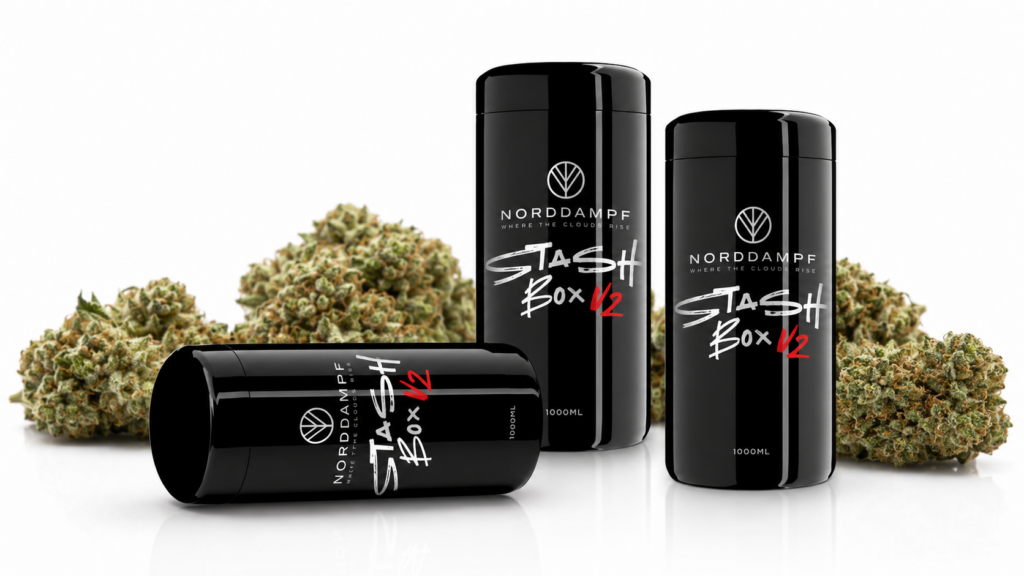
A big one, this. Store cured flower in an airtight glass jar. Miron violet glass is ideal, as it blocks light and air, and the Norddampf Miron cannabis storage jar even has a built-in hygrometer so you can check the humidity without opening the lid. Aim for 59–63% RH; cheap two-way humidity packs hold it there.
Keep it cool and dark, and skip the fridge or freezer, where condensation does the damage. Temperature swings in there cause condensation, which is precisely the type of moisture you are trying to avoid.
Keep an eye on it
Give anything kept longer than a few weeks a quick look and a sniff now and then. It's simple, effortless, takes mere seconds, and catches trouble while it's still fixable.
| ℹ️Pro Growers Tip:Dense, tightly packed colas are the most prone to internal bud rot, so good airflow during the grow and a patient dry-and-cure schedule matter more than any jar. You can't store your way out of a bud that was already compromised at harvest. |
Bottom Line
Ultimately, trichomes and mold can look like distant cousins at a glance, but on closer inspection, you will notice a remarkable difference. Trichomes emanate something intuitively good, with a sparkle and smell like the strain they came from. Moldy cannabis is dull, fuzzy, and smells like a neglected cellar. Just remember that when your eyes are unsure, let your nose be the judge.
The safety stance is worth reemphasizing. Put simply, when in doubt, don't consume it. Moldy cannabis simply isn't worth the risk, and vaporizing is not a clever workaround.
Almost every mold problem stems from drying, curing, or storage, and all are firmly within your control. Get those right, and the question of how to spot moldy cannabis becomes one you will rarely have to ask.
If you're now looking at your supplies with renewed skepticism, it's worth checking out our storage accessories.
FAQs
What does moldy cannabis look like compared to trichomes?
Trichomes are glassy, crystalline stalks that sparkle and range from clear to milky to amber. Mold is the opposite: dull, powdery, or fuzzy, in gray, white, brown, or black, with no shine at all. If it glitters, it's resin; if it looks dusty and lifeless, be suspicious.
Can you get sick from smoking or vaping moldy weed?
Yes. Most healthy adults experience coughing, nausea, or throat and sinus irritation. People with allergies, asthma, or weakened immune systems face a higher, sometimes serious risk of fungal lung infections. It's not worth the gamble.
Is it safe to just cut off the moldy part and use the rest?
No. Mold grows through the bud's internal structure, not just the surface, so the "clean" part rarely is. If one bud in a batch is moldy, treat the whole batch as suspect and discard it.
Does vaporizing cannabis kill mold or make it safe to use?
No. Mycotoxins are heat-stable and survive normal vaporization temperatures, and spores can survive even higher temperatures. Vaporizing moldy flower doesn't clean the weed; it just delivers the contaminants. A vaporizer is for good flower, not for salvaging bad.
What humidity level prevents mold in stored cannabis?
Keep relative humidity between 59% and 63%. Above roughly 63%, mold has enough moisture to grow; below 59%, the flower dries out, and terpenes degrade. A hygrometer and two-way humidity packs make holding that range easy.
Why does cannabis get moldy even when it's stored in a jar?
Usually, because it went in with too much moisture still in it. A rushed dry or cure, for example, or because the jar isn't truly airtight. A jar traps whatever conditions you put inside it, good or bad, which is why drying and curing matter as much as the container.
Sources
- Fungal and Mycotoxin Contaminants in Cannabis and Hemp Flowers: Implications for Consumer Health, Frontiers in Microbiology (2023) — https://www.frontiersin.org/journals/microbiology/articles/10.3389/fmicb.2023.1278189/full
- "Inhaled Medicinal Cannabis and the Immunocompromised Patient," Supportive Care in Cancer (2015) — https://pubmed.ncbi.nlm.nih.gov/25216851/
- Chronic necrotizing pulmonary aspergillosis in a patient with diabetes and marijuana use, CMAJ (2015) — https://www.cmaj.ca/content/187/17/1305
- Symptoms of Aspergillosis, U.S. Centers for Disease Control and Prevention (CDC) — https://www.cdc.gov/aspergillosis/signs-symptoms/index.html
- Evaluating the Effects of Gamma Irradiation for the Decontamination of Medicinal Cannabis, Frontiers in Pharmacology (2016) — https://www.frontiersin.org/journals/pharmacology/articles/10.3389/fphar.2016.00108/full
This article is for informational purposes only and does not constitute medical advice. Always consult a qualified healthcare professional before using cannabis products for health-related purposes.