

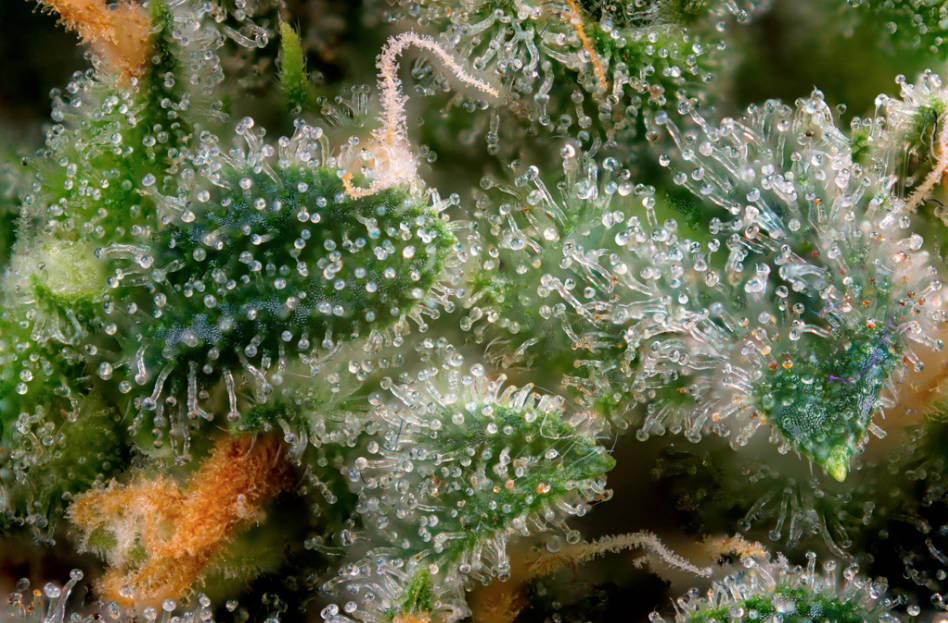
Contrary to popular belief, the crystalline frost on a high-quality flower isn’t just for decoration. You could say it’s the whole point. These tiny, glittering structures are cannabis trichomes, and that’s exactly where virtually all the cannabinoids and terpenes your plant produces are made.
If you use a dry herb vaporizer, what you’re heating and inhaling is almost entirely contained within these microscopic resin glands. By the end of this article, you’ll know what trichomes are, how the three main types differ, what they produce, and how to interpret their color to assess maturity at harvest time.
Key Points
- Cannabis trichomes are microscopic resin glands that produce cannabinoids, terpenes, and flavonoids.
- There are three types: bulbous, capitate-sessile, and capitate-stalked trichomes. Capitate-stalked trichomes are the largest and most chemically active.
- The color of the trichomes indicates maturity: clear means they're not ready yet; milky white means peak production; amber means the breakdown process has begun.
- Most growers aim for a stage with mostly milky trichomes and a few amber ones, though the ideal ratio depends on the strain and intended use.
- A jeweler's loupe with 30x to 60x magnification is the most practical tool for an accurate color assessment.
- The trichome density of your material directly affects what your vaporizer can handle.
What are cannabis trichomes?
The word comes from the Greek *tríchōma* and means “hair growth.” Trichomes are microscopic growths on the surface of plants that are particularly dense on flowers and sugar leaves. Interestingly, the plant developed them as a defense mechanism: sticky resin deters insects, reflects UV radiation, and limits moisture loss. The fact that this very resin contains the plant’s most interesting compounds is, from the plant’s perspective, a pure coincidence.
As small as they may be, trichomes contain the vast majority of the cannabinoids and terpenes in a sample. Their stage of maturity at harvest determines the cannabinoid profile of the resin. That’s the practical side; here, we’ll delve deeper into the biology.

Our Best Sellers
Discover the most popular Norddampf products


The Three Main Types of Cannabis Trichomes
Bulbous trichomes
The smallest type, measuring about 10–30 micrometers and invisible to the naked eye. They are found all over the plant’s surface and contain only very small amounts of cannabinoids and terpenes. Think of them more as background infrastructure rather than primary production sites.
Capitate-sessile trichomes
These medium-sized trichomes are more common than bulbous trichomes and sit directly on the plant's surface without a stalk. They are biochemically more active, but are still less significant than the third type.
Capitate trichomes
These are the trichomes that you can actually see. The “frost” on a well-grown flower that glitters in the light is essentially made up of capitate-stalked trichomes. They are about 50 to 500 micrometers in size and have a two-part structure: a stalk and a spherical head, known as the capitulum. Almost all of the biosynthesis of cannabinoids and terpenes takes place in this head.
What Cannabis Trichomes Actually Produce
The resin in the trichome head is an interesting but complex mixture of cannabinoids, terpenes, and flavonoids. Cannabinoids such as THC, CBD, CBG, and CBN are synthesized there and interact with the human endocannabinoid system. Terpenes are the aromatic compounds responsible for the differences in taste and smell between strains—in other words, why one flower smells like pine and citrus while another has a more earthy, fuel-like scent.
They are also significantly more volatile than cannabinoids, which is particularly important when using a vaporizer, especially when selecting the temperature. Flavonoids constitute a third class of compounds in trichome resin. They have been less extensively studied, but they also contribute to the overall character of various strains.
For vaporizer users, the most important thing to know is simple: trichome resin is what your device extracts. Our guide to how dry herb vaporizers work explains the extraction process in detail.
How to Examine Trichomes Up Close
| Tool | Enlargement | Costs | Notes |
| Jeweler's loupe | 30–60x | Low (10–30 €) | Portable, reliable, the best way to get started. |
| Digital / USB Microscope | 60–200x+ | Medium (30–100 €) | Better image quality; photos are easy to share. |
| Smartphone Macro Lens | Typically 10–30x | Low (10–20 €) | In practice, quality depends heavily on the attachment. |
| With the naked eye | 1x | Free of charge | Good for frost resistance, but not for color. |
| ℹ️ Don't underestimate the importance of lighting. Colored or uneven light distorts the colors you see. Neutral white light or natural daylight shows you the true colors. |
Trichome Color and What It Reveals About Maturity
Clear / translucent trichomes
Early stage. The plant is still ramping up cannabinoid production, and the terpenes haven’t fully developed yet. Under magnification, the bud heads look like tiny clear glass beads—pretty, but immature. If you harvest now, you’ll get low potency and a flat, underdeveloped aroma. Predominantly clear trichomes are the plant’s signal: Wait a little longer.
Cloudy / milky-white trichomes
Peak production. The resin has completely filled the gland head, turning it cloudy, much like frosted glass. At this stage, the cannabinoid concentration reaches its peak, and the terpenes are particularly pronounced—the full aromatic spectrum all at once. This is precisely the window that many growers deliberately aim for.
Amber-colored trichomes
The breakdown has begun. Once the plant passes its peak, THC slowly converts to CBN, and under magnification, the buds take on a yellowish to orange hue. A certain amount of amber-colored trichomes isn’t a problem in and of itself, since certain strains and specific uses actually call for them. However, the word“certain”carries quite a bit of weight in this sentence.
A mixture of milky and amber hues: The common goal
Most growers aim for predominantly milky trichomes with a smaller proportion of amber-colored trichomes. The right ratio is a matter of judgment and depends on the strain and growing conditions. Anyone who claims there’s a universal percentage rule is oversimplifying things.
| ℹ️ Trichome color is a guide, not a timer. Strain genetics, growing conditions, and intended use all influence what the actual harvest window looks like. |
Trichomes and Your Vaporizer: What's the Connection?
A dry herb vaporizer heats your material just enough to turn the compounds trapped in the trichome resin into vapor—without a flame and without combustion. And here’s the key point: Your flower sets the upper limit. The frostier the material, the more can be extracted per gram, and the more the device actually has to work with.
Terpenes vaporize before most cannabinoids. So start low—the first few puffs will be especially aromatic and flavorful. If you then increase the temperature, you’ll bring out the heavier cannabinoid fraction. If you use the entire temperature range instead of sticking to a single number, you’ll get noticeably more out of trichome-rich flowers.
Here’s a tip that’s worth its weight in gold: Be careful with the grinder when dealing with frosty buds. If you grind too aggressively, you’ll simply shear off the trichome heads, and they’ll end up caked in the grinder instead of in your chamber. A loose, airy grind wins every time.
| 👉 If you're looking for a device that makes the most of high-quality material, check out our popular selection of vaporizers featuring the latest features. |
Bottom Line
Trichomes aren’t just for show. They’re the plant’s chemical engine, and a frosty bloom shows just how much work it’s put in. For growers, reading their color is perhaps the most important skill when determining harvest time. For vaporizer users, this explains why quality can vary from session to session. Remember: A vaporizer is essentially a tool for trichome extraction—and it’s only as good as the material you put into it.
Frequently Asked Questions
What are trichomes in cannabis?
Trichomes are tiny, hair-like resin glands on the surface of the cannabis plant that produce cannabinoids, terpenes, and flavonoids. Capitate trichomes—the largest type—appear as a frosty layer on mature flowers and are the primary site for the production of cannabinoids and terpenes.
What color should trichomes be at harvest time?
Most growers harvest when the trichomes are mostly cloudy or milky white, with a certain proportion appearing amber. Clear trichomes indicate immaturity; trichomes that are entirely amber mean that significant degradation has already occurred. The ideal ratio varies depending on the strain and intended use.
Can you see trichomes with the naked eye?
You can see the general frosty layer, but not the individual trichome heads or their color. A jeweler's loupe with 30x to 60x magnification is the most accessible tool for an accurate color assessment.
Do trichomes affect a vaporizer's performance?
Yes, exactly. Trichomes contain the compounds that a vaporizer extracts. A higher trichome density in the material means more extractable content per gram, which improves the efficiency and quality of the session.
Why do trichomes turn amber?
The amber color results from the gradual oxidation of cannabinoids once the plant has passed its peak production. During this process, THC slowly converts to CBN. Heat, exposure to light, and humidity can accelerate this process.
Are all trichomes the same?
No, there are three types: bulbous trichomes, which are the smallest and produce the least resin; capitate-sessile trichomes, which are medium-sized and lie flat on the surface; and capitate-stalked trichomes, which are the largest and have a stalk-and-head structure. The latter are the primary source of resin and are responsible for the visible frost on mature flowers.
Sources
Livingston, S.J., Quilichini, T.D., Booth, J.K., et al. (2020). Cannabis glandular trichomes alter morphology and metabolite content during flower maturation. The Plant Journal, 101(1), 37–56. https://doi.org/10.1111/tpj.14516
Happyana, N., Agnolet, S., Muntendam, R., et al. (2013). Analysis of cannabinoids in laser-microdissected trichomes of medicinal Cannabis sativa using LCMS and cryogenic NMR. Phytochemistry, 87, 51–59. https://doi.org/10.1016/j.phytochem.2012.11.001
Russo, E.B. (2011). Taming THC: Potential Cannabis Synergy and Phytocannabinoid-Terpenoid Entourage Effects. British Journal of Pharmacology, 163(7), 1344–1364. https://doi.org/10.1111/j.1476-5381.2011.01238.x
Andre, C.M., Hausman, J.F., & Guerriero, G. (2016). Cannabis sativa: The Plant of the Thousand and One Molecules. Frontiers in Plant Science, 7, 19. https://doi.org/10.3389/fpls.2016.00019
Booth, J.K., Page, J.E., & Bohlmann, J. (2017). Terpene synthases from Cannabis sativa. PLOS ONE, 12(3), e0173911. https://doi.org/10.1371/journal.pone.0173911
European Monitoring Centre for Drugs and Drug Addiction (EMCDDA). (2023). Cannabis drug profile. https://www.emcdda.europa.eu/publications/drug-profiles/cannabis
This article is for informational purposes only and does not constitute medical advice. Always consult a qualified healthcare professional before using cannabis products for health-related purposes.