

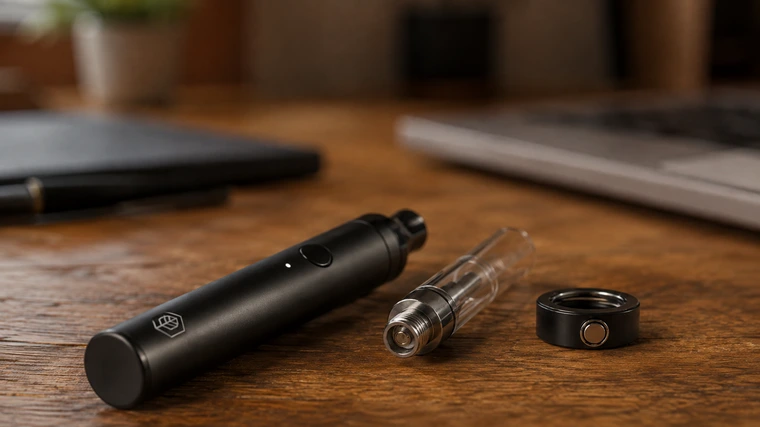
You've probably come across "510 thread" buried somewhere in a cartridge description and assumed it was just another specification you needed to understand. Luckily, this one is pretty simple.
It's the small threaded connection that allows a cartridge to be screwed onto a compatible battery, and one of the main reasons why vaping hardware from different brands can work together at all.
The name traditionally comes from the thread itself: ten threads spaced 0.5 mm apart. That might sound like a detail only an engineer could appreciate, but in practical terms, all you really need to know is that 510 has become the common language for a vast array of vaping hardware.
Of course, “common” doesn’t mean “universal.” A cartridge may have the right thread but still be incompatible with a battery due to its size, voltage requirements, or the way the contacts are aligned.
So, instead of turning this into a mini engineering course, let's take a look at what "510" actually means, what's inside a typical cartridge, when an adapter comes in handy, and how to tell if two pieces of hardware are likely to fit together.
The Summary
A 510 thread is the standard screw connection used between many vape cartridges, atomizer heads, and batteries.
The name traditionally refers to ten notches spaced 0.5 mm apart.
A typical 510 cartridge consists of a mouthpiece, a reservoir, a heating element, and a threaded base.
A 510 cartridge usually fits a 510 battery, but matching threads do not guarantee perfect compatibility.
Adapters are especially useful when two pieces of hardware use different types of connectors or when a battery uses a magnetic cartridge system.
Norddampf's DAB PEN Mini uses a universal 510 thread and is compatible with standard 510 cartridges.
What does “510” actually mean?
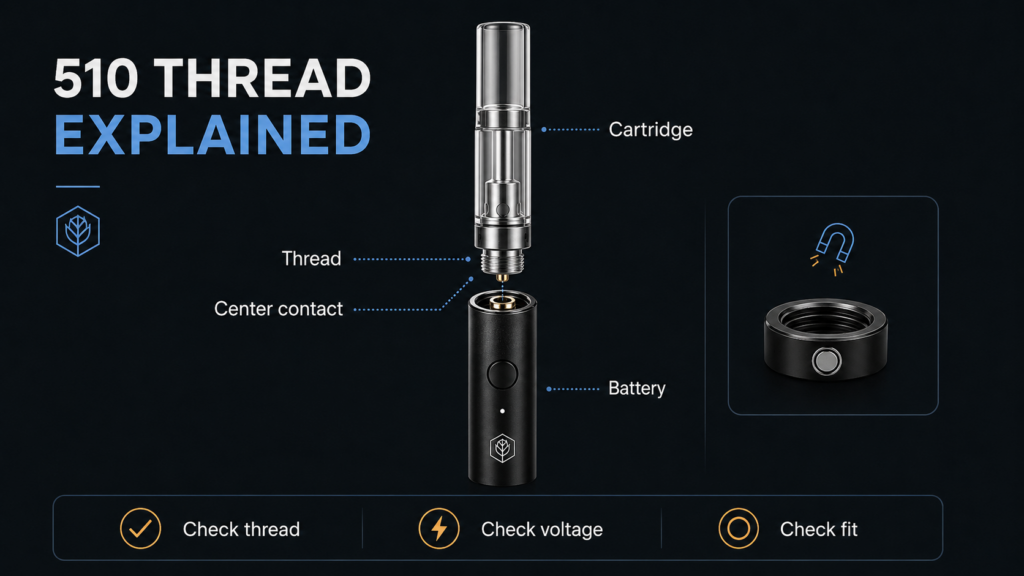
The name sounds more mysterious than the hardware itself.
A 510 connection is traditionally described as ten threads with a pitch of 0.5 mm. This is where the name “510” comes from, and it has since become the standard shorthand for this type of connection.
What matters, however, is what it actually accomplishes.
The external threaded section holds the cartridge in place on the battery, while the electrical contacts ensure that current reaches the heating element inside. Screw on the cartridge, activate the battery, and the heating element receives the power it needs.
Simple enough.
The clever thing about this is that so many manufacturers have adopted the same universal connection. Instead of buying a cartridge only to find that it works with just one specific battery, 510 hardware can often be mixed and matched across brands.
Here, however, the word “universal” starts to take on a bit too much meaning.
A matching thread does not automatically mean that every cartridge will work flawlessly with every battery. Voltage, cartridge width, airflow, and the exact position of the electrical contacts can still play a role, which is why it’s better to think of 510 as a standard hardware format rather than a guarantee that absolutely everything will fit with everything else.

Our Best Sellers
Discover the most popular Norddampf products
What's inside a 510-threaded cartridge?
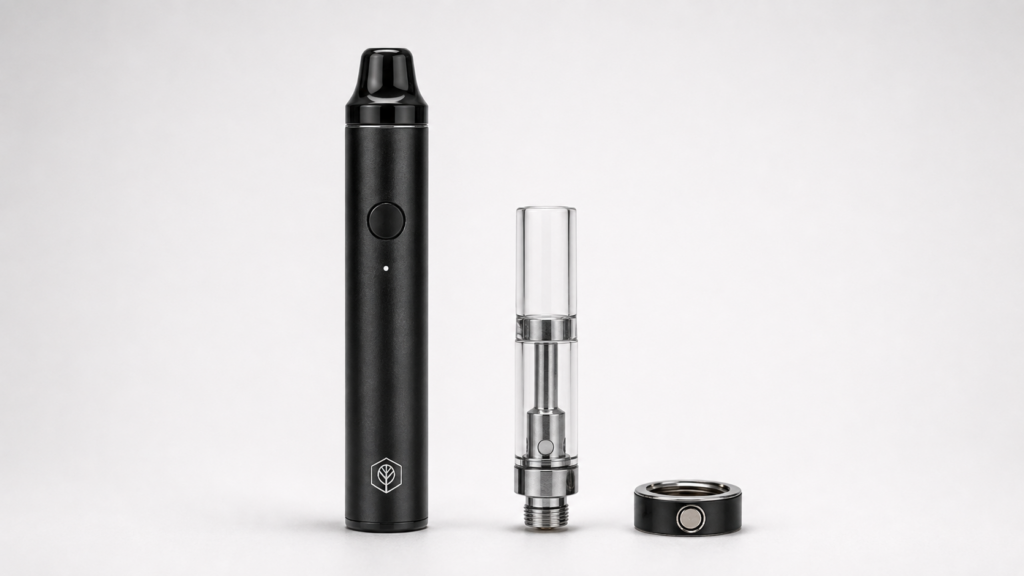
From the outside, most 510 cartridges aren't particularly complicated. They have a mouthpiece at the top, a small reservoir in the middle, and a threaded connection at the bottom.
There's a bit more going on inside.
mouthpiece
The mouthpiece is simply the part you inhale through.
Depending on the cartridge, it may be made of plastic, ceramic, glass, or metal. The shape and material affect the user experience, but have nothing to do with whether the connection to the base is a 510 connection.
Reservoir
The reservoir contains the oil or liquid that is vaporized.
Capacity varies from cartridge to cartridge, so there isn't really a useful universal figure to cite here. Some are tiny, some are significantly less so, and manufacturers have never shown much interest in making them all exactly the same size.
| ℹ️ One of the materials commonly found in pre-filled cartridges is cannabis distillate. If this term is just as mysterious to you, Norddampf’s guide to cannabis distillate explains what it is, how it’s made, and why it’s particularly well-suited for cartridges. |
Heating element
The evaporator head, or heating element, is located at the bottom of the reservoir.
Older cartridge designs often use a coil-wick configuration, while many newer ones use ceramic heating elements. Either way, the function is largely the same: to draw power from the battery and heat the material in the reservoir until it produces vapor.
The airflow can also vary. Some cartridges draw air from the bottom, while others use different intake designs, which is one of the reasons why two cartridges with the same threading can still feel quite different in actual use.
It’s also worth distinguishing between cartridges and concentrate atomizer heads. Both may use a 510 connection, but an atomizer head designed for loose wax or another type of concentrate isn’t automatically the same thing as a pre-filled cartridge.
Our FAQ on dabbing with vaporizers goes into more detail about this distinction.
510 Connection
And then comes the part that this is really all about.
The threaded base is the part that screws onto the battery and helps establish the electrical connection. If you want to find out whether a cartridge and a battery are compatible, that's the first thing to check.
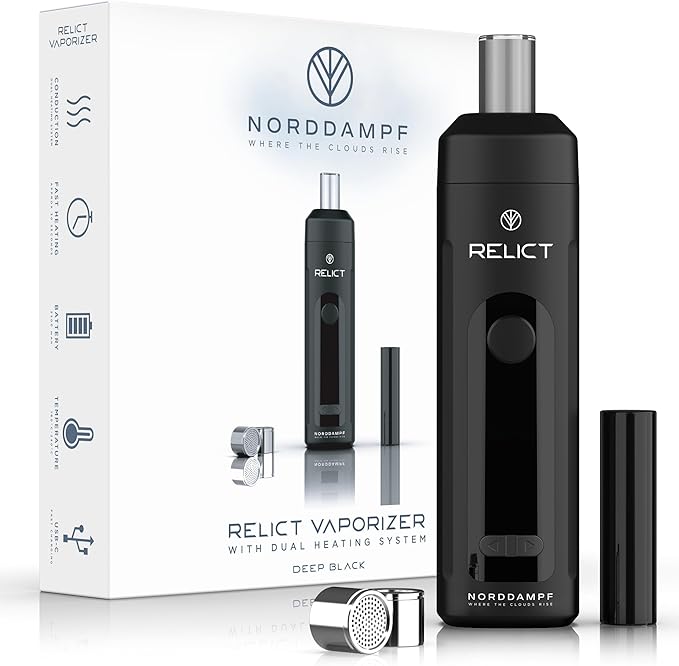
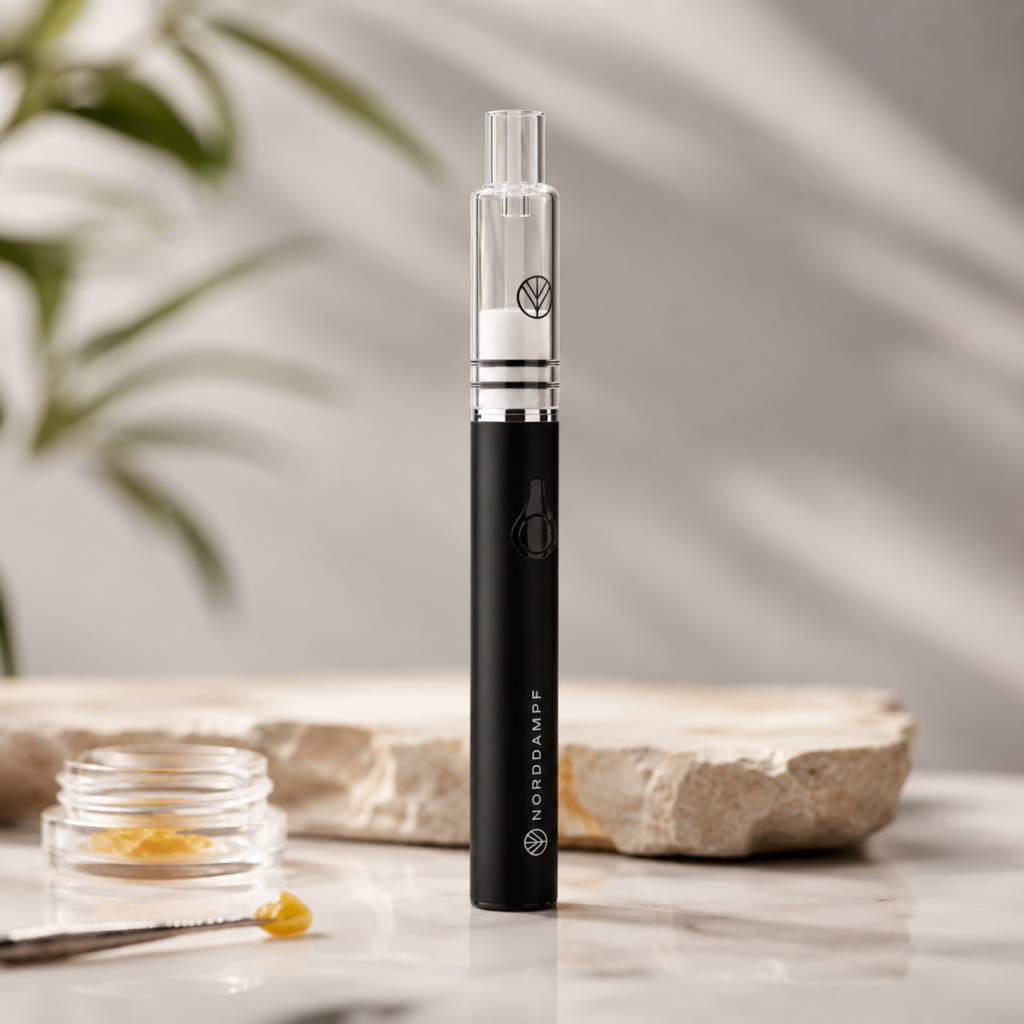
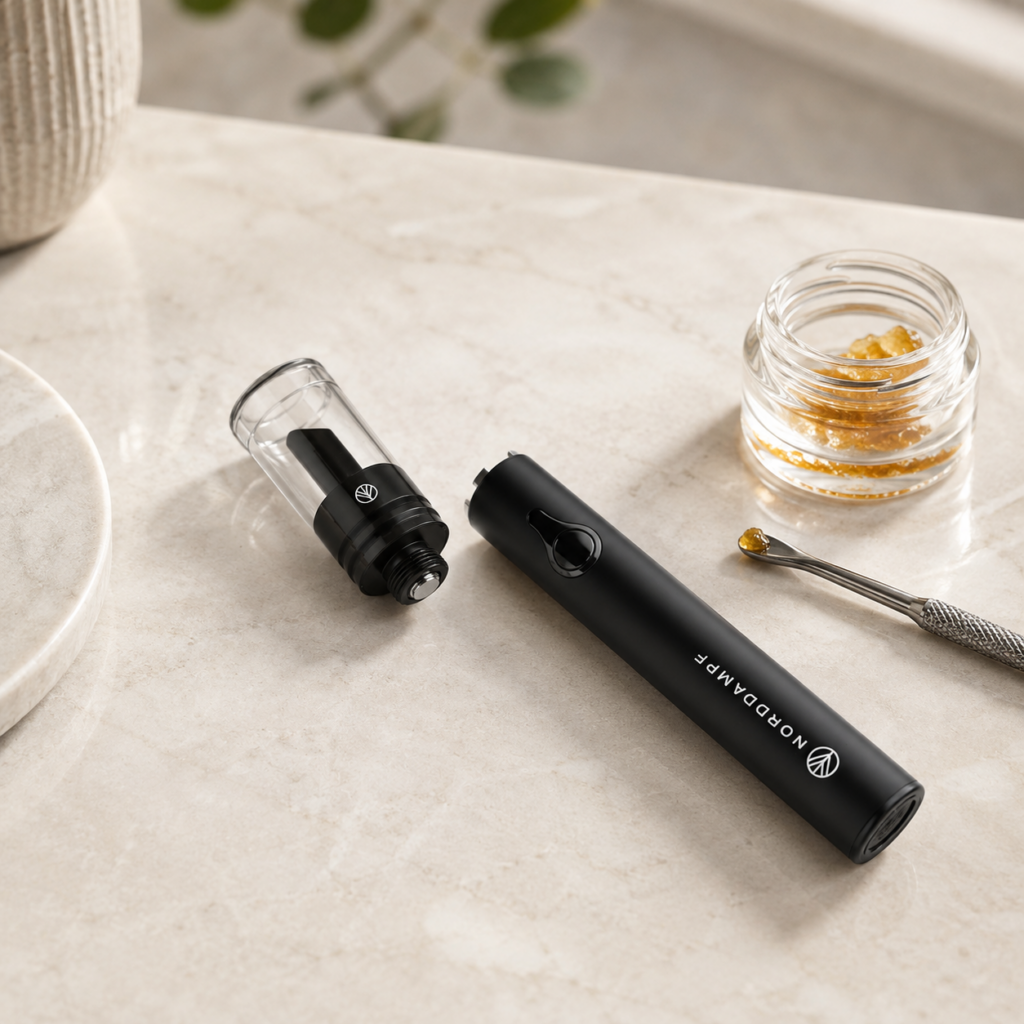
Our DAB PEN Mini uses a universal 510 thread and is compatible with standard 510 cartridges.
It also works with its own vaporizer head for concentrates, which you should keep separate in your mind. A concentrate vaporizer head and a 510 cartridge can share the same connection without actually being the same piece of hardware.
Same thread, different purpose.
Do I need a 510 thread adapter?
Usually not.
If your cartridge already has a standard 510 connection and your battery does too, using an adapter solves a problem you don't actually have.
Adapters come in handy when the two hardware components use different connection types, or when a battery has been designed around a different mounting system.
510-to-eGo Adapter
eGo is an older connection type that you may still come across, especially in older vaping devices.
Some devices are designed to support both eGo and 510 connections, while others require a small threaded adapter to connect the two. If you happen to have an older battery and a newer cartridge, this is one of the more obvious situations where an adapter really comes in handy.
Magnetic 510 Adapters
Magnetic adapters work a little differently.
Some compact batteries do not require you to screw the cartridge directly into the device body. Instead, you first screw a small 510 adapter onto the cartridge, and then the cartridge snaps into the battery, where magnets hold it in place.
The cartridge remains a standard 510 cartridge. The adapter simply provides the battery with a different way to hold it.
You’ll also see the term “adapter” used in other contexts when it comes to vaporizer hardware, which can make the terminology unnecessarily confusing. Norddampf’s RELICT bong adapter, for example, connects a vaporizer to glass bongs with 14.5 mm or 18.8 mm ground joints.
It has nothing to do with converting a 510 thread; it's simply a different type of adapter with a completely different purpose.
No matter which adapter you look at, the fit is still important. A loose or worn connection can result in unreliable electrical contact, a wobbly fit, or a device that simply refuses to start.
If everything already screws together smoothly and works as intended, there’s hardly any reason to add another component to the assembly.
How can you tell if a cartridge or battery is 510-compatible?
You don't need a caliper, a microscope, or a suspiciously intense interest in tiny metal threads.
There are three simpler ways to check this.
1. Read the product specifications
Start with the obvious.
Look for phrases such as “510 thread” or “510-compatible” on the product page, the packaging, or in the manual.
If it says 510 on both sides, you're already most of the way there.
This detail is more important than whether a cartridge simply looks roughly right, since many proprietary connectors are small enough to cause confusion at first glance.
2. View the connection
If the packaging disappeared months ago, take a look at the bottom of the cartridge.
A 510 cartridge typically has a small, fine threaded connection instead of the larger or differently shaped connectors used by many proprietary pod systems.
A visual comparison can be helpful, especially if there's another familiar 510 product nearby, but it's not foolproof.
Tiny metal threads don't really introduce themselves very well.
3. Carefully check the fit
If the cartridge is compatible, carefully screw it in.
A properly made 510 connection should screw in smoothly and make electrical contact without requiring any force.
If it feels off, if it's not quite right, or if you feel like you have to really push yourself, stop.
If you have to give it a little nudge, that usually tells you something about the hardware.
Damaged threads are a pretty expensive way to find out that two devices were never compatible to begin with.
Can any 510 cartridge work with any 510 battery?
Not necessarily.
A standard 510 cartridge can usually be screwed onto a 510 battery, but the thread is only half the story.
The battery must still provide an adequate amount of current for the heating element in the cartridge. Too much voltage can make the vapor harsh or burnt-tasting, while too little will leave you wondering if the device is even working at all.
Some batteries offer adjustable voltage, while others use fixed settings, so it's a good idea to check the range recommended by the cartridge manufacturer.
| ℹ️ Read the vaporizer battery guide, which covers battery technology and things to look out for in more detail. |
Physical size can also be an obstacle.
A wide cartridge may have exactly the right thread but still not fit into a battery with a recessed cartridge slot. Technically compatible at the connection point yet practically unusable—which is always helpful.
So check the recommended voltage, if specified, and make sure the cartridge physically fits into the battery.
“510-compatible” is a very good starting point. It’s not quite a blood oath.
Why 510 Became So Widespread
The answer is, above all, convenience.
Once a threaded connection had become widely adopted, manufacturers were able to design batteries and cartridges around the same standard format, rather than expecting users to buy another piece of hardware every time they switched brands.
That works out pretty well for everyone involved.
Manufacturers don't have to just come up with a new connector out of the blue, and users have a much better chance that a cartridge will work with the battery they already have.
Proprietary pod systems and other formats, of course, still exist, and they aren't going to disappear.
But when it comes to threaded vape cartridges, 510 is the connection you're most likely to come across.
A small thread with a big impact
For something so tiny, the 510 thread does a lot.
Cartridges and batteries from different manufacturers share a common connection method, which is why it's found in so much vaping hardware.
The rule is pretty simple: If both parts are truly 510-compatible, they usually connect without an adapter. After that, you still need to check the voltage, dimensions, and any manufacturer-specific requirements.
Once you know what you're looking for, the 510 turns out to be one of the less complicated specifications in vaping hardware.
FAQs
Do all vape cartridges have a 510 thread?
No. 510 is the most common threaded connection for cartridges, but there are also proprietary pod systems and other connection formats. Before purchasing, check the specifications of the cartridge and battery instead of assuming that every cartridge uses the same connection.
Is the 510 thread the same for nicotine and cannabis cartridges?
The 510 connection refers to the hardware interface, not what’s inside the cartridge. The same basic connection can therefore be found on different types of vaping hardware, while cartridge contents, power requirements, and applicable regulations remain separate considerations in each case.
Can I use a 510 battery with any 510 cartridge?
Most of the time, but not always. A standard 510 cartridge should physically connect to a 510 battery, but voltage requirements, cartridge dimensions, airflow, and battery design can still affect whether the combination works properly.
What is the difference between a 510 thread and a magnetic adapter?
A 510 thread is the screw connection on the cartridge or the battery itself. A magnetic adapter screws onto a 510 cartridge, allowing it to fit into a compatible magnetic battery instead of being screwed directly into the device.
D Norddampf s manufacture 510-compatible devices?
Yes. The DAB PEN Mini uses a universal 510 thread, and Norddampf states that it is compatible with standard 510 cartridges.
*Note: This article is for informational purposes only and does not constitute medical advice. Always consult a qualified healthcare professional before using cannabis products for health-related purposes.*