

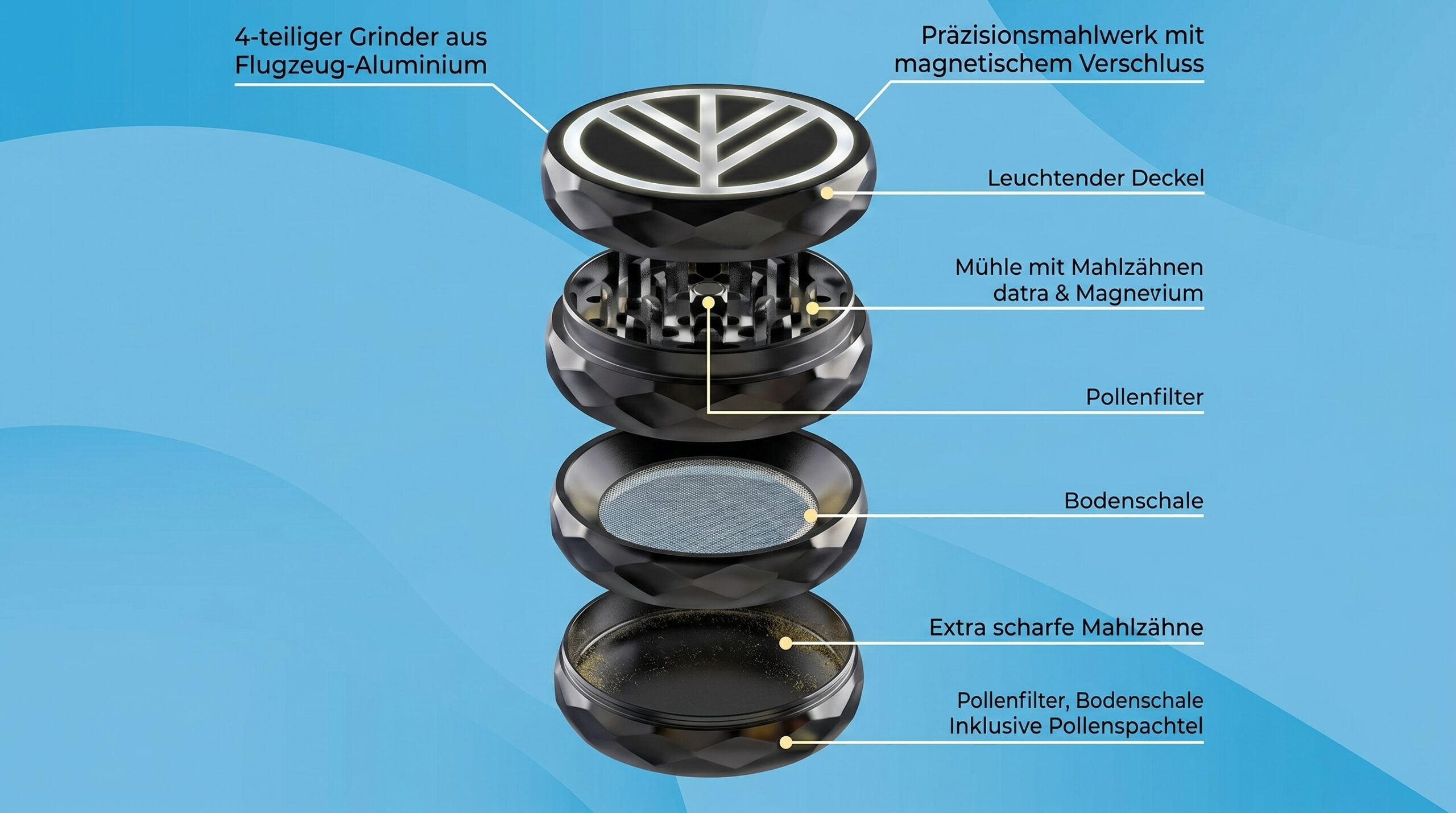
You’re faced with a choice: a 2-piece or a 4-piece grinder? The answer is less complicated than it seems—but it depends on your priorities. The main difference between a 2-piece and a 4-piece grinder lies in their functionality: While the 2-piece grinder doesn’t separate the ground material, the 4-piece grinder features additional chambers for separating the ground material and collecting kief. This guide will show you where the real differences lie, which model fits your vaporizer setup, and why the right grind is crucial for the result.
Key Findings (Brief Overview)

- Main difference: 2-piece = simple & compact; 4-piece = multi-chamber system with a pollen compartment for more efficient herb processing.
- Two-piece grinders are ideal for beginners and occasional users who mainly want to prepare their vaporizer quickly.
- 4-piece grinders are popular among experienced users thanks to their pollen catcher, improved handling of larger quantities, and greater efficiency.
- The best grinder models are made of stainless steel or aluminum, as these materials are recommended for their durability and hygiene.
- The quality of the materials (e.g., CNC-machined aluminum or stainless steel) is more important than the sheer number of parts when it comes to durability and grinding consistency.
- Quality over quantity: A high-quality two-piece set outperforms a cheap four-piece set in almost every way.
Introduction: Why the Right Grinder Is So Important for Vaporizer Users
Preparing herbs for your vaporizer doesn’t start when you turn it on. It starts with grinding. A consistent, fluffy grind is crucial for efficient heating, optimal flavor release, and consistent results. The right grind ensures that the herbs are heated evenly, significantly improving the vaporizer’s efficiency and results. Unevenly ground herbs lead to hot spots—areas that are heated unevenly and can reduce extraction efficiency by up to 20–30%.
For years, many cannabis enthusiasts and vaporizer users have been torn between 2-piece and 4-piece grinders. The added value of a pollen tray or an extra collection chamber isn’t immediately obvious. But choosing the right grinder isn’t rocket science—if you know what to look for.
In this article, you’ll learn in practical terms how both types are designed, what the real differences are in terms of usability and efficiency, and which design is actually best suited for your everyday needs. No marketing jargon—just clear facts to help you make your decision.

Our Best Sellers
Discover the most popular Norddampf products



How does a grinder work, basically?
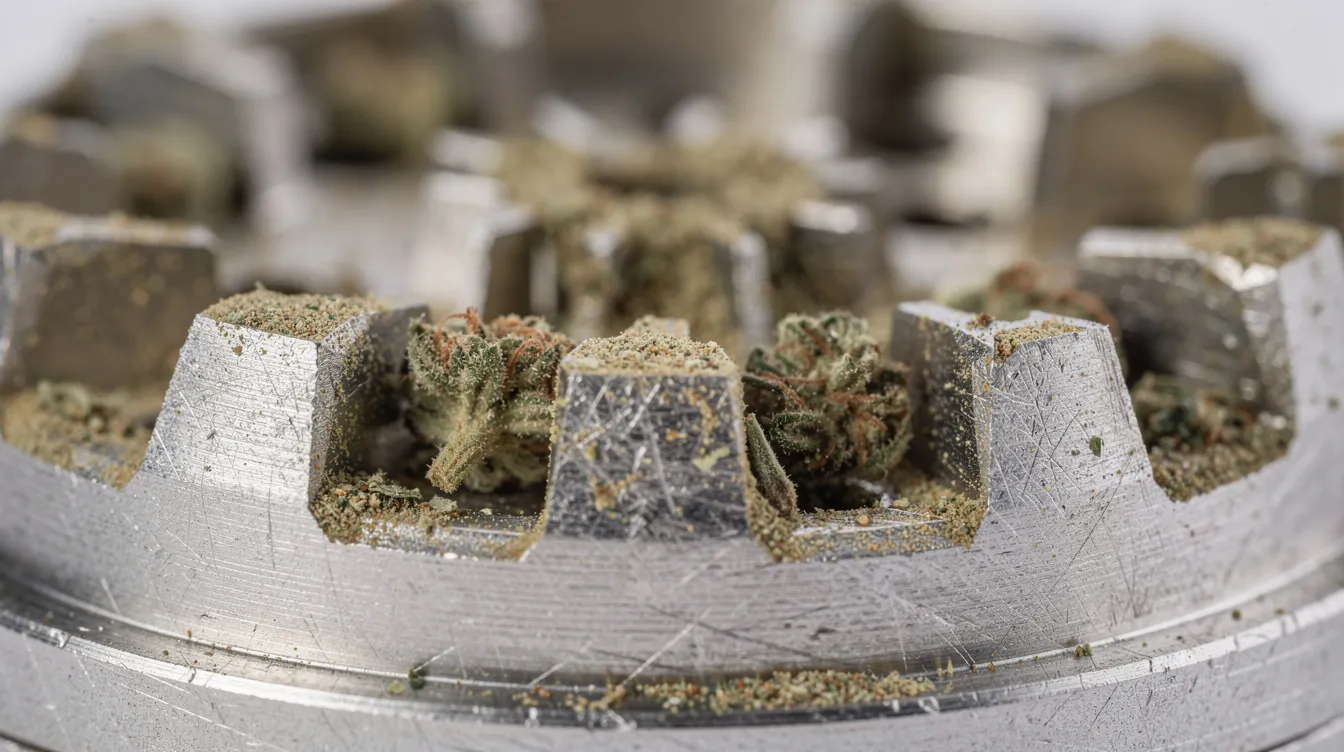
A grinder—also known as an herb grinder, crusher, or shredder—is a compact grinding device consisting of two rotating parts. Both parts are equipped with interlocking teeth that break down herbs through rotational friction. The result is a loose, consistent grind, which is essential for vaporizers.
The basic process is simple:
- Herbs (ideally dried to 10–15% moisture content) are placed in the grinding chamber
- With 10–20 full rotations, the flowers are compressed and cut between the teeth
- The ground material can be removed and used in the vaporizer
The quality of the grind has a significant impact on the consistency of the ground material and, consequently, on the efficiency and results when used in a vaporizer.
The teeth of a grinder are typically diamond- or pyramid-shaped and spaced 2–4 mm apart. Depending on the design, they produce grind sizes ranging from coarse (for conduction vaporizers) to medium-fine (for convection models).
Why is consistency so important?
Particle surface area is directly correlated with vaporization efficiency. Studies on herb grinding show a 15–25% improvement in the release of aromatic compounds from uniformly ground material at temperatures of 180–220 °C. Uneven particles result in uneven heat distribution—and thus wasted potential.
Construction: What is the difference between 2-piece and 4-piece grinders?
The fundamental difference lies in the layered design. A two-piece grinder consists of just two parts: a lid and a base. A four-piece grinder expands on this principle to include four stacked components, each with a different function.
2-piece grinder:
- Lid with teeth
- Base with teeth
- Usually a magnetic closure
- No additional chamber
4-piece grinder:
- Toothed lid (upper grinding chamber)
- Middle collection chamber with perforations
- Stainless steel mesh screen (typically 60–120 µm)
- Lower jaw compartment (pollen compartment)
Typical sizes for compact models range from 40 to 50 mm in diameter. For 4-piece models, standard sizes of 55 to 63 mm have become the norm, as this allows enough space for the grinding chamber and filter. The total height of a 4-piece model is 50 to 70 mm, while 2-piece models are significantly flatter, at 20 to 30 mm.
Important: The number of parts does not determine the quality of the material. It merely defines the range of functions and the overall height. A high-quality two-piece aluminum grinder can be far superior to a cheap four-piece model in terms of performance and durability.
2-piece grinder: Simple design, maximum compactness
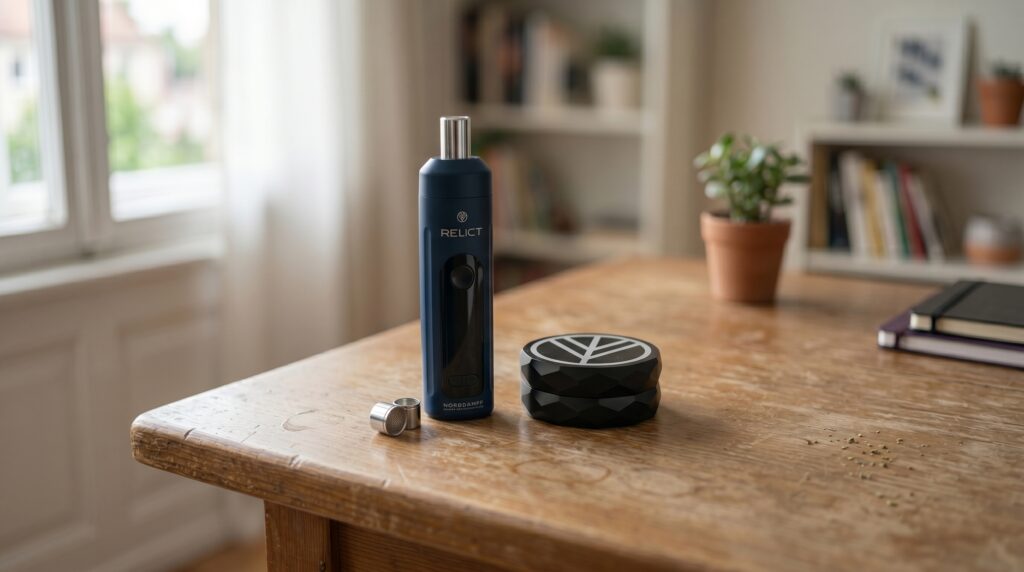
The two-piece weed grinder strips the design down to the essentials: a top half with teeth and a bottom half with teeth, often held together by neodymium magnets with a holding force of 5–10 kg. After grinding, all the ground material stays in the same compartment—no sieve, no pollen tray, no additional chambers.
This construction method offers clear advantages:
- Slim design: Fits in any bag or case
- Hardly any parts to lose: just two components
- Quick to use: Turn, open, remove
- Easy to clean: just two surfaces—that's it
Typical materials used in two-piece vaporizers range from inexpensive plastic to zinc alloys, high-quality aluminum, and stainless steel. For regular use with your vaporizer, a metal model is definitely recommended—plastic wears out faster and can lose its teeth.
This two-piece vaporizer is ideal for users who are trying a vaporizer for the first time in 2026 and are looking for a hassle-free way to get started.
4-piece grinder: Multi-chamber system with pollen compartment
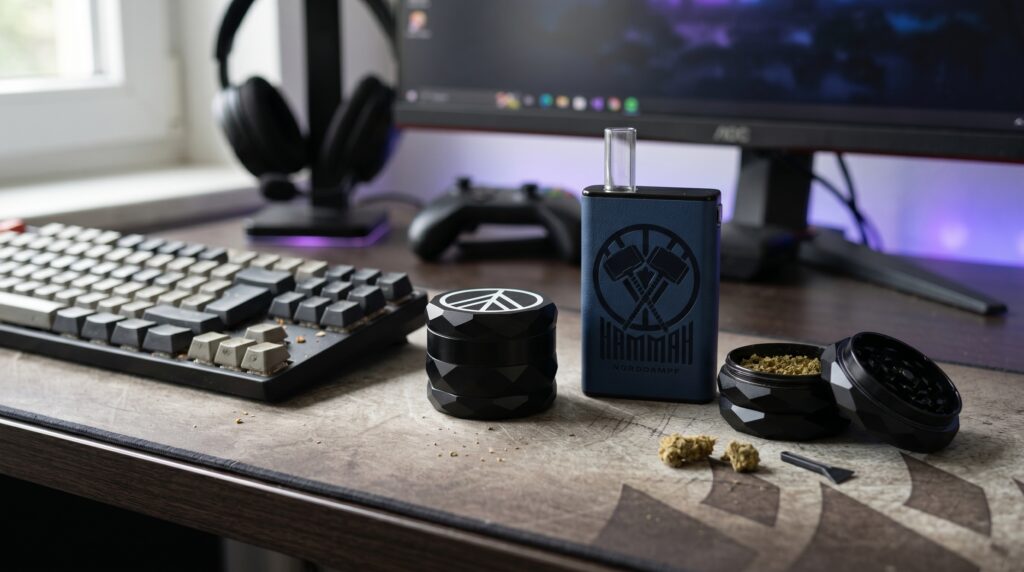
The 4-part grinder works like a tiered system. Imagine four levels screwed together one on top of the other:
- Top level: Lid with grinding teeth
- Second level: Grinding chamber with perforations (2–5 mm holes)
- Third level: Collection chamber with a fine metal screen
- Bottom shelf: Pollen tray for trichomes
During grinding, the crushed material falls through the holes in the grinding chamber into the collection chamber below. With repeated use, the finest particles—the valuable trichomes—sift through the stainless steel screen into the lower compartment. With regular use, this results in a weekly collection of 0.5–2 g of kief per 50 g of processed herbs.
The multi-chamber system offers convenient handling for users who regularly prepare herbs for stationary or portable vaporizers. Prepared material can be stored in the collection chamber for days without having to grind it again each time.
Due to its design, the 4-piece model is slightly heavier (80–150 g compared to 50–80 g for 2-piece models) and taller. The threads must be cleaned regularly to ensure they remain smooth.
Handling & Efficiency Compared: 2-Piece vs. 4-Piece
The practical experience with both types of grinders differs more significantly than the number of parts might suggest.
Grinding process: A 2-chamber grinder typically takes 15–30 seconds to grind a 0.3-gram batch. The 4-chamber grinder takes a bit longer—20–45 seconds—because the material must first fall through the perforations. However, this results in a cleaner and more controlled discharge from the collection chamber.
Efficiency: The key difference lies in the automatic separation. 4-way splitters separate fine particles and collect valuable trichomes—rich in terpenes and aromatic compounds—over time in the pollen tray. According to user experiences shared on vaping forums, this method allows users to recover 15% more usable material each month through kief collection.
Ease of use: More parts mean more screws and more cleaning. On the other hand, with a 4-piece grinder, you don’t have to empty the entire unit as often. If made from high-quality materials, larger 4-piece grinders actually turn more smoothly than compact 2-piece models, as the larger diameter provides more leverage and the grinder fits comfortably in your hand. The grinding action feels comfortable and controlled in the hand, making it particularly user-friendly.
For vaporizer users, the following applies: The quality of the teeth and the precision of the grinding mechanism determine the grind size more than the number of sections. A grinder with dull or misaligned teeth produces uneven results—regardless of whether it has two or four sections.
Everyday scenario with a 2-piece grinder

Imagine this: You’re preparing a small amount of herbs for your portable vaporizer. You open the two-part grinder, put 0.2–0.3 g of buds inside, grind 15–20 times, and your ground herb is ready to go.
The grinder is responsive and quick to use. However, it’s nearly impossible to avoid touching the material with your fingers when emptying it. You can either tip the open grinder over the chamber of your vaporizer or scrape the ground material out with your fingers. The material ground with this two-piece grinder is also ideal for rolling or filling cigarettes, as its consistency is perfect for making cigarettes.
With smaller models (e.g., 40 mm), you'll need a bit more torque, especially if the herbs are drier or more compact. The compact lever makes turning it more strenuous than with larger models.
The big advantage: it’s quick to clean. Two parts, one brush—done in under a minute. Ideal for anyone who wants to keep the effort to a minimum and takes the grinder with them regularly. Easy to clean and low-maintenance—that’s what defines the two-piece model.
Everyday scenario with a 4-piece grinder
You have a tabletop vaporizer and prepare herbs regularly. The 4-piece set is within easy reach on your desk. You grind larger quantities (0.5–1 g) at a time, and the ground material falls into the collection chamber, where it’s ready for several sessions.
After a few weeks, a fine layer of pollen has accumulated in the lower compartment. The trichomes—which you would have lost on the teeth and inner walls of the two-part container—are now collected and ready for targeted use.
Removal is neater: Simply unscrew the collection chamber and use the included scraper. No tilting, less spillage. According to comparative tests, the risk of mess is reduced by about 70% compared to the two-piece model.
The extra effort required for cleaning—the sieve, the threads, the pollen compartment—is real. But for power users who grind several times a week, the added value clearly outweighs the effort.
Pros and Cons: A Detailed Look at the 2-Piece Grinder
The two-piece set is defined by minimalism. This brings clear strengths—and equally clear limitations.
Advantages:
- Compact and lightweight (50–80 g for metal versions)
- Fits in 95% of all vaporizer cases and pouches
- Virtually indestructible thanks to CNC-machined aluminum
- Very easy to use, with no learning curve
- Cleaning in under a minute
- Lower purchase price (€10–30 for metal versions)
- Hardly any parts to lose or damage
Disadvantages:
- No pollen compartment – no separation of fine materials
- Less orderly retrieval with a 10–15% risk of spillage
- Limited capacity (0.2–0.4 g per charge)
- Fine particles adhere to teeth and the inner walls
- For plastic models: faster wear and tear; teeth may break off
A top grinder in a two-piece design is made of CNC-machined aluminum or stainless steel. Durability tests show that such models can withstand over 5,000 cycles before tooth wear reaches 5%.
Recommendation: Ideal for beginners, minimalists, users with a compact vaporizer setup, or as a travel grinder.
Pros and Cons: A Detailed Look at the 4-Piece Grinder

This four-piece set is designed for users who want more than just shredding. It is a system for efficient material utilization.
Advantages:
- Built-in tray for prepared herbs
- Pollen tray (pollen catcher) collects valuable trichomes
- Cleaner dispensing thanks to separate chambers
- A better overview of available quantities
- Better utilization of all parts of the plant in the long term
- A larger diameter provides more torque
- Precision threads (1–2 mm pitch) for smooth disassembly
Disadvantages:
- More parts, more complexity
- Heavier weight (80–150 g)
- More thorough cleaning every 2–4 weeks
- Higher purchase price (€40–100)
- Prone to stripped threads if not properly maintained
- The screen may clog if the mesh size exceeds 100 µm
According to industry analyses, 4-piece grinders are preferred by 60–70% of advanced vaporizer users. According to expert analyses, the kief catcher recovers 10–25% of the plant’s total value over time.
Recommended for: Advanced users and frequent users who regularly prepare herbs for various vaporizers and appreciate the added value of a pollen tray.
What is a pollen trap (pollen catcher)—and is it really worth it?
The pollen chamber is the bottom compartment of a 4-part grinder, separated from the collection chamber above by a fine metal screen. This screen—usually made of surgical-grade stainless steel with a mesh size of 60–100 µm—traps 95% of all particles smaller than 150 µm.
What is Kief?
Resin refers to the fine, resin-rich glandular trichomes that are released from the surface of the herbs when they are ground. These particles are particularly rich in terpenes and aromatic compounds—they account for 10–20% of the plant’s total potency.
Separation occurs mechanically through gravity and the vibrations generated during grinding. With each use, the finest particles pass through the screen and collect in the tray.
Who would benefit from a pollen filter?
- Regular users (5 g+ per week): Significant added value, as usable resin accumulates each month for additional vaporizer sessions
- Occasional users: Less relevant, as accumulation remains minimal (less than 0.05 g)
The Kief Catcher minimizes waste and allows for customizable grind sizes. However, the screen requires regular maintenance: according to cleaning guides, uncleaned screens reduce airflow by 50% after 20 uses. A soft brush or paintbrush should be part of your standard equipment.
Which grinder is right for whom? (Beginners vs. experienced users)
The choice between a 2-piece and a 4-piece grinder depends on your usage habits.
Beginners and occasional users: Start with a high-quality 2- or 3-piece metal grinder, 50–55 mm in size. You’ll learn how to use it and get a feel for the grind size without having to worry about sieves or pollen chambers. The focus is on the essentials: a consistent grind for your first vaporizer.
Experienced users and frequent users: If you’ve been using various vaporizers regularly for years, a sturdy 4-piece model with a pollen chamber and a diameter of 55–63 mm is a worthwhile investment. The additional features are justified by daily use and the added value of collecting resin over time.
Travelers and minimalists: Even experienced users often carry a small two-piece set with them when they’re on the go. A 40–45 mm model fits in any case and won’t break the bank.
Design fans and tech enthusiasts: For you, aesthetics matter just as much as function. This premium 4-piece set, featuring CNC machining, a ceramic coating, and precision threads, delivers both performance and style.
Checklist: How to Make the Right Choice in 2026
Use these points to align your priorities:
- How often do you prepare herbs for your vaporizer? Daily = 4-part, occasionally = 2-part
- Do you process more than 0.5 g per session? Yes = 4-part set with larger capacity
- Is a pollen compartment important to you? Yes = 4-compartment, no = 2-compartment is sufficient
- Do you travel a lot with your gear? Yes = compact 2-piece set (40–50 mm)
- How much cleaning do you mind doing? Minimal = 2-piece set, no problem = 4-piece set
- Your budget? Under €40 = high-quality 2-piece set; over that = 4-piece set possible
- Do you use desktop or portable vaporizers? Desktop = 4-piece, portable = both options
Investing in quality pays off. A good grinder will work reliably for several years without any problems—well into 2026 and beyond.
Material, quality, and durability—whether it’s a 2-piece or 4-piece set
The materials used in the grinder have a greater impact on its lifespan and grinding consistency than whether it is made of two or four parts.
Aluminum (CNC-machined, anodized): The standard for 2026. Aircraft-grade 7075 aluminum offers optimal lightness with a density of 2.8 g/cm³ and a hardness of 150 HB. CNC-milled aluminum accounts for over 70% of high-end sales—thanks to precision tolerances of less than 0.1 mm in gear tooth alignment. Expect a service life of 10+ years with proper care.
Stainless Steel Grinder: The Premium Choice. With a density of 7.9 g/cm³ and a hardness of 200 HB, stainless steel is exceptionally durable, but twice as heavy as aluminum. Ideal for users who want to keep their grinder for decades and don’t mind the weight.
Zinc alloys: An affordable alternative, but with a significantly shorter lifespan. Zinc alloys wear out about three times faster than aluminum.
Plastic: An affordable option for beginners. Plastic typically breaks after 1,000 cycles—which means after 2–3 years of daily use. Suitable for testing, but not recommended for long-term use.
Quality characteristics regardless of the material:
- Burr-free threads (tolerance 0.05 mm)
- Strong N52 magnets (8–12 pieces)
- Tooth geometries with a 50–60° angle for a fluffy grind
- Smooth rotation (with a nylon ring if necessary)
- No sharp edges at contact points
Care & Cleaning for a Long Service Life

Regular maintenance will significantly extend the life of your grinder—whether it's a 2-piece or 4-piece model.
Deep cleaning (weekly for regular use):
- Unscrew the grinder
- Remove large pieces with a brush or soft-bristled brush
- Remove particles from the teeth and cavities
- If necessary, wipe with a dry cloth
Deep cleaning (every 2–4 weeks):
- Soak metal parts in 90% isopropyl alcohol for 5–10 minutes
- Alternatively: Use warm soapy water
- Gently clean the strainer with a soft-bristled toothbrush
- Allow to dry completely before first use
Pro tip: Place heavily clogged grinders in the freezer at -18 °C for 30 minutes. The cold makes resin residue brittle, making it up to 80% easier to remove.
With 4-piece models, the screen and threads require special attention. Screens clogged with resin dramatically reduce flow. Stuck threads increase the coefficient of friction from 0.1 to 0.4—turning them becomes a real workout.
A Subtle Tip: Why a High-Quality Grinder Is Worth the Investment for Vaporizer Users
Vaporizers rely on the perfect grind. Even, fluffy, not too coarse, and not too powdery—that’s what makes for efficient vaporization. The grind consistency determines whether your vaporizer performs at its best or suffers from hot spots and uneven extraction.
High-quality grinders made of CNC-machined aluminum or stainless steel, featuring precision-cut blades and a strong magnet, deliver a consistent grind for years to come. Ceramic coatings reduce sticking by up to 40%—a trend that will become widespread in premium models by 2026.
A cheap grinder may work in the short term. But dull blades, uneven grinding, and jerky rotation directly affect the vaporizer’s efficiency. Premium models priced at €100 or more show less than a 5% loss in efficiency after two years—compared to 30% for budget models.
Investing in a well-built 2-piece or 4-piece vaporizer will save you from having to replace it multiple times. And it noticeably improves the experience every day you use it.
Conclusion: 2-piece vs. 4-piece grinder – which model is right for you?
A comparison between 2-piece and 4-piece grinders shows that there is no objectively “better” model. There is only the model that best suits your habits.
Two-piece sets are recommended for:
- Beginners with their first vaporizer
- Minimalists who value simplicity
- Travelers who prefer compact luggage
- Users who want a quick clean
- Anyone looking for a second grinder to take on the go
4-piece sets are recommended for:
- Experienced users who use it regularly
- Owners of desktop vaporizers such as the Volcano or Mighty
- Users who want to actively use a pollen tray
- Anyone willing to invest in quality and care
There’s a wide variety of options on the market. Don’t let yourself be guided solely by the number of parts or the price. Pay attention to material quality, craftsmanship, and how well it fits your setup. A well-chosen grinder makes your daily life with vaporizers noticeably easier—less prep work, better-prepared herbs, and consistently great flavor. Wooden grinders, in particular, stand out for their choice of materials and construction, which ensure safety in use and offer timeless quality.
Make a conscious choice. Your vaporizer will thank you for it.
Frequently Asked Questions (FAQ) About 2-Piece and 4-Piece Grinders
This article has covered the key differences between 2-piece and 4-piece grinders. The following questions address additional details that were only briefly touched upon in the main text. The author of this article is an expert on cannabis, CBD, and psychedelics and regularly writes guides and product recommendations to share in-depth knowledge.
As a beginner, should I buy a 4-piece grinder right away?
Not necessarily. As a beginner, you can’t go wrong with a high-quality 2- or 3-piece grinder. It’s easier to use, simpler to clean, and it helps you get familiar with the basic grinding process. A 4-piece grinder is worth it if, after a few months, you realize you’re grinding regularly and want to take advantage of the added value of a pollen chamber. More important than the number of parts: Don’t skimp on materials or workmanship. A high-quality two-piece set made of aluminum is better than a cheap four-piece set made of zinc.
What size is most practical for everyday use?
For most users, the sweet spot is a diameter of 50–55 mm. This grinder offers enough capacity for typical vaporizer fills, yet remains compact enough for on-the-go use. Smaller grinders measuring 40–45 mm are ideal for travel or solo use. Larger models with a diameter of 60–63 mm are ideal for stationary setups with tabletop vaporizers, where you regularly prepare 0.5–1 g of herb. Very large grinders (80 mm+) are only relevant for users who regularly process larger quantities or grind seeds.
Will I lose pollen in the two-part setup because there's no screen?
With a two-part grinder, there’s no separation. The fine pollen stays mixed in with the rest of the ground material and sticks to the teeth and inner walls. This isn’t really a “loss” in the traditional sense—you use all the components together when smoking or vaping in a bong or vaporizer. You just can’t collect them separately. Clean your grinder regularly with a soft brush to loosen accumulated fine particles and reuse them. The side of the grinder where the most material accumulates deserves special attention.
How often should I clean my grinder?
How often you clean your grinder depends on how often you use it. If you use it very frequently (daily), we recommend a thorough cleaning every 1–2 weeks. If you use it only occasionally, once a month is sufficient. Watch for clear signs: clogged screens on 4-piece grinders, stiff threads, and jerky turning motions indicate an urgent need for cleaning. It’s better to clean them briefly more often than to perform a rare, labor-intensive deep clean with solvents. This will keep all types of grinders functioning properly in the long run.
Does a ceramic coating make sense for grinders?
High-quality ceramic coatings can reduce buildup and keep the spindle running smoothly for longer. They are particularly effective when combined with a good base material such as 7075 aluminum—in this case, they enhance the already high quality. Cheap coatings on low-quality materials offer little benefit and often peel off after a few months. Consider ceramic coating as a useful extra for premium models, not a must-have feature. Overall workmanship, tooth geometry, and the quality of the threads remain more important. All coated products should still be cleaned regularly—the coating is no substitute for proper care. You can find more information on formats and shapes on our website or in the author’s respective article.