
There's a widespread, inaccurate belief among vapers that heating your cannabis is somehow gentler on your bloodstream than burning it, and that the two produce meaningfully different results on a drug test.
Unfortunately, it isn't really true. Vaping is a demonstrably cleaner way to consume cannabis, but cleaner is not the same as invisible. Once THC enters your bloodstream, your body processes it the same way regardless of whether it arrived via vapor or smoke.
But how long does THC vapor stay in your system, exactly? Well, it turns out the answer is quite nuanced, but in this blog post, we cover what happens after you exhale, how long the traces linger across different types of drug tests, and which factors can shift the timeline in either direction.
Key Findings
- Vaping THC doesn't shorten detection times compared to smoking flower.
- The main variable in detection is frequency of use, not delivery method.
- Urine tests can detect THC metabolites for 3 to 30+ days, depending on use pattern.
- Blood, saliva, and hair tests detect different substances over different time periods, and a longer detection window doesn't necessarily indicate current impairment.
- Body fat percentage, metabolism, and product potency all influence the timeline.
- Detox products don't reliably work. Time is the only honest solution.
How Vaporized THC Is Processed by the Body
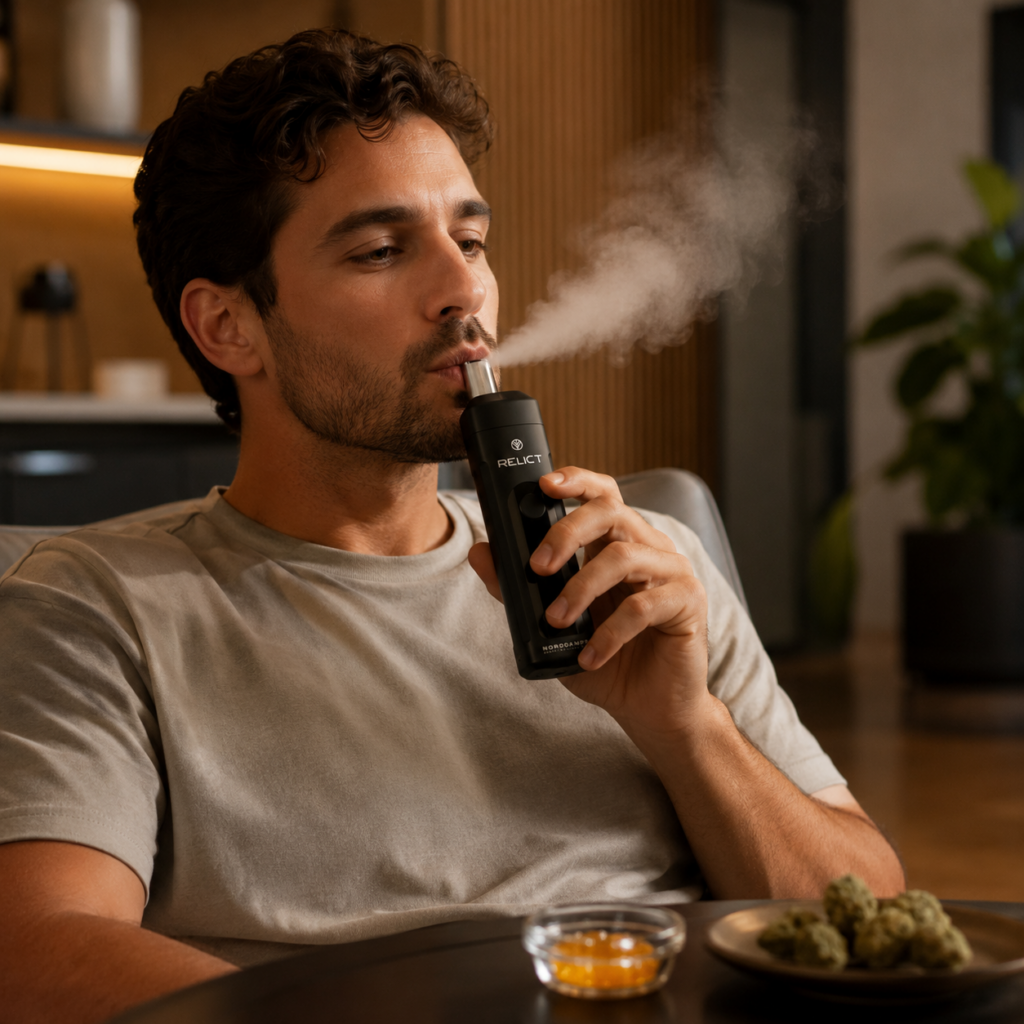
Vaporizing cannabis heats plant material below the point of combustion, and because there is no conventional burning, it produces significantly fewer of the typical combustion byproducts such as tar and carbon monoxide. The aerosol may still contain other substances, depending on the material, the temperature setting, and the device itself.
That makes a huge difference for your lungs (and, one hopes, for the state of your curtains), but what it doesn't affect is the metabolic fate of the THC itself.
Once you inhale THC, here's what happens:
- THC enters the bloodstream: THC passes from the lungs into the bloodstream within seconds, which is why the effects are felt almost immediately.
- THC is distributed and metabolized simultaneously: Once absorbed, THC is rapidly distributed throughout the body while also being progressively metabolized in the liver into several metabolites, including 11-hydroxy-THC and THC-COOH.
- THC and some of its metabolites remain in the body: Because they are fat-soluble, they can accumulate in adipose tissue with frequent use and remain detectable for extended periods, sometimes days or even weeks.
- Drug tests detect the metabolite: THC-COOH can remain detectable long after the high has worn off. Not every test looks for the same thing, though. Saliva tests usually target unchanged THC, while blood analyses may detect both THC and various metabolites depending on the purpose of the test.

Our Best Sellers
Discover the most popular Norddampf products

THC Detection Times by Test Type
Detection windows vary enormously by test type, and the ranges below are general estimates rather than laboratory guarantees.
| Test Type | Occasional Use | Regular Use | Chronic / Heavy Use |
| Urine | 3–7 days | 7–21 days | 30+ days |
| Blood | 1–2 days | 2–7 days | 7–30 days |
| Saliva | 24–72 hours | 1–3 days | up to 30 days |
| Hair | Up to 90 days | Up to 90 days | Up to 90 days |
These figures are rough estimates only. Actual detection depends heavily on the test type, the lab's cutoff level, frequency of use, dose, and individual biological factors. Reliable individual predictions are simply not possible, particularly for blood and saliva tests. Two people with identical use patterns can and do produce quite different results.
| ℹ️For a personalized estimate based on your own body composition and consumption habits, our THC detection calculator is more useful than any general table will ever be. |
What Actually Changes Your Detection Window
If the method of consumption is largely beside the point, the factors that really change the timeline are worth looking at individually:
| Factor | Effect on Detection Window |
| Frequency/duration of use | Largest variable; daily use builds reserves that take longer to clear |
| Body composition | Higher body fat equals longer window (THC-COOH is fat-soluble) |
| Metabolism/genetics | High individual variation, not fully predictable |
| Product potency | Higher THC content equals more metabolites and longer clearance |
| Hydration/exercise | Minor, unreliable effects; can even backfire (diluted urine flags, released stored THC) |
Frequency and Duration of Use
By far the largest variable. A single Saturday session might clear a urine test within a week. Daily use for months builds THC-COOH reserves in fatty tissue that can take a month or more to fully clear. The body doesn't discriminate between the vapor from a premium desktop unit and smoke from a hand-rolled joint. It just tallies up the total exposure.
Body composition
Body composition can influence detectability, and THC-COOH being fat-soluble means that a higher body fat percentage generally correlates with a longer detection window. Average body fat percentages differ between men and women, which is worth mentioning, but sex or body fat percentage alone will never provide a reliable prediction for any given individual. Any drug testing lab worth its salt already accounts for these variables in its interpretation.
Metabolism, Liver Function, Genetics
Individual variation is enormous. Two people of similar weight and consumption habits can test differently based on their metabolic rate, liver enzyme profiles, and genetic quirks that nobody has quite mapped completely. If you've ever wondered why your friend seems to sober up faster than you, this is roughly why.
Product potency
A higher-THC flower or a concentrate delivers more THC per session, which produces more THC-COOH, which takes correspondingly longer to clear. Modern flower at 25% THC is a rather different creature from the mystery bags of the 1990s.
Hydration and Exercise
Both can nudge things slightly. Neither is a magic wand. Chugging water before a test dilutes urine but also raises red flags at competent labs. Physical activity and shifts in fat metabolism may, in theory, affect measured values, but they don't offer any reliable way to predict or influence a test result. Detox products, meanwhile, are the snake oil of the wellness aisle. Time is the only honest solution.
Vaping vs Smoking vs Edibles: Does Method Matter for Detection?
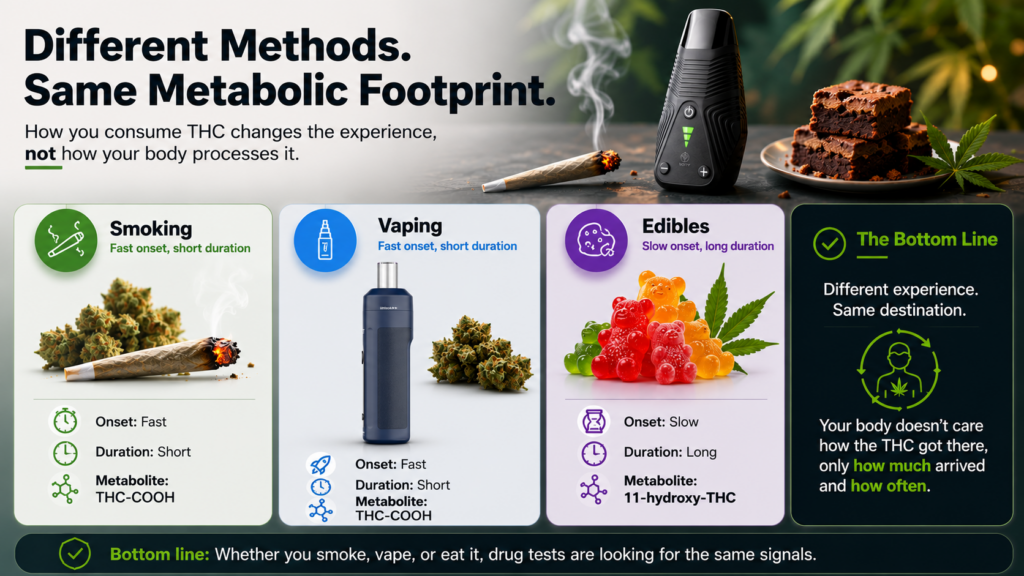
Ask anyone who's tried all three, and a joint, a vaporizer, and a plate of brownies feel like entirely different experiences. Different onset, different duration, different vibes altogether. Whether any of that translates to a different result on a drug test, though, is another matter.
What matters biologically is how much THC arrived and how often you have been sending it, not the route it took to get there.
- Smoking and vaping produce the same main THC metabolites, with fast onset and short duration, though the amount absorbed and the concentration curves over time can differ between the two methods.
- Edibles are the odd ones out, with a slower onset, considerably longer duration, and a different metabolite profile owing to the route they take through the body.
Oral consumption produces comparatively more 11-hydroxy-THC due to first-pass metabolism in the liver, and this metabolite is more potent and lingers considerably longer than the parent compound. It's why a plate of cookies can floor you for six hours while a vape session might barely make it past dinner.
How long a test remains positive, however, still depends mainly on dose, frequency, test type, and cutoff level.
| Method | Onset | Duration | Metabolite Profile |
| Smoking | Fast | Short | Standard THC-COOH |
| Vaping | Fast | Short | Identical to smoking |
| Edibles | Slow | Long | Higher 11-hydroxy-THC, longer-lingering |
Either way, what it doesn't do (rather inconveniently for the I only had a gummy defense) is extend how long you might show up as positive on a screening.
Bottom Line
Vaporizing cannabis has real advantages over combustion, chief among them the absence of the substances that make smoke unpleasant to inhale. What it doesn't do is give you a shorter appearance in the results of a workplace urine test. The metabolites care about how much you consumed and how often, not the elegance of your device.
If you are thinking about picking up a dry-herb vaporizer, detection times aren't really the reason to bother. The reason is that you get your cannabinoids without inhaling the byproducts of a small controlled fire, which most lungs tend to appreciate.
FAQs
Does Vaping THC Show Up on a Drug Test the Same Way as Smoking?
Yes. The metabolites are identical because the substance is identical. Vaping affects the onset speed and lung experience, not the chemistry that shows up in urine.
How Long Does Vaped THC Stay in Urine?
Anywhere from 3 days for a single-use scenario to over a month for chronic users. Frequency of use is the dominant variable.
Can Vaping THC Affect a Roadside Drug Test in Germany or the EU?
Yes. In Germany, saliva tests may be used as preliminary screening tools at the roadside, while the THC concentration in blood serum is what carries weight for the legal assessment. A saliva result doesn't provide a reliable indication of driving ability or of what a follow-up blood test will show. No vehicle should be driven after THC consumption.
Does Body Fat Percentage Change How Long THC Is Detectable for Women vs. Men?
On average, yes, modestly. THC-COOH is fat-soluble and stored in adipose tissue, so a higher body fat percentage tends to correlate with somewhat longer detection windows. Individual variation is significant.
Is THC From a Vaporizer Weaker, or Does It Clear Faster Than THC From Smoking Flower?
Neither. It's often more efficient in delivery, meaning less material for the same effect, but the metabolite it produces and the timeline for its clearance are identical.
How Accurate Is a THC Detection Calculator?
Calculators give a considered estimate based on the inputs you provide. Actual results vary by lab cutoff levels, individual biology, and the honesty with which the form is filled out. Useful as a starting point, not a legal guarantee.
Sources
How Long Is Marijuana in Your System? — American Addiction Centers.
Factors That Influence THC Detection — Medical News Today.
Human Cannabinoid Pharmacokinetics — Chemistry & Biodiversity, NCBI/PMC.
Cannabinoid Metabolism and Distribution — PubMed, Cannabis and Cannabinoid Research.
Disclaimer: This article is for general informational purposes only and does not constitute medical, forensic, or legal advice. Detection times vary considerably from person to person and cannot be reliably predicted for any individual. Always consult a qualified healthcare professional before using cannabis products for health-related purposes.