
Most of the flavor in a joint is either developed or lost in the first few days after harvest—long before the curing process even begins. The process is a somewhat tedious phase: hanging the plants in a dark room—not much else happens besides simply letting them hang there. When dried properly, however, sharp, grassy cannabis transforms into mild, aromatic weed.
Patience, as is so often the case with these things, is a virtue. Anything that isn't properly dried can result in the grassy variety that causes coughing and wheezing.
While this brief guide isn't exhaustive, it covers the basics of drying cannabis: the necessary conditions, the different methods, and how to tell when it's ready. We'll also explain why this is so important for your cannabis vaporizer.
Key Points
- During the drying process, most of the water is removed from a fresh bud, but the speed is just as important as the end result.
- The ideal conditions are a temperature of about 15–21 °C and a relative humidity of 45–55%, in a dark environment with gentle, indirect air circulation.
- If dried too quickly or in too warm an environment, the terpenes evaporate; if dried too slowly in stale, humid air, mold sets in.
- The stem-break test indicates that the drying process is complete when small stems break cleanly instead of bending.
- Well-dried buds vaporize much more evenly than brittle, overdried ones—and they taste better, too.
Why Drying Cannabis Is More Important Than Many Growers Realize
A fresh bud consists mostly of water (often three-quarters of its weight), which is why drying cannabis is essentially nothing more than a very slow evaporation of this moisture. The key word here is “slow.” If you rush the process, you’ll ruin the result.
If you dry too slowly, in stagnant, humid air, the opposite problem arises. Surface moisture lingers, mold takes advantage of the situation, and the harvest is either compromised or completely lost. Mold is by far the most common reason home growers lose their harvest during this phase.
The sweet spot is a slow, steady, controlled loss of moisture. If you get this right, everything that follows—including the cannabis curing process —has a real chance of success. If it goes wrong, there’s definitely no way to fix it later.

Our Best Sellers
Discover the most popular Norddampf products
Ideal drying conditions
| factor | Target Range | Why It's Important |
| Temperature | 15–21 °C | Higher settings speed up drying but remove terpenes |
| Humidity | 50–60% relative humidity | Too low = sharp, brittle bud; too high = risk of mold |
| Light | Dark | UV light breaks down terpenes just as quickly as heat |
| Air Circulation | Soft, indirect | Direct air circulation dries the hair unevenly and too quickly |
The generally recommended target range is 15–21 °C and 50–60% relative humidity, in a dark environment with gentle, indirect air circulation. The goal is to stay within a reasonable range rather than hitting an exact single value.
Darkness is far more important than most first-time growers realize. UV light breaks down terpenes just as effectively as heat, which is why hanging buds under a bright kitchen light is counterproductive.
A simple hygrometer doesn't cost a fortune and is not only essential for success but also extremely useful.
Drying Methods: Choosing the Right Method for Your Space
There are two main approaches, both of which are perfectly suitable, depending on the setup.
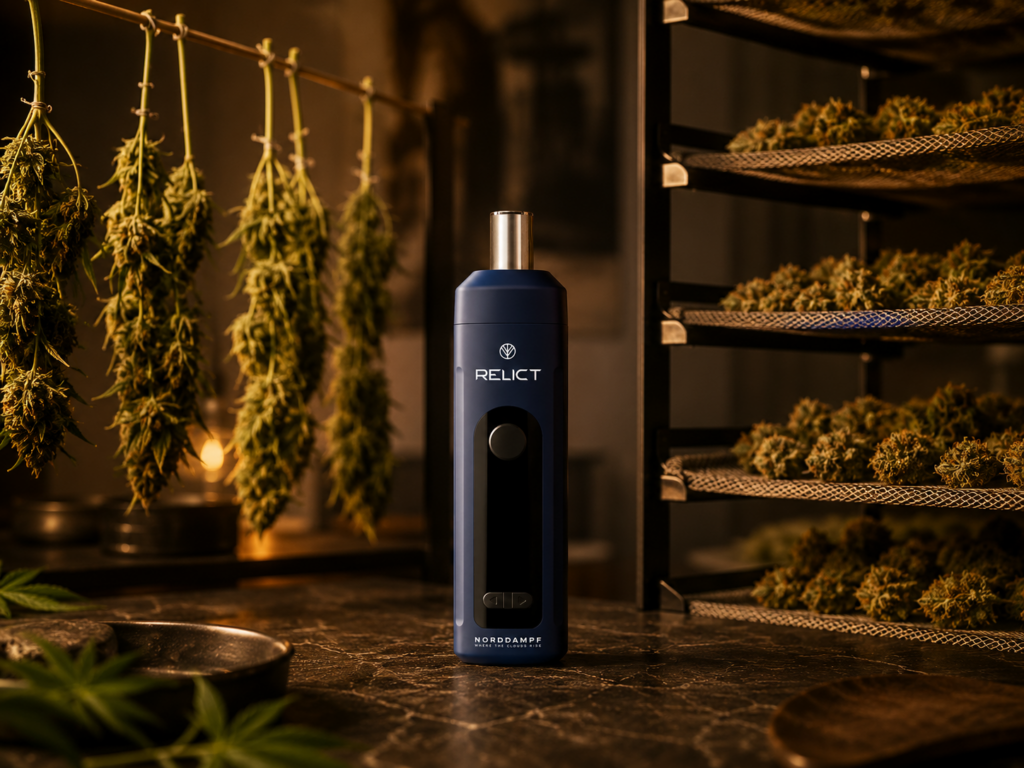
Hang-dry (the standard method)
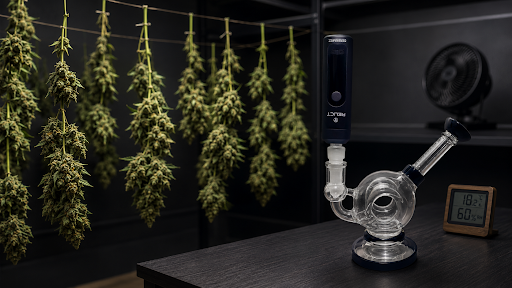
Cut off the branches, remove the largest fan-shaped leaves, and hang the branches upside down in a dark, well-ventilated room. The buds should not touch each other. This works well at average humidity levels.
Rack or air drying
Separate the buds from the stems and lay them out on a mesh rack. This saves space, dries them faster, and is practical for smaller apartments. Flat spots may form where the buds touch the mesh, so turn them occasionally.
Adapting to Your Local Climate
- Dry climate: Leave more leaves on the plant or hang up entire branches to slow moisture loss.
- Average humidity: Standard hanging drying with the fan blades removed works well.
- Humid climate: prune thoroughly, ensure gentle, active air circulation, and check the buds daily for mold.
How can you tell when the buds are ready?
The classic test is the stem-bending test. Take a smaller stem and bend it; if it breaks cleanly with a distinct snap, it’s done drying. If it bends without breaking, it needs more time.
The buds themselves should feel dry on the outside, but not brittle throughout. Residual moisture on the inside is normal—that’s what the curing process takes care of.
The most common mistake at this stage is to judge doneness based solely on the outside. If you overcook it until everything is evenly crispy, you’ll destroy the remaining terpenes.
From Drying to Curing: What Happens Next
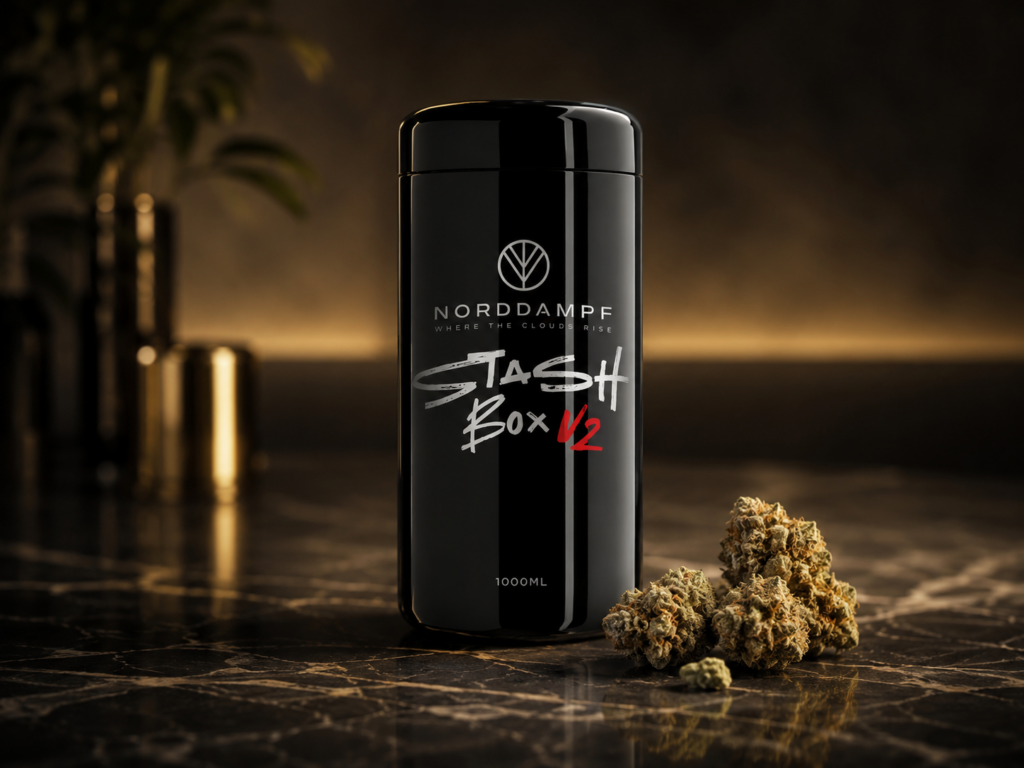
Once the buds pass the snap test, the curing process can begin.
During curing, the remaining internal moisture distributes evenly throughout the bud, chlorophyll continues to break down, and the flavor matures. In this phase, the bud transforms from “sufficiently dried” to “truly enjoyable.” Moving directly from drying to consumption isn’t dangerous, but the taste is noticeably harsher. Take those extra two weeks. Our complete curing guide (linked above) covers burping schedules and storage in detail.
How Proper Drying Affects Your Vaporizer Experience
🔴 Overly dry, brittle material is more likely to burn than to vaporize cleanly at lower temperatures, resulting in a harsher, less aromatic vapor. You’ll probably turn up the device’s setting to compensate. That’s not a particularly good idea, though.
🟡 Material that hasn't been dried properly and is still damp presents the opposite problem. It evaporates unevenly, produces visible "steam"—which is actually just water vapor—and clogs screens more quickly.
🟢 Well-dried, well-cured material vaporizes evenly across a wide temperature range and retains more of its terpene profile. Precise vaporizer temperatures make it possible to target specific cannabinoids—but this only works if the material itself is right.
If the buds feel slightly firmer than you'd expect for smoking, they can often still be vaporized just fine. Very brittle, crumbly buds are definitely a sign of over-drying.
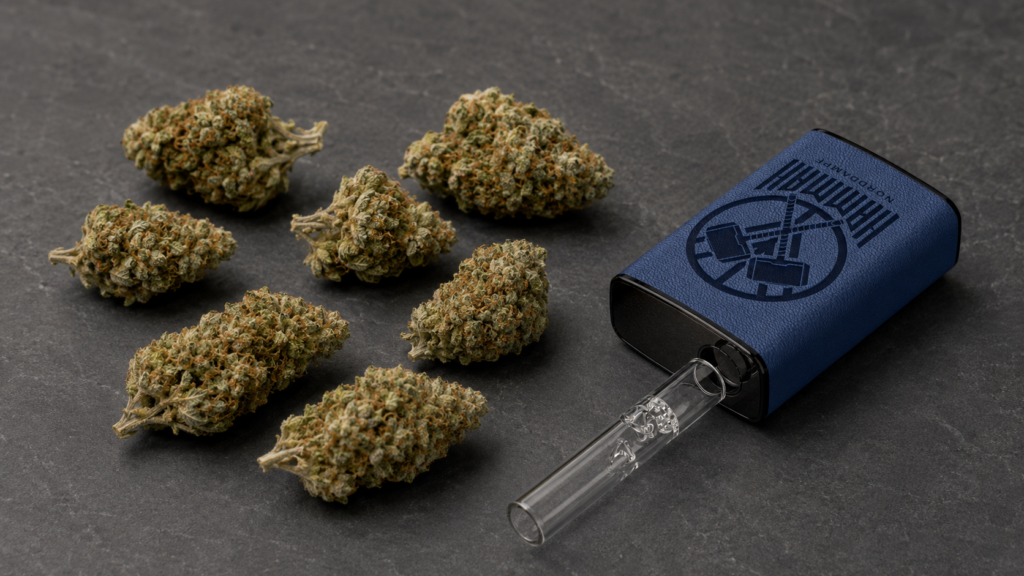
Common drying mistakes you should avoid
Here are five things that almost every first-time grower does at some point when drying cannabis—try to avoid them if you can.
- Use heat to speed up the process. Oven, hair dryer, microwave, and direct sunlight. Remember: All of these destroy terpenes.
- Drying them in the kitchen, “because it’s convenient.” It ’s warm, bright, and there’s a lot of foot traffic. All of these things are bad.
- Do not point a fan directly at the buds. Instead, aim it at a wall or ceiling for gentle, indirect air circulation.
- Once dry, proceed directly to consumption. Curing turns “dried” into “premium.” Just two more weeks.
- When drying buds, pack them so tightly that they touch each other. This creates pockets of uneven moisture and promotes mold growth.
Conclusion
Drying isn't complicated. It's a slow, dark, cool, and patient process—that's the whole trick. No one wants to hear that after twelve weeks of tending to a crop, but the growers who consistently achieve outstanding results are exactly the ones who resist the urge to rush through the final week.
Once your flower is properly dried and trimmed, the device you use to vaporize it determines how much of that effort actually pays off for you. The entire line of Norddampf vaporizers is designed for the exact temperature precision needed to get the most out of well-trimmed material.
Frequently asked questions
How long does it take to dry cannabis properly?
Usually seven to fourteen days, depending on humidity, temperature, and bud density. Slower is generally better; if it’s done after three days, it’s drying too quickly.
What humidity and temperature levels are best for drying cannabis?
Aim for a temperature of about 15–21 °C and a relative humidity of 45–55%, in a dark place with gentle air circulation. The figures vary depending on the source, so treat them as a range rather than an exact target value.
Can I speed up the drying process with a fan or a heater?
Just one fan, pointed away from the buds, for indirect air circulation. Heaters, hair dryers, and ovens drive out terpenes and leave a harsh taste. Avoid them.
How can I tell when cannabis is completely dry?
Bend a small stem. If it breaks cleanly, it's ready; if it bends with resistance, it needs more time. A little residual moisture inside is normal and will be balanced out during curing.
Is properly dried cannabis better when vaporized than when smoked?
Proper drying helps with both, but especially with vaporization. Even non-brittle material vaporizes cleanly over a wider temperature range and retains more of its flavor.
Is it safe to vaporize cannabis that hasn't been fully cured yet?
Yes, it's absolutely safe, although it's stronger and less aromatic. Curing is a quality-control step, not a safety measure—provided the buds have been dried properly and show no signs of mold.
Sources
- In Pursuit of Optimal Quality: Cultivar-Specific Drying Approaches for Medicinal Cannabis, Plants (MDPI), 2024 — https://www.ncbi.nlm.nih.gov/pmc/articles/PMC11013261/
- "The Preservation and Augmentation of Volatile Terpenes in Cannabis Inflorescences," Journal of Cannabis Research, 2020 — https://doi.org/10.1186/s42238-020-00035-z
- "Vapor-Phase Terpenes Mitigate Oxidative Degradation of Cannabinoid Content in Cannabis sativa Inflorescences," *Cannabis and Cannabinoid Research*, 2023 — https://doi.org/10.1089/can.2021.0207
- Novel Solventless Extraction Technique to Preserve Cannabinoid and Terpenoid Profiles of Fresh Cannabis Inflorescences, *Molecules* (MDPI), 2021 — https://www.mdpi.com/1420-3049/26/18/5496
- Fungal and Mycotoxin Contaminants in Cannabis and Hemp Flowers: Implications for Consumer Health, Frontiers in Microbiology, 2023 — https://www.frontiersin.org/journals/microbiology/articles/10.3389/fmicb.2023.1278189/full
This article is for informational purposes only and does not constitute medical advice. Always consult a qualified healthcare professional before using cannabis products for health-related purposes.