
Reading time: approx. 8 min
Table of Contents:
- Key Findings
- Introduction
- Basics: Male, female, and hermaphroditic plants
- How to Identify Cannabis Hermaphrodites
- Causes of hermaphroditism
- When do intersex traits appear?
- Prevention
- Measures for Hermaphrodites
- Impact on yield and quality
- Conclusion
- Frequently Asked Questions
Key Findings (Brief Overview)
- Cannabis hermaphrodites have both male pollen sacs and female flowers on the same plant
- Growers should maintain stable environmental conditions and use high-quality seeds to minimize genetic instability and the formation of hermaphroditic plants, thereby ensuring crop quality.
- Special care is needed during the flowering period: During this phase, hermaphroditic plants are particularly easy to identify by their banana-shaped or spherical structures.
- Early detection of hermaphroditic plants can mean the difference between a high-quality harvest and one that is severely compromised.
- To protect the crop, hermaphroditic plants should be removed or isolated immediately to prevent them from pollinating other plants.
- Early detection during the pre-flowering stage (approximately 3–5 weeks after germination) can reduce yield losses by up to 90%
- The main causes are stress (light leaks, temperatures above 28°C, pH fluctuations) and unstable genetics
- If you suspect an infestation: Check plants daily, remove severely affected plants immediately, and inspect the grow room for sources of stress
- A single hermaphrodite can pollinate all the female plants in the room and ruin the entire crop
Introduction: Why Cannabis Hybrids Are a Problem
Hermaphroditism in cannabis is every grower’s nightmare. You invest weeks into your plants—and suddenly you discover male pollen sacs among your female flowers.
A cannabis hermaphrodite is a cannabis plant that develops both male and female reproductive organs. Such hermaphrodites bear both male and female flowers, thereby promoting seed production. This phenomenon arises as an evolutionary survival strategy: under extreme stress, the plant ensures its reproduction through self-pollination.
The problem for you: hermaphrodite plants produce seeds instead of potent buds. The plant directs its resources toward seed production, which significantly compromises the quality of the harvest and the consumer experience. The result is a harvest with significantly fewer cannabinoids, reduced aroma, and lower quality. In this article, you’ll learn everything you need to know about identifying hermaphrodites, the most common causes, and practical tips for preventing them.
Note: This article is intended solely to provide educational information about the biology of cannabis plants.

Our Best Sellers
Discover the most popular Norddampf products

Basics: Male, female, and hermaphroditic cannabis plants
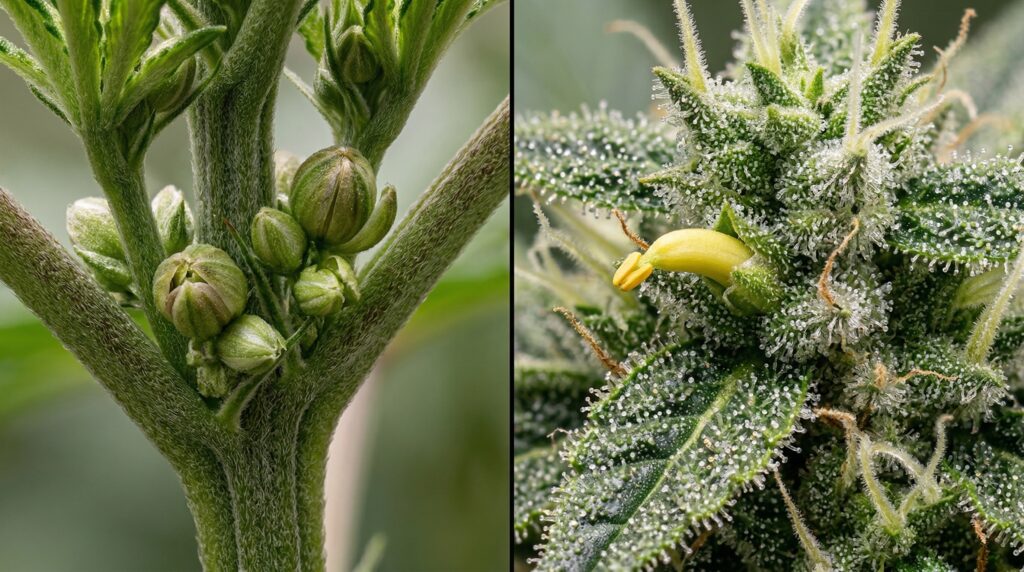
Cannabis is typically dioecious—male and female reproductive organs are found on separate plants. To harvest high-quality flowers, you need only female plants. Hermaphroditic cannabis plants can develop in response to unfavorable growing conditions, which serves as a survival mechanism. Optimal growing conditions for cannabis plants are crucial to prevent the formation of hermaphroditic plants.
Male plants:
- Starting in weeks 4–6, symmetrical, spherical pollen sacs form in clusters
- Typically 5–20 bags per Nodius (hub)
- Yellowish-green, without white hairs
- Do they develop small, round balls or sacs without hairs?
- Pollen spreads over a distance of 10–30 meters
Female plants:
- Small, pearl-like calyxes appear at the nodes
- Form small, cup-shaped pre-flowers with two fine, white to light green hairs
- White, pistil-like stigmas (tiny hairs) protrude
- These structures are sticky and trap pollen
- Ideal for seedless sinsemilla harvests
Hermaphrodites:
- Combines both: male and female characteristics on the same plant
- Could they be true hermaphrodites (with both sexual characteristics on different nodes)?
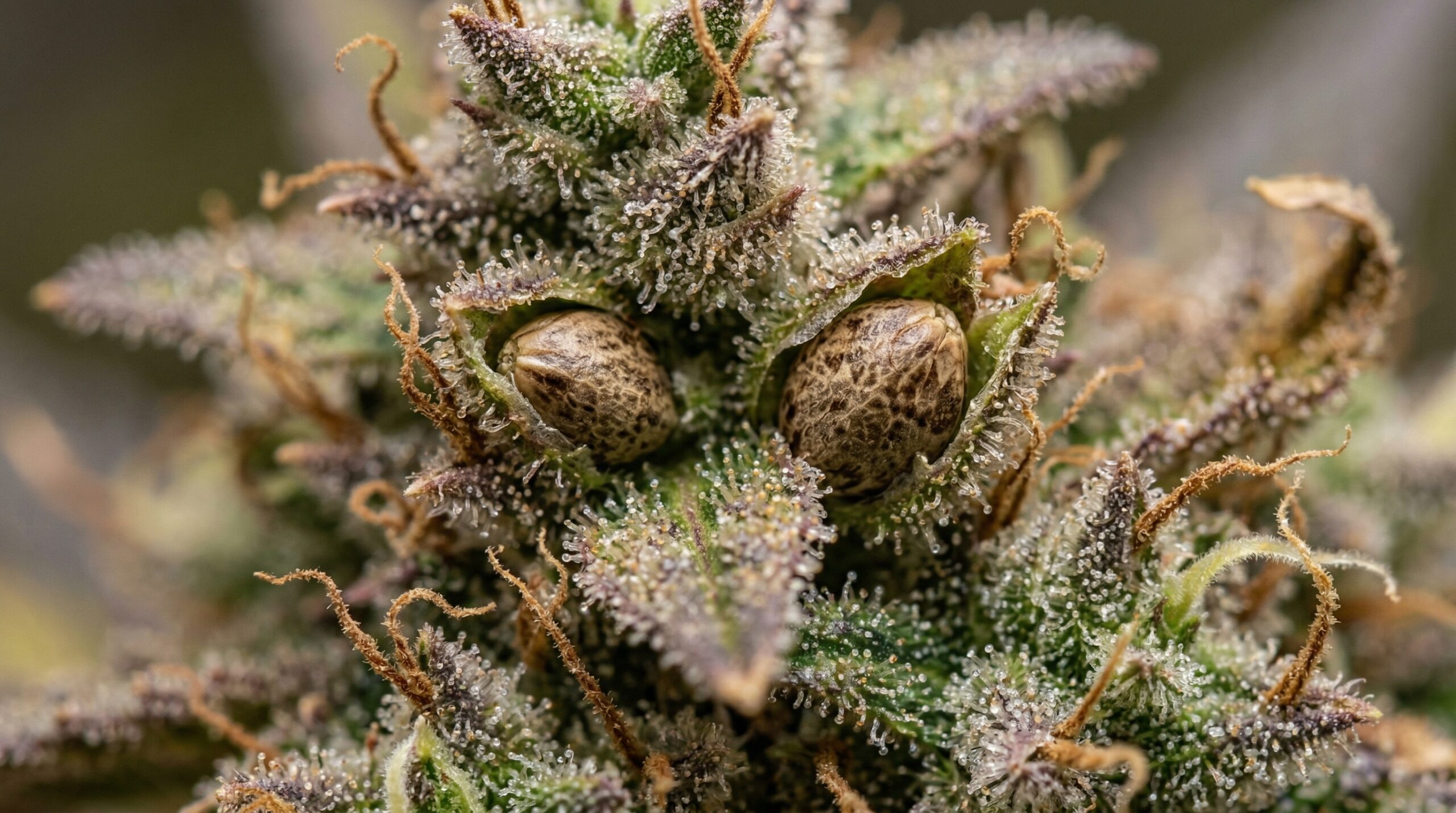
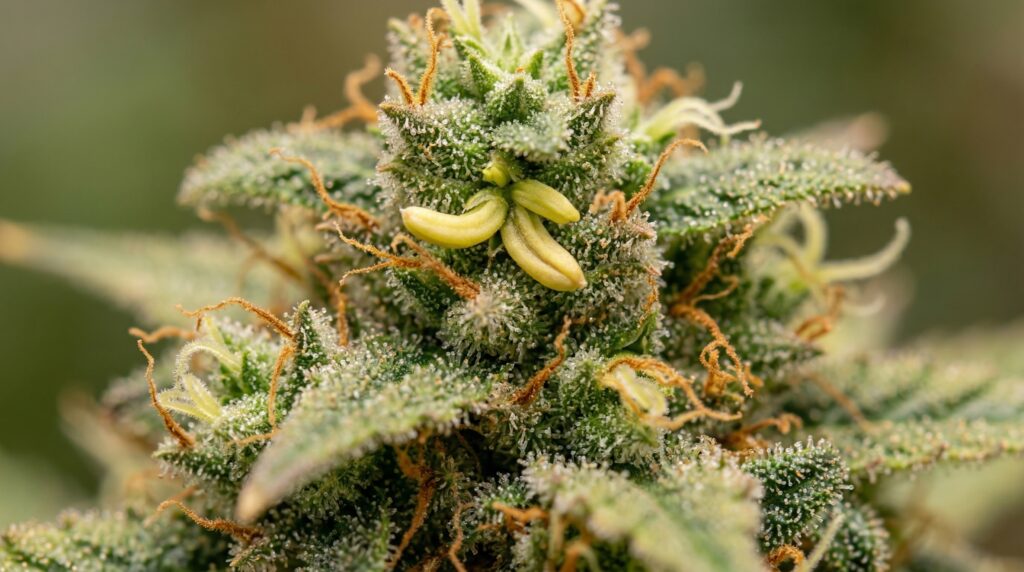
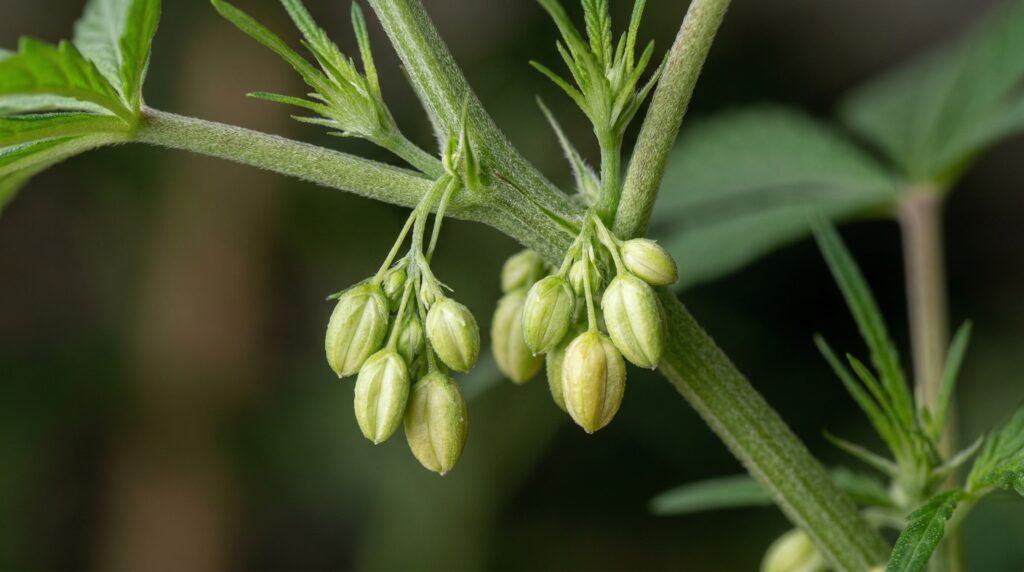
- Or display “bananas”—elongated structures within otherwise female flowers
- The so-called "bananas" are male anthers that grow directly from inside the female flower and can release pollen immediately.
- They differ from pure males in that they have female stigmas
Identifying Cannabis Hermaphrodites: Early and Late Signs
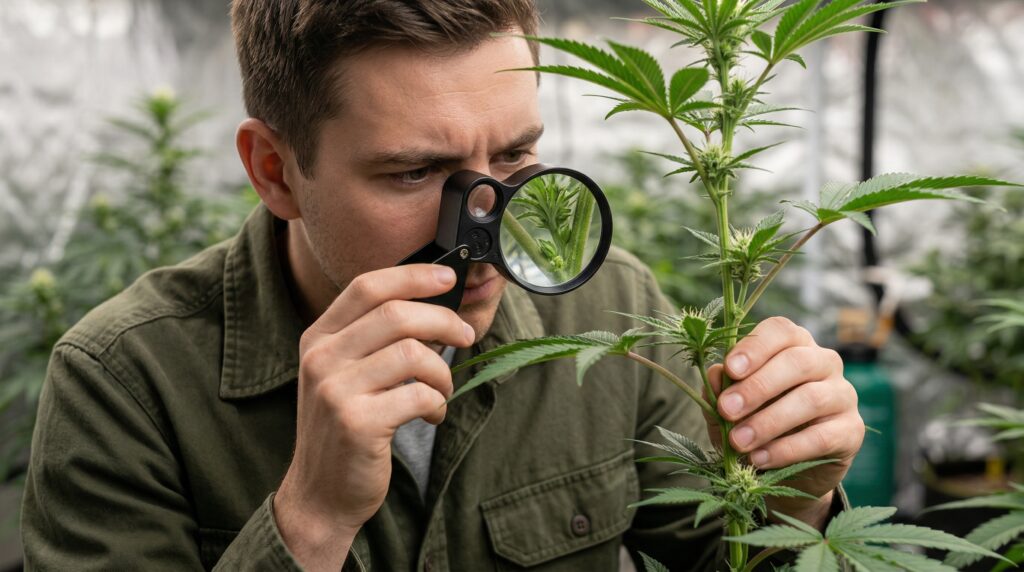
Early detection of hermaphrodites determines the success or failure of your harvest. It is especially important to closely monitor the plants during the flowering stage, as typical hermaphrodite characteristics—such as banana-shaped or spherical structures—become visible during this phase. The flowering stage is therefore crucial for identifying cannabis hermaphrodites and taking timely action.
Here are the characteristics by development phase:
Early detection of hermaphroditic plants during the flowering stage is particularly important for ensuring the quality of the harvest.
Early signs during the pre-flowering stage (weeks 3–5)
The following appear simultaneously at the nodes:
- Small calyxes with white hairs (female)
- Tiny round beads without hairs (male, 1–2 mm in diameter)
A magnifying glass with 20–60x magnification is essential for determining the sex of cannabis plants. Without magnification, it’s easy to miss the early signs.
“Bananas” (Nanners) – the warning signal
Bananas are the most common sign of hermaphroditism:
- Elongated, yellowish-green structures (3–10 mm)
- protrude from what are actually female flowers
- Can release pollen even before they burst
- They look like little bananas—hence the name
Late signs during flowering (weeks 5–7)
- Individual pollen sacs hidden among dense buds
- Often visible only upon closer inspection
- Often on lower nodes and in the spaces between flowers
Important: Open pollen sacs (identifiable by yellow pollen dust) have already begun pollination. One or two burst sacs can completely pollinate a 3x3m grow box.
Check your plants daily, especially during the first 2–3 weeks after switching to a 12/12 light cycle.
Causes: Why Does Cannabis Become Hermaphroditic?
Hermaphroditism is primarily a stress response—the plant switches to “emergency mode” for reproduction. Growers have a special responsibility to create stable environmental conditions and use high-quality seeds to minimize the risk of hermaphroditic plants. These factors can be divided into genetic and environmental causes.
In stressful environments, up to 30% of plants may produce hermaphroditic flowers, underscoring the importance of optimal conditions and careful seed selection.
Genetic causes (40–60% of cases)
| Seed type | Risk of hermaphroditism |
|---|---|
| Premium feminized seeds | < 5% |
| Unstable lines/bagseeds | 20–30% |
| Seeds from hermaphroditic plants | up to 40% |
Light stress
- Light leaks during the dark phase (standby lights, door gaps)
- Just 4–8 hours of light exposure can trigger hermaphroditism
- Timer errors and irregular cycles
Temperature and Climate Stress
- Temperature fluctuations of more than 10°C increase the risk threefold
- Temperatures consistently above 28–30°C or below 16°C
- Extreme humidity during the flowering phase
Other stress factors
- Mechanical stress: severe bending, breaking, and excessive defoliation during flowering
- Nutrients: Over-fertilization (EC > 2.0), pH levels outside the range of 5.8–6.5 (hydroponics) or 6.0–6.8 (soil)
- Pests: Spider mites reduce photosynthesis by 30%
- Outdoor factors: storms, hail, light pollution from streetlights
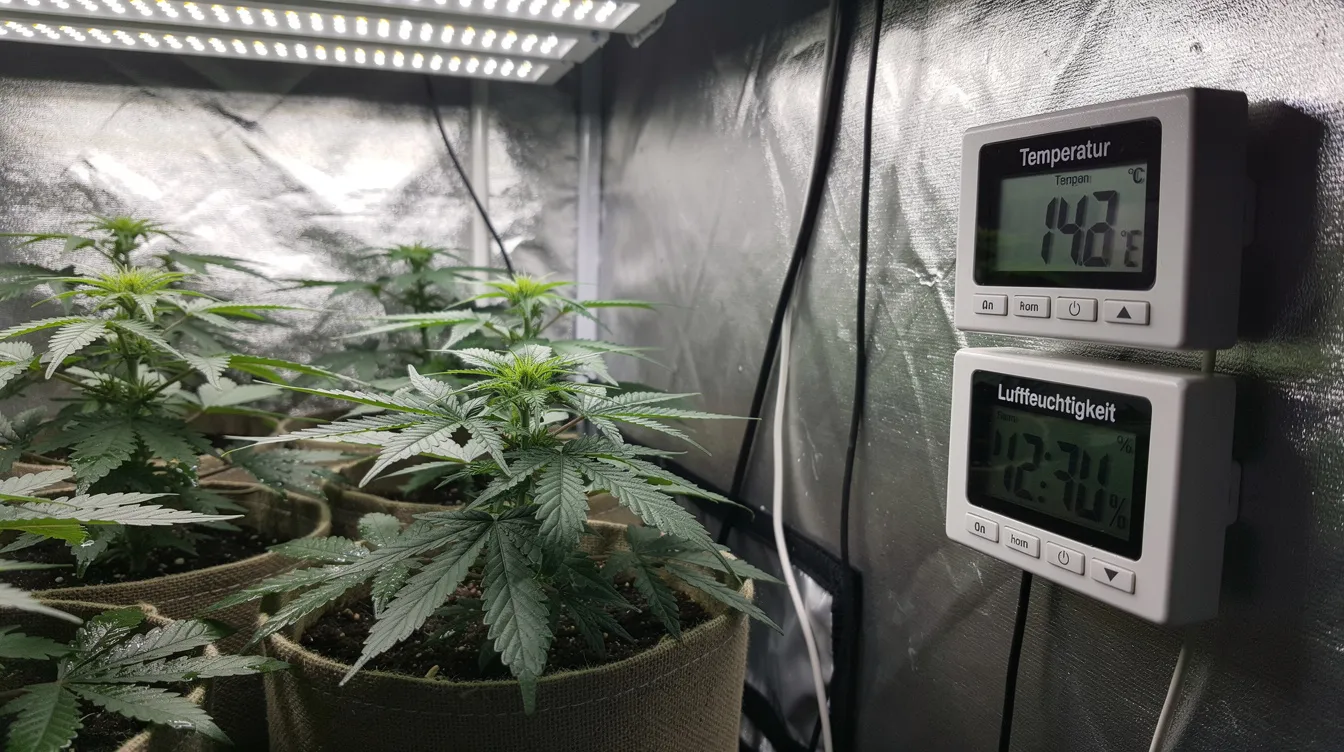
When do intersex traits usually appear?
Hermaphroditism typically manifests itself during certain sensitive phases:
| Phase | Period | Frequency | Common triggers |
|---|---|---|---|
| Pre-flowering | Weeks 3–6 after germination | 20–30% | True genetic hermaphrodites |
| Start of bloom | Weeks 1–3 after 12/12 | 50% | Light leaks, light stress |
| Mid-bloom | Weeks 4–6 | 25% | Heat, mechanical training |
| Late bloom | Week 7+ | 5% | Overripe, overharvested |
After stressful events such as power outages, signs often become visible within 48 hours. Bananas typically appear 7–14 days before they burst.
Avoiding Cannabis Hybrids: Practical Prevention Tips
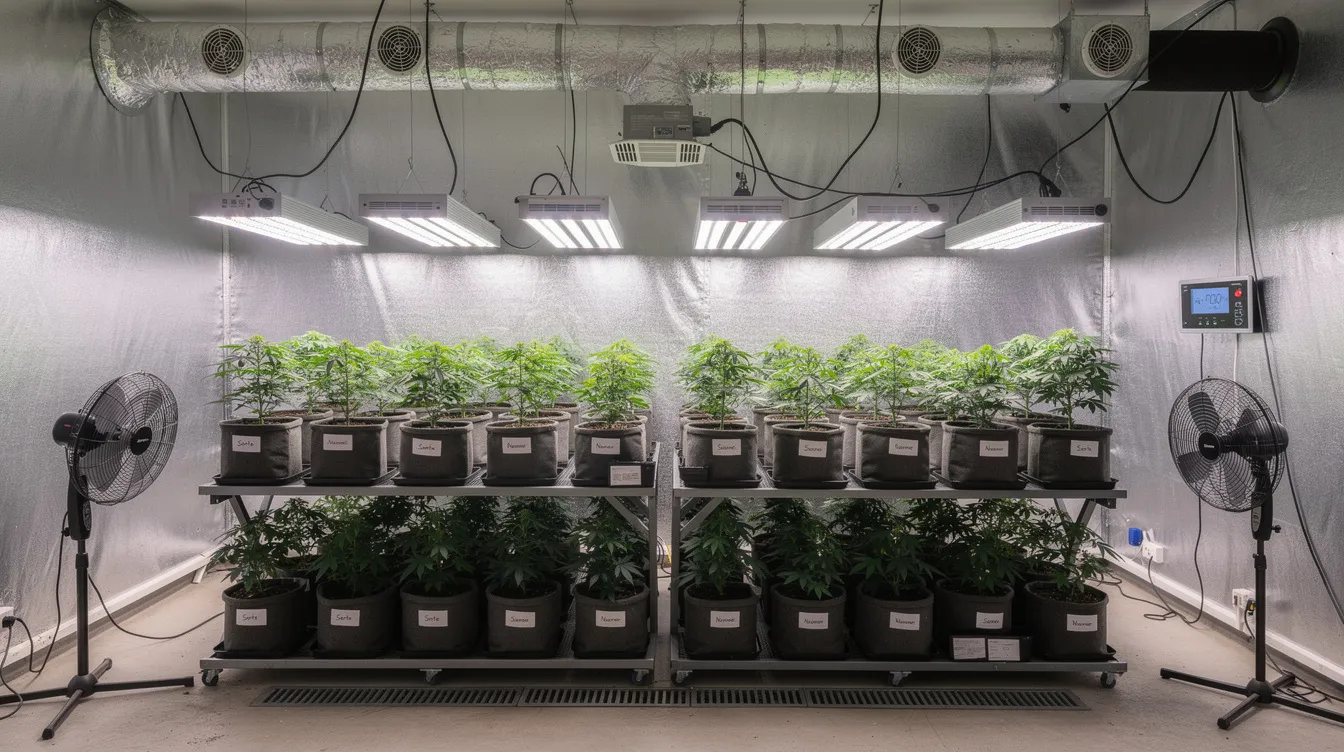
This checklist and these tried-and-true tips will minimize the risk of hermaphroditic cannabis plants in your grow:
Here's how to prevent hermaphroditism, step by step
- Choose reliable genetics – Buy feminized seeds from reputable breeders with a documented low hermaphrodite rate
- Test for light leaks – Turn off all the lights in the evening and check the grow room for light leaks
- Seal any leaks —use blackout tape for tents, door gaps, and standby LEDs
- Stick to the 12/12 cycle consistently – no “turning on the light to check” during the dark phase
- Control temperature and humidity – target range: 20–26°C, 40–50% RH during flowering
- Take care of stressful procedures during the growth phase —repotting, LST/HST, and heavy pruning—before flowering
- Monitor pH and nutrients – follow the manufacturer’s instructions, check the drain, and keep the pH stable
- Check daily – Inspect flower clusters and nodes with a magnifying glass at least every 1–2 days
Key strategies for minimizing risk
- Nutze qualitative Timer mit < 1% Abweichung
- Install recirculating fans (reduce hot spots by 5°C)
- Never use pollen from hermaphrodite plants for breeding
- Document every grow for continuous improvement
What should you do if a plant becomes hermaphroditic?
Have you found a hermaphrodite plant? Now is the time to act fast. Here are your options:
Pronounced hermaphrodites (> 5 sacs per node)
- Remove the plant immediately and carefully
- Seal in a plastic bag to prevent pollen from spreading
- Remove from the grow area and dispose of outside
- Cleaning the grow room: Wipe down surfaces with a damp cloth
Mild cases (isolated instances)
- Stop air circulation for 24 hours
- Carefully remove the bananas with sterile tweezers
- Don't squeeze the pollen sacs—that releases pollen
- Mark the plant and check it daily
After removal
- Check the HEPA filter and clean it if necessary
- Wipe all surfaces down with a damp cloth
- Document the stress event (e.g., “Light leak on March 15, 2026”)
- Use this information for the next round
A hermaphroditic crop is generally usable, but it contains more seeds and often fewer terpenes and THC. The quality of the crop rarely meets premium standards.
Effects of hermaphrodites on yield and quality
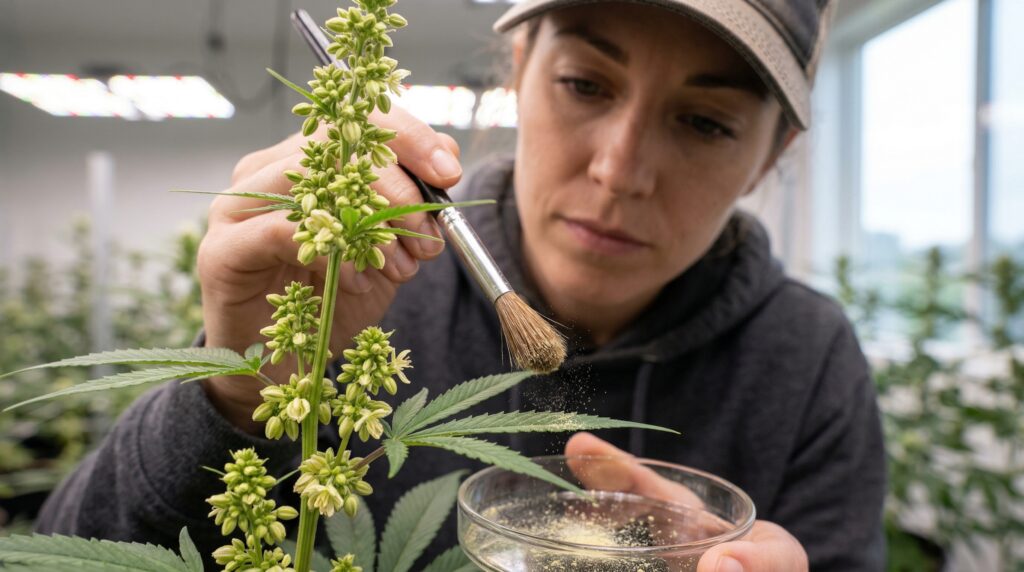
Why are growers so sensitive to hermaphrodite plants? The numbers speak for themselves:
Loss of revenue:
- Up to 50% weight loss due to seed production
- Looser, lighter buds
- Less resin production
Decline in quality:
- THC content drops from 20% to 12–15%
- Altered terpene profile, less aroma
- An unpleasant crackling sound when smoking due to seeds
Risk to the entire area:
- A hermaphrodite pollinates 100% of the surrounding female plants
- Pollen is invisible and can travel several meters
- The entire section may be affected
Crop rotations:
- Sperm from hermaphrodites have a 40% higher risk of hermaphroditism
- Genetic instability is passed down over 2–3 generations
Research findings on cannabis hybrids
Cannabis hybrid plants.
Scientific breakthroughs.
Research is making progress.
Significant progress.
More studies. More precise findings. Clearer connections.
Why do hermaphrodites occur? How do they affect crop production?
Science provides the answers.
Focus: Causes of hermaphroditism.
Focus: Harvest quality.
Focus: Yield.
Genetics plays a decisive role.
The environment also plays a role.
Both factors work together.
Unstable seeds increase the risk.
Significantly.
Seeds from hermaphroditic plants?
The likelihood of hermaphroditism increases.
Significantly.
Stress factors exacerbate the problem.
Temperature fluctuations. Irregular light cycles. Nutrient deficiencies.
The flowering stage is particularly sensitive.
Unfavorable conditions lead to hermaphroditism.
This has been scientifically proven.
Identification. Prevention. Control.
Research develops methods.
Effective methods.
Modern approaches emphasize precision.
High-quality seeds. Controlled environmental conditions. Regular inspections.
Early detection is key.
Scientific recommendation:
Feminized seeds from trusted breeders.
Stress monitoring throughout the entire growing process.
Hermaphroditism is minimized.
Proven impact on crop quality.
Self-pollination by hermaphrodites results in more seeds.
More seeds mean lower potency.
Fewer cannabinoids. Fewer terpenes.
Lower yield.
The flowers lose quality.
They lose their aroma.
The entire harvest is affected.
Early detection is crucial.
Consistent prevention safeguards the crop.
The health and productivity of the cannabis plants are maintained.
Research confirms this.
The latest findings. Clear recommendations.
Use stable genetics.
Optimize environmental conditions.
Carefully identify hermaphroditic plants.
The risk is decreasing.
Significantly.
Crop quality is improving.
Sustainable.
Continuous improvement of cultivation methods.
Application of scientific findings.
This is the key to high-quality cannabis harvests.
Successful harvests.
Scientifically proven.
Conclusion: How to Spot and Avoid Cannabis Hybrids – Key Points
Cannabis hermaphrodites are a real challenge in cannabis cultivation—but with the right knowledge, they can be managed.
The key points:
- Checking early and regularly with a magnifying glass is your best defense
- Robust genetics combined with low-stress environmental conditions drastically reduce the risk
- If you suspect something: make quick decisions; don't hesitate
- Document every grow—you learn the most from your mistakes
While hermaphrodite plants can be harvested, they almost never match the quality of seedless premium flowers. Invest in good genetics, maintain consistent environmental conditions, and check on them daily.
Your next grow will be better. Guaranteed.
FAQ on Cannabis Hybrids
Can you use seeds from a hermaphrodite plant?
Technically, yes, but it’s not recommended. Seeds from hermaphroditic plants carry an increased risk of producing hermaphrodites again—studies show a probability of up to 40%. For consistent results, it’s better to use professionally bred, feminized, or regular seeds. Investing in premium genetics will save you trouble and crop failures in the long run.
Is a single "banana" on the plant always cause for panic?
Don't necessarily panic, but you should take it seriously. Individual bananas can appear during the later weeks of flowering (week 7+) and don't automatically mean the crop is completely ruined. Carefully remove the affected area with tweezers, minimize air movement, and check the plant daily from then on. A single instance is manageable—but multiple bananas in different places indicate a bigger problem.
Are there any varieties that are more prone to hermaphroditism?
Yes, certain strains are more sensitive. Highly stretched Sativa-dominant hybrids and genetically unstable strains from unselected breeding show greater susceptibility. Modern autoflowers often have lower rates (2–5%) due to their Ruderalis genetics. Before buying, read reviews and, as a beginner, choose robust strains known to be “stable.”
How can I tell the difference between a true hermaphrodite and a purely male plant?
Pure male plants produce only pollen sacs—symmetrical, in clusters at the nodes, and completely lacking white stigmas. True hermaphrodites also exhibit female characteristics: calyxes with white hairs on the same plant, sometimes even on the same node. If you see both male pollen sacs and female structures, you definitely have a hermaphroditic plant.
Can environmental improvements "cure" a plant that is already hermaphroditic?
No, pollen sacs or bananas that have already formed will not disappear simply because environmental conditions improve. These structures remain. However, an optimized environment (stable temperature, proper light cycles, balanced nutrients) can prevent further hermaphroditic traits from developing. The plant remains a risk to your other plants, however, and should be closely monitored.