
CBN, CBD, and THC all come out of the same plant, share a chemical family tree, and get talked about in the same breath constantly, but they behave in different ways once they are in your body, and many people confuse the terms.
In short, THC is the strongly psychoactive one, the compound responsible for actually getting you high, while CBD is non-intoxicating and works through broad, indirect routes rather than directly switching anything on.
CBN differs from both CBD and THC. It interacts with cannabinoid receptors but produces much weaker intoxicating effects than THC, and in practice, it is associated with physical relaxation rather than a head change.
This short article explains how all three work and what makes them different.
⚠️This article is for informational purposes only and does not constitute medical advice. Always consult a qualified healthcare professional before using cannabis products for health-related purposes.
Key Findings
- THC binds tightly to CB1 receptors and produces the classic cannabis high. It is the only one of the three that reliably does this on its own.
- CBD is non-intoxicating and does not bind directly to CB1 or CB2 receptors in the usual way. It works through broader, indirect pathways instead.
- CBN binds weakly to CB1 and has greater affinity for CB2, which is why its effects are far milder than THC's. It is capable of mild psychoactivity at higher doses, but nothing close to a THC high.
- CBN forms as THC ages and oxidizes, whereas CBD is synthesized directly by the plant.
- All three trace back to CBGA, the so-called parent cannabinoid, which is why they are chemically related despite behaving so differently.
The Core Difference Is Psychoactivity
The cleanest way to run a CBN vs CBD comparison, with THC in the frame too, is to ask which one gets you high. The only problem is that the honest answer is not a simple yes or no. THC is the only one that reliably produces a strong high on its own, thanks to its firm binding to CB1 receptors. CBD does not produce a high at any dose. It is non-intoxicating, full stop.
CBN, however, doesn't fit neatly into either category. At typical doses, it is generally described as non-intoxicating or only mildly so, but because it is chemically close to THC, it keeps some capacity for mild psychoactive effects when the dose climbs. Calling CBN 'non-psychoactive' like CBD is tidier, but it is not quite accurate.
| ℹ️Want to know how long THC remains in the system? Our THC breakdown calculator estimates how long it stays detectable, based on how much you use and how often. |

Our Best Sellers
Discover the most popular Norddampf products
CNB vs CBD and THC: Where They Come From
Every cannabinoid starts in the same place. CBGA is the parent compound, and what it becomes depends on which enzyme reaches it first. THC and CBD come out of that process directly, each built from its own acidic precursor while the plant is still growing.
Contrary to popular belief, CBN does not. The living plant makes almost none of it. CBN accumulates after harvest, as THC sits in light and air and gradually oxidizes into something much weaker. For example, a jar left on a sunny shelf for a year will test higher in CBN than the same flower did the week it was cured.
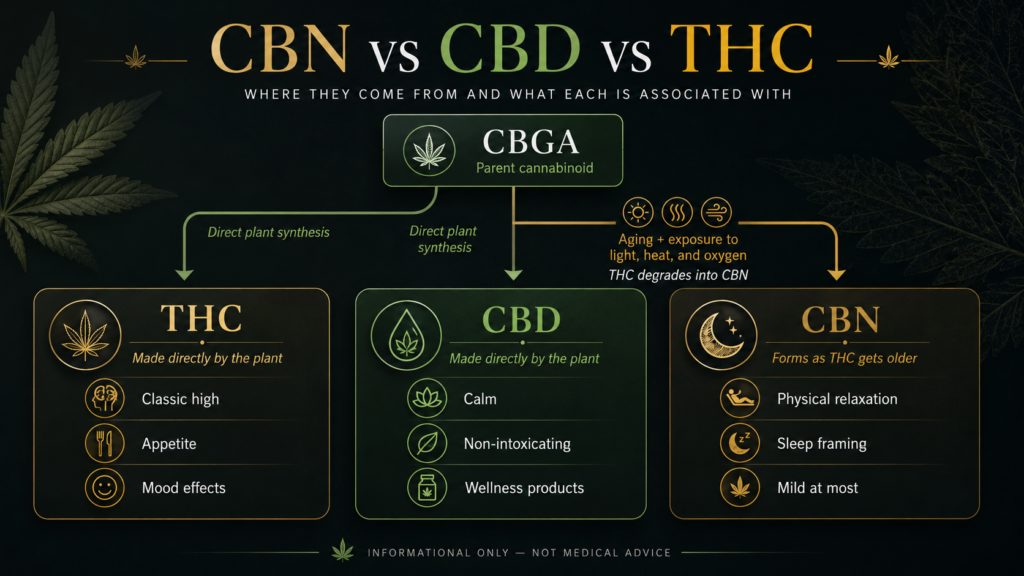
That is the sharpest divide in any CBN and CBD comparison: one is a compound the plant sets out to make, the other is what is left behind as THC breaks down. The same branching point also produces the minor cannabinoids, including the CBC cannabinoid.
Comparison Table: CBN vs CBD vs THC
| THC | CBD | CBN | |
| Psychoactivity | Strong, reliable high | None | Mild at most, dose-dependent |
| Primary receptor | Binds tightly to CB1 | Indirect, broad pathways | Weak CB1, stronger CB2 |
| Typically associated with | Intoxication, appetite, mood | Calm, non-intoxicating wellness use | Physical relaxation, sleep framing |
| Origin | Direct plant synthesis | Direct plant synthesis | Degradation byproduct of aged THC |
What Each Cannabinoid Is Typically Associated With
Each of the three has a reputation, and for the most part, the reputations are earned. THC intoxicates, and at moderate doses, it nudges appetite and mood along with it. CBD does none of that at any dose, which is why it turns up in everything from tinctures to bath salts. CBN is the one people commonly overlook in favor of CBD, despite its growing reputation as a sleep cannabinoid.
CBN is often marketed as the 'sleep cannabinoid,' but that reputation got a head start in folklore before the lab caught up: smokers worked out decades ago that old weed left them sluggish, and the 'blame' landed on CBN.
Early controlled studies have since found improvements in some sleep-related outcomes, for example, one trial using 20 mg of CBN over seven nights reported fewer nighttime awakenings and less overall sleep disturbance, though no significant improvement in how quickly participants fell asleep, and a more recent study using a much higher 300 mg dose found improvements in some sleep parameters without a significant result on its main outcome measure.
The evidence is interesting, but still limited, and it does not yet establish CBN as a proven sleep aid.
That said, plenty of products combine all three deliberately, on the entourage-effect theory that cannabinoids change how each other behave.
Getting the Most Out of a Full-Spectrum Profile
Temperature decides what you actually inhale. Cannabinoids vaporize at different points, so the setting you choose changes the balance of what comes off the flower and what stays in the bowl. Lower settings favor the lighter compounds. Push the heat up, and the heavier ones follow, along with a harsher draw.
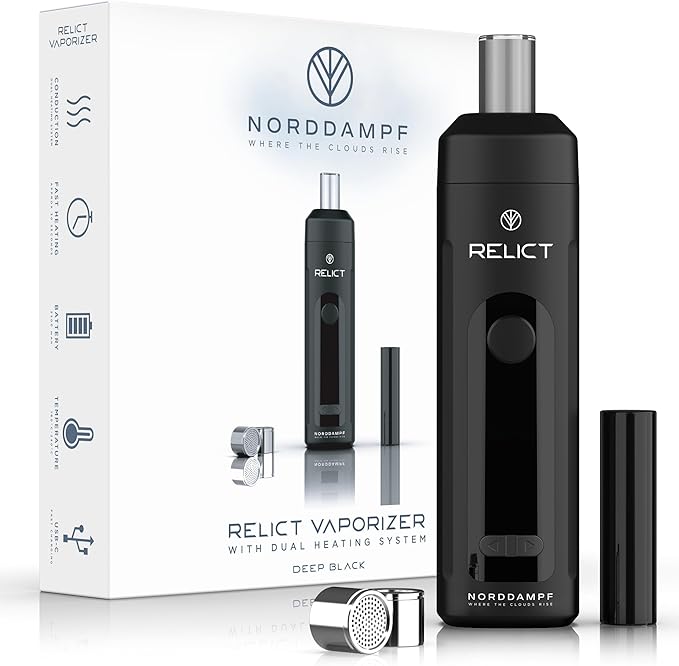
Precision is worth something here. The Relict vaporizer holds an exact set temperature rather than a rough band, so you can work through a range and notice how the same material behaves at 180°C compared with 200°C.
No device isolates a single cannabinoid or guarantees a particular effect, and anything sold on that promise is overstating its case, but what good temperature control buys you is repeatability.
Bottom Line
So, what you have with CBN, CBD, and THC is pretty much the same starting molecule, but with three very different destinations. THC gets you high, CBD does not, and CBN differs from both: it can interact with cannabinoid receptors, but produces much weaker intoxicating effects than THC even at higher doses.
The CBN vs CBD vs THC comparison becomes quite useful in the context of a lab report: the CBD number tells you what the plant made on purpose, and a higher CBN number is a sign of THC degradation and oxidation.
It's not a precise clock, since light, oxygen, temperature, and storage conditions all affect the rate, but read together with the other numbers, it tells you something about how the flower has been treated.
Curious about the sleep side of CBN? Our CBN effects guide is a fascinating read on what the research actually shows.
FAQs
Does CBN Get You High?
Not the way THC does. CBN binds only weakly to CB1 receptors, so it reads as non-intoxicating or close to it at normal doses, despite being a direct product of THC breaking down.
What Is the Main Difference Between CBN and CBD?
Origin, mainly. CBD is produced by the plant and does not bind directly to CB1 or CB2, whereas CBN forms as THC degrades and binds weakly to CB1, with a stronger affinity for CB2. Their effects differ because their chemistry does.
Why Does Aged Cannabis Have More CBN?
Because CBN is what THC turns into as it oxidizes. Exposure to light, oxygen, and warm temperatures speeds that up, so how the flower was stored matters as much as how long it has been sitting around. That also means a CBN reading is a sign of degradation, not a reliable way to pinpoint a flower's exact age.
Can CBD and CBN Be Used Together?
Yes, and plenty of products pair them deliberately. The reasoning is the entourage effect, the theory that cannabinoids influence each other when taken together. Treat it as a promising idea rather than an established one.
Is CBN Legal Everywhere CBD Is Legal?
Not always. Rules vary by country and region, so check your local law rather than assuming CBN and CBD are treated the same way everywhere Norddampf ships.
Sources
Chemical diversity, receptor binding affinity, and pharmacology of phytocannabinoids (PubMed): https://pubmed.ncbi.nlm.nih.gov/40967679/
Cannabinol overview, ScienceDirect Topics: https://www.sciencedirect.com/topics/neuroscience/cannabinol
Therapeutic potential of acidic cannabinoids: an update (PMC): https://www.ncbi.nlm.nih.gov/pmc/articles/PMC12895846/
This article is for informational purposes only and does not constitute medical advice. Always consult a qualified healthcare professional before using cannabis products for health-related purposes.