
Almost every cannabis menu in the world is sorted into the same three categories of sativa, indica, and hybrid. The system is universal and widely accepted enough that most buyers assume that it actually means something. The problem is, for the most part, it doesn't.
While there is some truth to the labeling, the distinctions are somewhat ambiguous. In some cases, the different strains are labeled correctly. In others, they simply aren't.
The Evidence
This assertion isn't just anecdotal. In 2021, researchers at Dalhousie University sequenced hundreds of cannabis samples and checked them against the names they were sold under. True distinguishable genetics accounted for barely one-third of the labeling.
In short, plants sold as indica were frequently closer to sativa-labeled ones than to each other, and the rest often came down to what the grower decided they were. But when the cannabis labeling study was published, the wider industry completely ignored it. Old habits (especially highly profitable ones) are hard to change.
If you need clarity on the difference between sativa and indica, this article explains what those three words actually relate to.
Key Points
- The sativa and indica names began as botanical descriptions of plant shape, with no claim about effect.
- Genetic testing repeatedly finds that labels fail to match a plant's actual ancestry.
- A 2021 Nature Plants study found that the genetic and chemical differences examined explained only a limited portion of the variation in sativa/indica labeling, roughly 37%.
- "Hybrid" absorbs almost anything, which leaves it with very little predictive weight.
- Chemovar, the specific mix of cannabinoids and terpenes, generally provides more useful information than a simple sativa or indica label, though even this cannot reliably predict how an individual will respond.
- Vaporizer temperature is one of the few variables a user directly controls.
Where the Sativa/Indica Split Actually Comes From
Carl Linnaeus named Cannabis sativa in 1753, describing the tall, narrow-leafed hemp then grown across Europe for fiber. Thirty-two years later, Jean-Baptiste Lamarck examined material collected in India, noted that it grew shorter and broader in the leaf, and argued it constituted a separate species, Cannabis indica.
Both classifications described plant morphology. Neither made any claim about psychoactive effects, for the fairly logical reason that neither botanist was studying psychoactive effects.
Either way, the terms remained a matter of academic taxonomy for the better part of two centuries before mass retail entered the equation, changing everything. As legal markets opened, dispensaries needed a vocabulary simple enough to deploy across a counter in under a minute, and the sativa and indica pair was available, familiar, and free of charge.

Our Best Sellers
Discover the most popular Norddampf products
Myth-Busting: What the Labels Get Wrong

The labeling system has produced a handful of claims that get repeated so consistently they now pass for common knowledge. Here are the four that come up most often when people discuss the difference between sativa and indica, and what the evidence actually says about each.
Myth #1: Sativa energizes, and indica sedates, reliably
Individual responses vary far more than the labels allow. Two people can consume sativa and indica and describe different experiences, and the same person can respond differently on different days.
Dose and tolerance both shape the outcome, as does prior expectation, which is notoriously difficult to disentangle from the effect itself when the buyer has already been told what to expect.
Myth #2: The label reflects the plant's genetic ancestry
This is the claim the aforementioned study undermined most directly. Samples labeled indica frequently proved as closely related to sativa-labeled samples as to one another. The same study identified pairs sold under identical names, including OG Kush, with less genetic commonality than samples sold under entirely different names.
Decades of crossbreeding explain most of this. Commercial cannabis is now extensively hybridized, and whatever genetic boundaries the labels once implied were blurred a very long time ago.
Myth #3: Hybrid means a predictable 50/50 blend
Hybrid operates as a residual category. Anything that fails to sort cleanly into the other two usually ends up filed there, which means two products under the same heading can occupy opposite ends of any spectrum worth measuring. In short, the word establishes mixed ancestry and very little else.
Myth #4: A higher THC percentage means a stronger high
THC content indicates concentration, *not *character. A higher THC level may increase the potential intensity of a session, but it does not by itself reliably predict how any given individual will experience it. The surrounding terpenes and cannabinoids influence how the effect feels, and tolerance complicates matters further, since an identical percentage produces markedly different results in a daily consumer and an occasional one.
What Actually Predicts Effect?

The term researchers prefer is chemovar,meaning chemical variety. It treats each batch as its own specific profile of cannabinoids, including THC, CBD, and CBG , alongside terpenes, the aromatic compounds responsible for why one sample smells of pine and another of diesel.
Terpenes have drawn considerable attention through the entourage effect, the proposal that terpenes and cannabinoids interact and modify one another's activity. The hypothesis is credible and supported by some laboratory work. It is not established, and products marketed on its strength are running ahead of the evidence.
Terpenes
Terpenes are the aromatic compounds that give each plant its smell, and a few of them come with associations worth knowing:
- Myrcene: associated with sedation
- Limonene: associated with lift/uplift
- Linalool: associated with serenity
- Pinene: associated with alertness
This is where we can really drill down on the difference between sativa and indica. Two samples can carry near-identical THC numbers and produce quite different evenings, and the terpene profile likely plays a role in that gap, alongside cannabinoids, dose, tolerance, expectation, and other individual factors that all contribute to the experience.
It also explains why the old labels work at all, at least partially. The study team found indica-labeled samples contained more myrcene on average, while sativa-labeled samples tended toward sweeter compounds such as farnesene. The findings suggest the labels may correlate more closely with certain aroma profiles than with any clear line of genetic ancestry.
So Should You Ignore Sativa/Indica Labels Entirely?
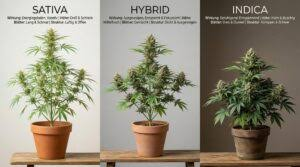
No. At least, not entirely. A weak correlation still carries some useful information, and where nothing else is on offer, a weak classification is probably better than none at all.
The sensible approach is to treat the label as a starting point. Where a certificate of analysis or a terpene breakdown is available, that data should override the label without much hesitation. Where it is not, the label can inform a guess, provided the buyer remembers that it is a guess.
Vaping Temperature and the Chemovar Connection
Temperature is the variable most firmly within a user's control, and it has a measurable effect on what a session delivers. Each compound vaporizes at its own point:
| Temperature | What Happens |
| ~157°C | THC begins converting to vapor |
| ~185°C | Many terpenes start degrading |
| ~220°C | Most terpene content already vaporized/broken down |
| ~230°C+ | Material begins to combust |
ℹ️These are approximate reference values. The actual release or degradation of individual compounds can depend on the device used, heating duration, airflow, and the plant material itself.
| ℹ️Our vaporizing temperature guide covers how cannabinoids behave once heat is applied. |
Above 220°C, most terpene content has already vaporized or broken down. Past approximately 230°C, the material begins to combust, producing exactly the byproducts that vaporizing exists to avoid. The exact transition point varies by device and usage conditions, and the risks of overheating, charring, and combustion increase as temperatures climb.
Bottom Line
So, there is a lot of ambiguity and confusion when it comes to the difference between sativa and indica strains, but that doesn't mean the labels are worthless. Try to view them as rough guides to how something smells, which loosely correlates with how it might feel.
The things that genuinely shape a session are the chemovar in front of you, and the temperature you run it at, and only the latter can still be changed once you have bought the stuff. Even then, individual responses can vary considerably between people with similar chemical profiles, and none of the relationships described here guarantee a specific outcome.
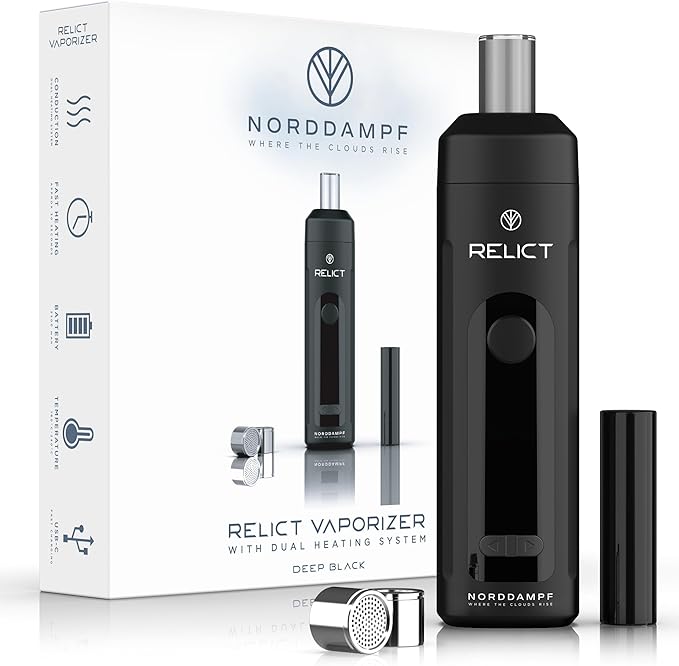
That is a decent reason to pay more attention to your device than your packaging. Something with real temperature control, like the RELICT Vaporizer, lets you work through the range instead of winging it.
FAQs
Is there really a difference between sativa and indica?
There is a real botanical difference in how the plants grow and a much weaker one in how they affect a user. Genetic testing repeatedly finds labels failing to match ancestry, so the difference between sativa and indica describes leaf shape far more reliably than it describes an experience.
What is a "chemovar" in cannabis?
A chemovar is a chemical variety: the specific profile of cannabinoids and terpenes in a given plant. It describes what is genuinely present in the material instead of which marketing category it was assigned to, which makes it a considerably better predictor of effect.
Does hybrid mean 50/50 sativa and indica?
No. Hybrid serves as a catchall for anything that resists neat classification, so two products carrying that label can have profiles with almost nothing in common. The word confirms mixed ancestry and tells a buyer little else.
Does a higher THC percentage mean a stronger high?
Not dependably. THC content influences intensity, but the surrounding terpenes and cannabinoids shape the experience's character, and tolerance greatly affects perceived strength. The highest number on a menu is not automatically the strongest session.
What vaporizer temperature should I use for a specific strain?
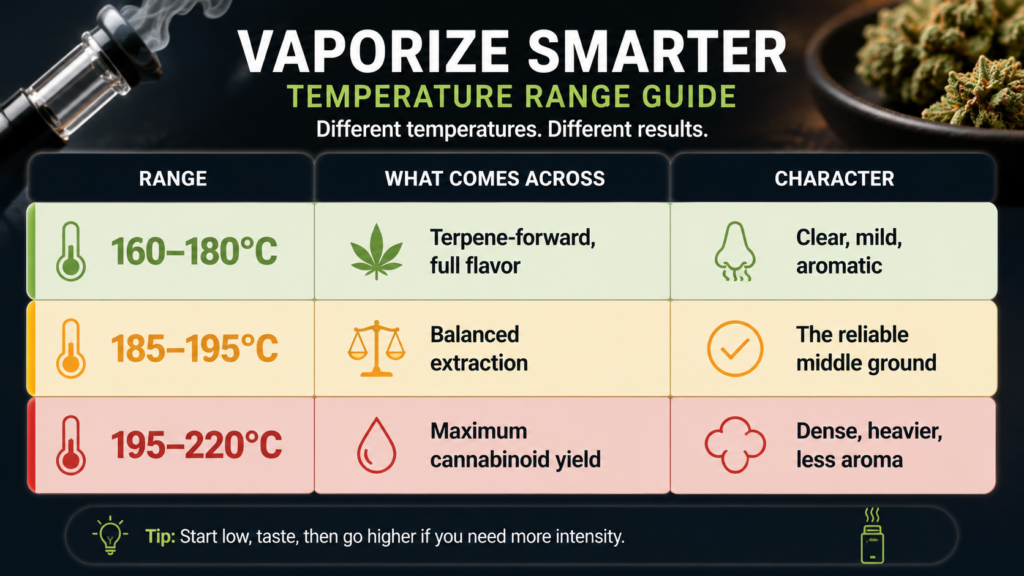
Work from what the material contains. Lower settings around 160-180°C favor flavor and a clearer feel, while 195-220°C extracts more cannabinoid content at the cost of aroma. Starting low and stepping up through a session lets a user sample the full range.
Sources
Watts, S. et al. (2021), Cannabis labeling is associated with genetic variation in terpene synthase genes, Nature Plants. https://www.ncbi.nlm.nih.gov/pmc/articles/PMC8516649/
Smith, C. J. et al. (2022), The phytochemical diversity of commercial Cannabis in the United States, PLOS ONE. https://journals.plos.org/plosone/article?id=10.1371/journal.pone.0267498
Piomelli, D. & Russo, E. B. (2016), The Cannabis sativa Versus Cannabis indica Debate, Cannabis and Cannabinoid Research. https://www.ncbi.nlm.nih.gov/pmc/articles/PMC5576603/
Russo, E. B. (2011), Taming THC: potential cannabis synergy and phytocannabinoid-terpenoid entourage effects, British Journal of Pharmacology. https://www.ncbi.nlm.nih.gov/pmc/articles/PMC3165946/
Sawler, J. et al. (2015), The Genetic Structure of Marijuana and Hemp, PLOS ONE. https://journals.plos.org/plosone/article?id=10.1371/journal.pone.0133292
Disclaimer: This article is for general informational purposes only, does not constitute medical advice, and does not guarantee any specific effects. Always consult a qualified healthcare professional before using cannabis products for health-related purposes.