
Most new home growers will arrive at a moment, at some point or another, when admiration of their own work changes instantly into suspicion.
It starts when you notice, with no shortage of glee, that the plants have filled out beautifully and the leaves boast a lovely, waxy sheen. You expected this to be difficult and prepared yourself for potential failure, but the whole business of growing your own cannabis is going exceedingly well, it would seem.
Reality Check of Doom
On closer inspection, you are yanked back into reality after realizing that two of them are producing small, round growths at the joints where the others have something finer and paler. Unwittingly, it turns out, you’ve been growing a male plant.
Oddly enough, cannabis is among the minority of crops that bother with separate sexes, and the male exists purely to broadcast pollen to any female within reach. Let him succeed, and you will still get a harvest, albeit a harvest of seeds and, as even a complete novice will know, you can't smoke seeds.
If you are new to this caper, you probably need to know the basics of a male vs female cannabis plant, including how to tell the two apart, when the plant will tell you itself, and what the males are actually good for.
That's what this blog post is for. We only cover the raw basics, but at this stage, that's all you need to know. Let's get to it.
Key Points
- Cannabis is dioecious. Most plants come up either male or female, and only the females produce the resin-rich flowers worth harvesting.
- Sex usually declares itself between weeks three and six of vegetative growth, at the nodes where branches meet the main stem.
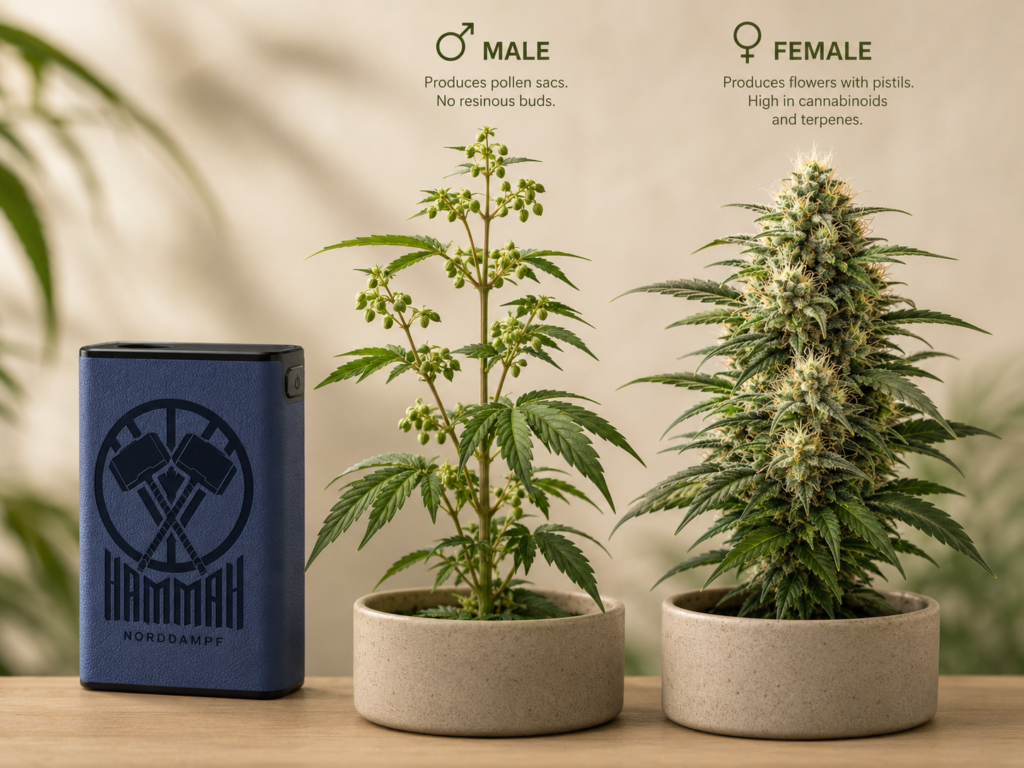
- Males carry smooth, round pollen sacs. Females carry fine hair-like pistils. Height and bushiness settle nothing.
- A pollinated female moves her energy out of resin and into seed, and potency falls away with it.
- Under a three-plant legal limit, one missed male writes off a third of the year.
- Feminized seeds come up female roughly 95-99% of the time.
Why This Matters More for Home Growers Than You'd Think
Germany's cannabis law, the KCanG, allows an adult to tend three plants at home. Now, three is a generous allowance if you are growing tomatoes, but a rather tense, nervous one if you are growing something capable of sabotaging itself, like cannabis.
A licensed producer who finds a male in week five pulls it, notes the loss, and carries on with the remaining several thousand. The home grower performs the identical removal and has just written off a third of everything he owns. It's its situation that plays out exactly like that, every single day.
The problem is that an unpollinated female (what the trade calls sinsemilla ) spends her flowering period building resin loaded with cannabinoids and terpenes. Once pollinated, a larger share of her energy shifts into seed production, which can noticeably reduce yield, resin production, and cannabinoid content compared with what an unpollinated female would produce.
Depending on the study and growing conditions, figures of around 60% to 75% are commonly cited for the drop in cannabinoid content after pollination, though the actual impact will vary with genetics, cultivar, and how the plant is grown.
Either way, the pattern is consistent enough that the exercise comes down to catching the male before he opens. Not shortly afterward, as it's impossible to be quick enough to deal with Mother Nature in that way, but before.
| ℹ️Fast Fact: Sexing is one stage in a much longer sequence, and the decisions taken well before it shape how legible the signals are when they finally arrive. Light schedule and feeding regime both play into it. Our cannabis cultivation guide covers the grow from seed to harvest. |

Our Best Sellers
Discover the most popular Norddampf products

Male vs Female Cannabis Plant: Quick Reference
Everything below explains the reasoning, but if you're standing over a tent right now, this table is the whole answer.
| Feature | Male | Female |
| Structure at node | Small, round pollen sacs | Fine, hair-like pistils |
| Texture | Smooth-walled, clustered | Wispy, open |
| Timing | Slightly earlier | Slightly later |
| Height/bushiness | Not reliable | Not reliable |
How to Identify a Male Cannabis Plant
Everything of consequence happens at the nodes, the points where branches meet the main stem. Many plants show their first sexual characteristics somewhere between around weeks three and six, though the exact timing depends on genetics, cultivation type, and environmental conditions. Some declare themselves earlier, others later.
The male grows small, round sacs, smooth-walled and clustered like undersized grapes, and he tends to get on with it slightly ahead of the females. He may also run taller and leaner, though a fair number of females do precisely the same, and the silhouette proves nothing whatever. Either way, the sacs are the evidence - and no, that's not a metaphor.
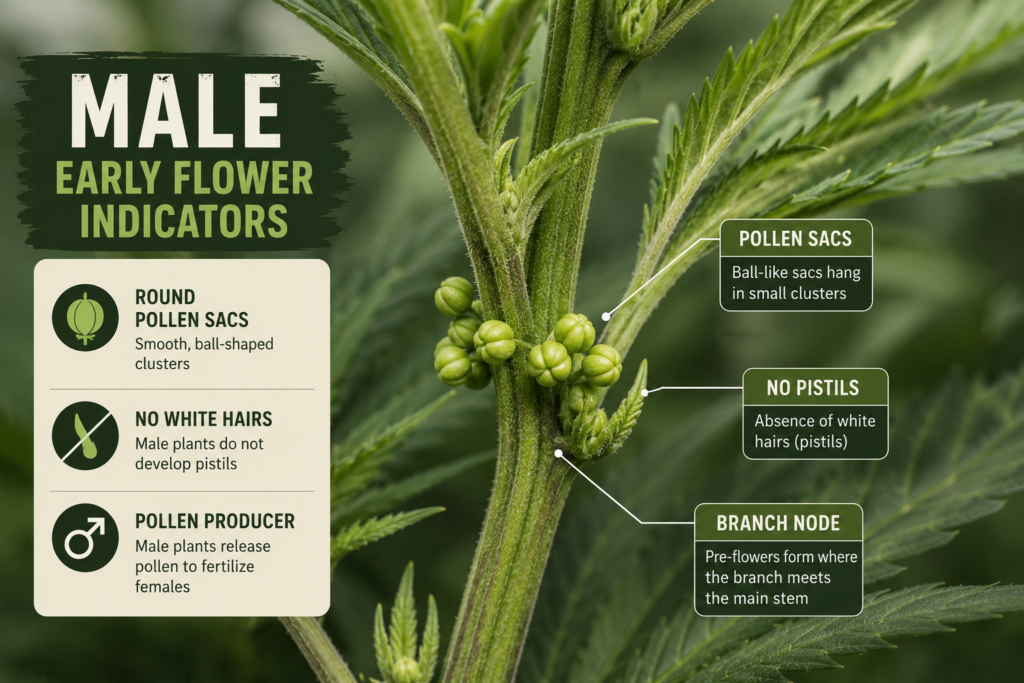
A jeweler's loupe is worth the eight euros it costs. At the stage that matters, an immature pollen sac and an emerging pistil cluster are close enough to be confused by anyone working from memory (or maybe optimism), and that confusion is the most common route by which a tent full of females ends up seeded.
Once you have your answer (and assuming no intention to breed), the male leaves. Preferably, the same day, and preferably into a bag, since pollen travels on air currents and shirtsleeves with equal willingness.
How to Identify a Female Cannabis Plant
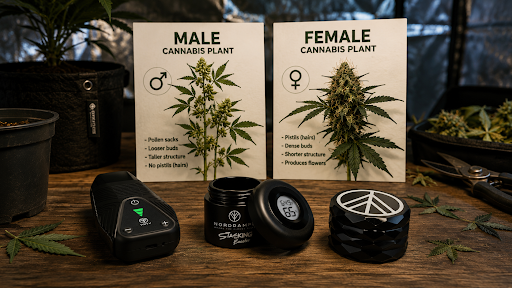
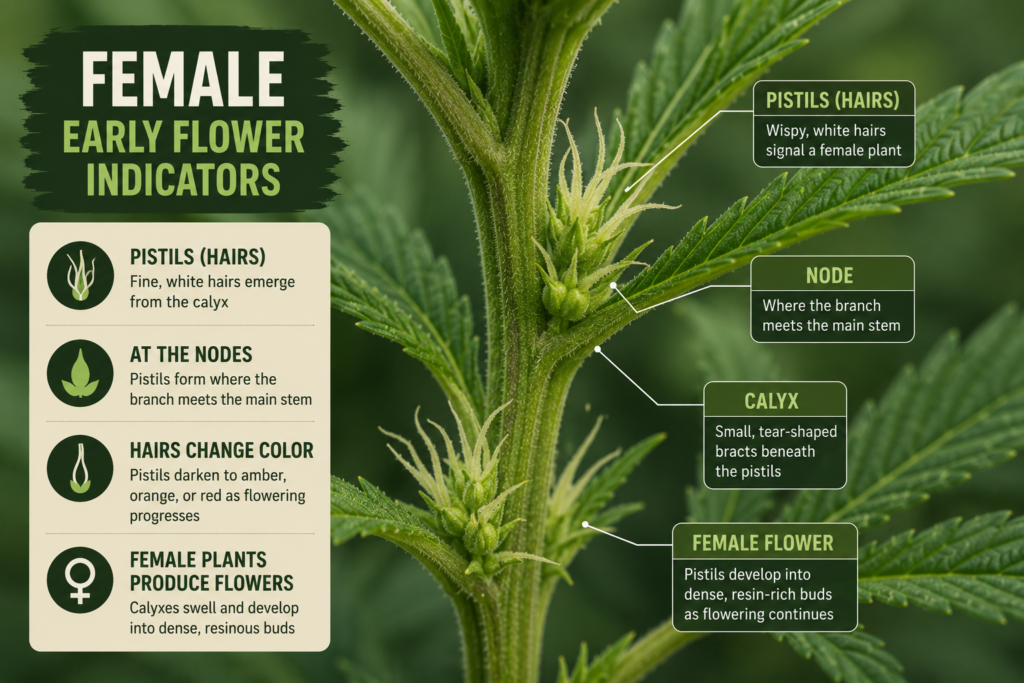
The female announces herself with pistils, fine pale filaments pushing out from those same nodes. Where the male offers something rounded and closed, she offers something more wispy and open, and once you have seen the two side by side, the distinction between male vs female cannabis plant should be quite obvious, once you know.
As flowering runs on, the pistils darken toward amber or red depending on the strain, and the calyxes behind them swell into the dense resinous flower that was the point of the entire undertaking. She will often hold in vegetative growth a little longer before committing, which unnerves many growers into assuming the worst about a plant that is simply taking her time. Just be patient and wait for the pistils.
What About Hermaphrodites?
Now and then, a plant declines to commit and produces both sets of parts at once:
- Light leaks during the dark cycle
- Extended or irregular flowering stretch
- Physical stress/damage to the plant
- Temperature swings or nutrient extremes
The hermaphrodite is arguably more dangerous than the male, for the obvious reason that nobody is watching for her. She can pollinate herself and everything around her while presenting, to a casual glance, as a perfectly ordinary female having a good season.
The distinguishing feature is a small, banana-shaped structure known as an anther, hidden among the flowers. It is the pollen-bearing part of a male stamen that appears without the sac that would normally enclose it. It is precisely this absence that is the problem. A pollen sac must first mature and burst open before it can cause any damage, which gives you at least a few days’ head start. An exposed anther, on the other hand, releases pollen almost immediately. Growers call them “nanners.” |
Are Male Plants Actually Useless?
Not at all. Not in the true sense of the word, anyway.
- Breeding new cultivars and deliberate crosses
The male's sole raison d'etre in life is to breed. Every new cultivar and every deliberate cross depends on his pollen, and the people who maintain genetic lines regard him as the indispensable half of the operation rather than the disposable one.
- Preserving/maintaining genetic lines
Male plants are essential for maintaining stable genetics and developing future cannabis varieties, making them invaluable to breeders.
- Fiber and industrial applications
Fiber and industrial applications exist as well, though anyone pursuing those is arguably not the person squinting into a three-plant tent at midnight. For the ordinary grower who is after flower and nothing else, the male's finest hour is his removal.
Feminized seed avoids the question altogether. As an estimated range, feminized seed is bred to come up female around 95% to 99% of the time, which takes most of the risk out of a legally capped grow. A degree of vigilance remains sensible, however, as stress during growth or genetic factors can still result in the odd plant developing male floral characteristics.
| ℹ️Fast Fact: Pistil color is a rough guide to ripeness and a poor thing to harvest by. The accurate read comes from the trichomes, which turn from clear to cloudy as the plant finishes. The week-by-week cannabis flowering guide covers what to look for and when to expect it. |
Bottom Line
It's all really quite simple when you know what to look for, and when. The plant tells you what it is, at the nodes, between weeks three and six. Remember, Round sac, male. Hair-like pistil, female. Learn those, and the whole male vs female cannabis plant debacle stops being a source of dread and becomes a simple two-minute job with a loupe.
Ultimately, catching the male early is the difference between a harvest and a jar of seeds, and once a clean, unseeded female has been brought through to the end, the only remaining question is how to do her justice further down the line, which turns out to be a matter of temperature control above all else.
Which brings us neatly to a quick, shameless plug.
A precise low-temperature dry herbRELICT vaporizer draws the terpenes out intact rather than incinerating them on the way past, and if you haven't got one, you don't know what you are missing.
FAQs
How can you tell if a cannabis plant is male or female?
Look at the nodes where branches meet the stem. Males produce small, round pollen sacs, and females fine, hair-like pistils. Those two features answer the male vs female cannabis plant question far more reliably than height or bushiness, both of which vary too much to be worth anything.
When do cannabis plants show their sex?
Many plants show their first sexual characteristics between roughly weeks three and six of vegetative growth, though the exact timing depends on genetics, cultivation type, and environmental conditions. Males often declare themselves marginally earlier, which is reason enough to start inspecting sooner than feels necessary.
What happens if a male plant pollinates a female plant?
A pollinated female shifts more of her energy into seed production, which reduces yield, resin, and potency. Depending on the study and growing conditions, cannabinoid losses in the range of 60% to 75% are commonly reported, though the actual impact varies with cultivar and setup.
Are male cannabis plants good for anything?
Yes. Breeding, preserving genetics, creating new seed lines, and certain industrial hemp applications all depend on them. For a grower who simply wants flowers, though, the male is best removed before he can pollinate anything.
Do feminized seeds guarantee a female plant?
Not a guarantee, but close to one. Feminized seeds are estimated to produce females roughly 95% to 99% of the time, making them the simplest way to reduce risk when the plant count is legally capped. Stress during growth or genetic factors can still cause the odd plant to develop male floral characteristics, so a bit of vigilance never hurts.
Sources
- Bernstein, N. et al. (2021). Fertilization Following Pollination Predominantly Decreases Phytocannabinoids Accumulation in Cannabis Inflorescences. Frontiers in Plant Science.
- Hermaphroditism in Cannabis sativa L.: Impacts, Inducers, and Industry Implications (2026). Plants.
- Timoteo Junior, A. A. & Oswald, I. W. H. (2024). Optimized guidelines for feminized seed production in high-THC Cannabis cultivars. Frontiers in Plant Science.
- Wizenberg, S. B. et al. (2023). Cosexuality Reduces Pollen Production and Fitness in Cannabis sativa L.. Plants.
- Meier, C. & Mediavilla, V. (1998). Factors influencing the yield and the quality of hemp essential oil. Journal of the International Hemp Association, 5(1), 16-20.
Disclaimer: This article is for general informational purposes only and does not constitute legal or cultivation advice. Local laws on cannabis cultivation vary considerably and should always be checked in your own jurisdiction before growing at home.