
Most people are quite familiar with THC and CBD. Anyone who has been following the market closely lately may even be familiar with CBG and CBN. But there’s a fourth compound that sits right alongside them in the plant’s chemical makeup—often in significant quantities—yet hardly anyone talks about it. It’s called CBC, or cannabichrome.
CBC is a non-psychoactive cannabinoid. It does not bind to the CB1 receptors in the brain the way THC does, which is why it does not get you high. It appears to interact with the body through a different pathway (primarily CB2 receptors and TRP channels), and early preclinical research has suggested potential anti-inflammatory and pain-related effects, although these have not yet been confirmed in clinical trials involving humans.
This guide explains what CBC actually is, how it relates to THC and CBD, what the lab data has shown so far, and why you're probably already consuming it without even realizing it.
| ℹ️Note: This article is for informational purposes only and does not constitute medical advice. Always consult a qualified healthcare professional before using cannabis products for health-related purposes. In Germany, the purchase, possession, and use of cannabis products outside of authorized medical or cultivation channels are regulated under the KCanG. Please check your local legal status before purchasing. |
Key Points
CBC (cannabichromene) is a non-psychoactive cannabinoid. It does not produce the “high” associated with THC.
It is, in fact, one of the more abundant compounds in cannabis and, along with THC, CBD, and CBN, is present in the plant's raw chemistry, but it is rarely highlighted on labels.
CBC, THC, and CBD all derive from the same parent molecule, cannabigerolic acid (CBGA). They are chemically related, which explains why they often appear together in the same strains, even though they have very different effects on the body.
Early preclinical research suggests that CBC may interact with CB2 receptors and TRP channels and may have anti-inflammatory or analgesic effects. These findings have not yet been confirmed in robust clinical trials in humans.
It is believed that CBC contributes to the “entourage effect,” the theory that phytocannabinoids and terpenes work better together than they do in isolation. This is an active area of research and not a proven rule.
What is CBC (cannabichromene)?
CBC was first identified in the 1960s and is one of over 100 phytocannabinoids found in the cannabis plant. It remains somewhat under the radar because commercial breeders have focused on THC or CBD breeding for decades, making CBC a background compound in most chemovars. It is usually present in smaller amounts than the “big two,” but it’s almost always there.
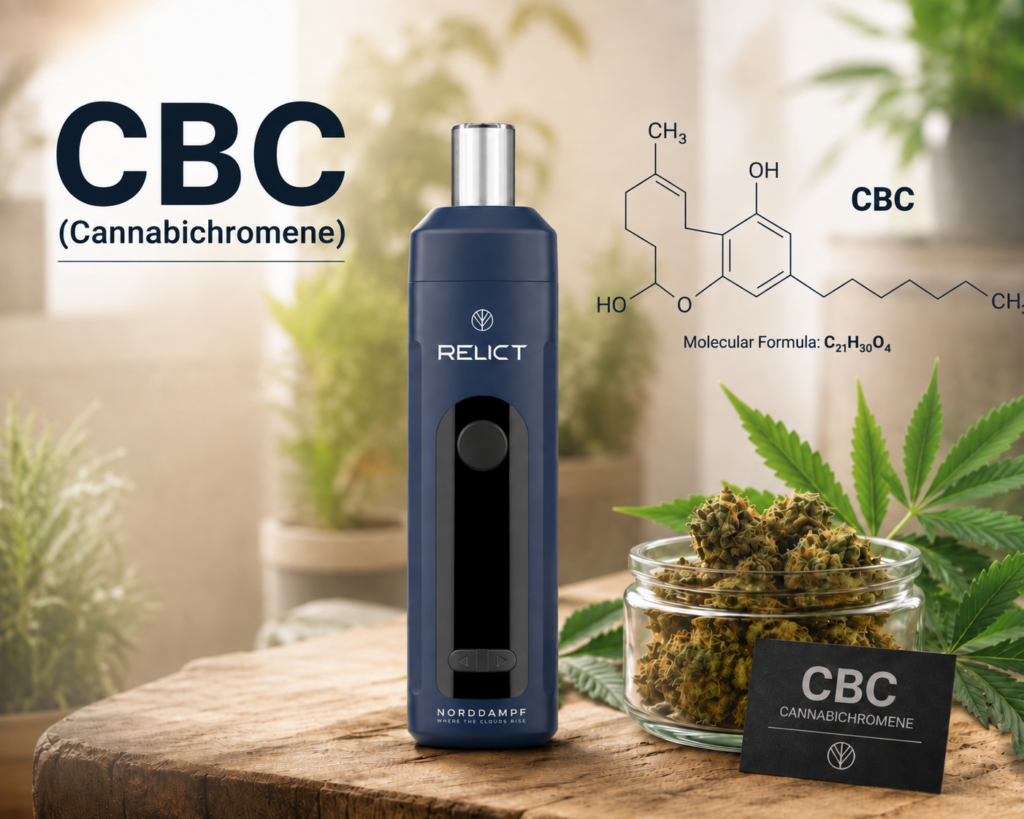
To understand why it exists, you have to look at the plant’s biosynthetic pathway. CBC, THC, and CBD all derive from the same precursor: cannabigerolic acid, or CBGA. As the plant matures, certain enzymes convert CBGA into the various cannabinoids. That’s why CBC is found in almost every strain, even though it’s rarely the compound listed as dominant on the jar.
The important (and often overlooked) distinction for consumers is that CBC is non-psychoactive. It does not activate the CB1 receptors in the brain, which is why it does not alter your state of mind.

Our Best Sellers
Discover the most popular Norddampf products

CBC vs. CBD vs. THC: How They Differ
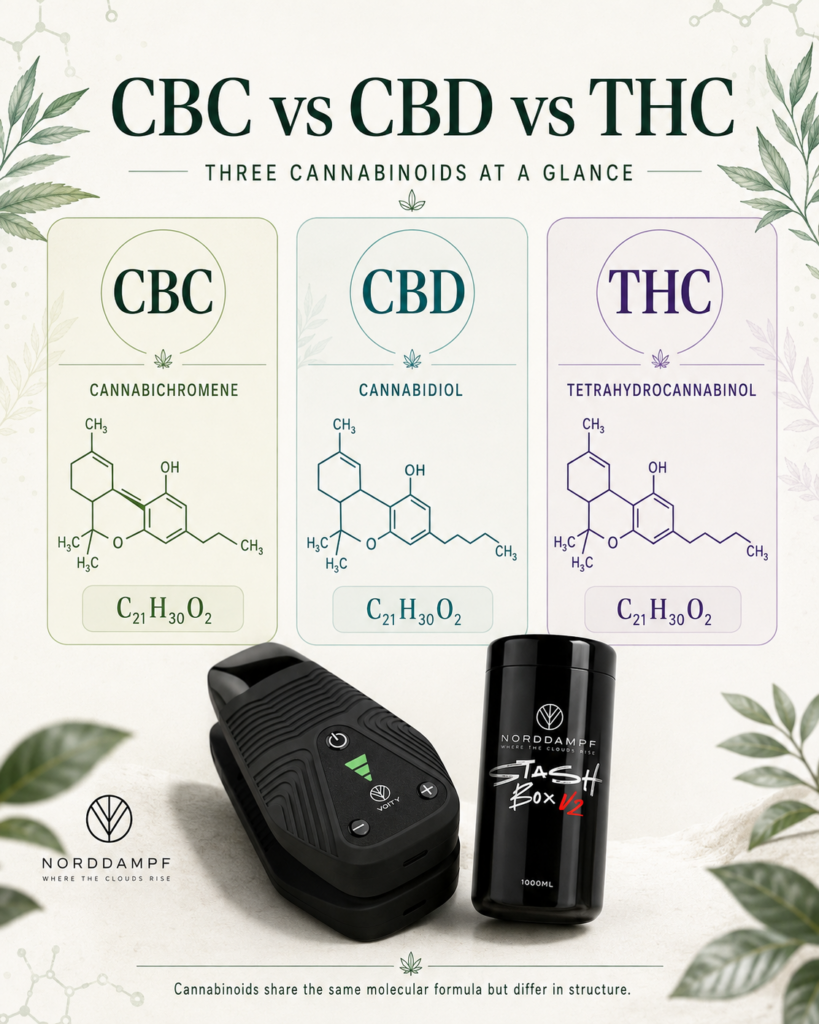
If you buy a product because of its THC content, you're looking for a specific, predictable high. If you buy CBD, you're usually looking for non-intoxicating support without the high. CBC is neither.
You don’t choose a CBC product to avoid getting high, nor are you seeking a specific physical sensation, as you might expect with CBD. The interest in CBC lies in its potential supportive role. CBC may contribute to interactions between different cannabinoids in full-spectrum products, although this potential connection remains the subject of ongoing research.
| ℹ️Our in-depth guide on how vaporizers work covers the entire process of heat transfer and decarboxylation. |
What does early research say about CBC?
Current research on CBC is preclinical; in layman’s terms, this means we’re looking at Petri dishes and animal models, not large-scale clinical trials in humans. This is exploratory work; it does not represent an established, widely recognized therapeutic profile.
Nevertheless, the focus is currently on two specific targets: CB2 receptors and TRP channels. CB2 receptors are found primarily in the immune system, which is why scientists are interested in their role in inflammation.
TRP channels, in turn, play an important role in how the body perceives pain. Preclinical studies suggest that CBC may interact with both, although this has not yet been confirmed in human studies.
Of course, none of this means that CBC is a cure for anything, but the science is worth keeping an eye on in the future. We don’t yet have any reliable dosing protocols, nor are there any approved medical claims. It’s a promising compound, but certainly not a proven medicine.
CBC and the Entourage Effect
The entourage effect is the theory that the plant’s phytocannabinoids and terpenes work together synergistically. The idea is that a full-spectrum extract containing dozens of compounds produces a different effect than an isolate of a single compound.
CBC likely plays a role in this synergy. As a consistent component in full-spectrum flowers and extracts, it may contribute to overall balance. While the exact mechanism is not yet fully understood, this is the main reason why many consumers prefer full-plant extracts over isolates.
The practical consideration here is that you’re probably already consuming CBC. If you buy full-spectrum flowers or concentrates, there’s a good chance they contain CBC. You experience it as part of the plant’s overall profile, even if you aren’t specifically looking for it.
| ℹ️If you're still trying to figure out how the lesser-known cannabinoids compare to one another, you might find our breakdown of the key differences between CBG and CBD interesting. |
Getting the Most Out of Full-Spectrum Cannabinoids
Different cannabinoids and terpenes have different boiling points. When you use a cannabis vaporizer, the temperature you select determines which compounds are released into the vapor. Greater temperature precision allows you to specifically target certain cannabinoids, including smaller ones like CBC.
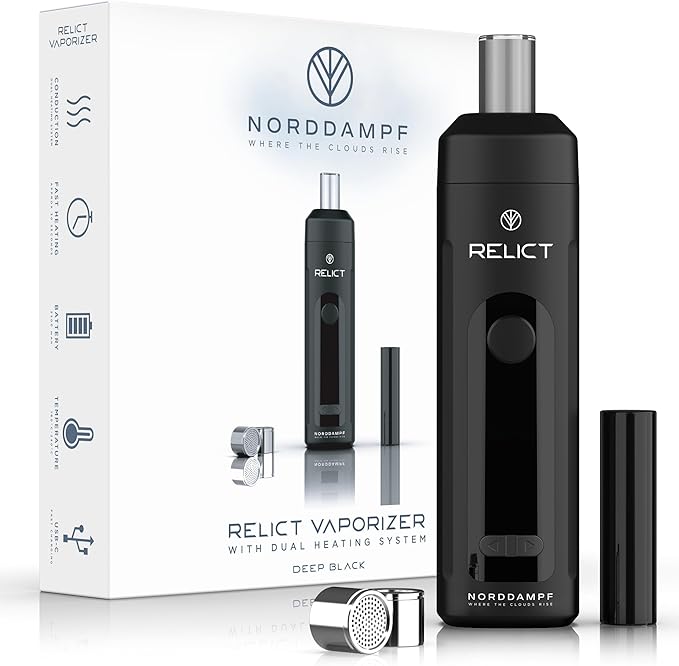
If you want to explore a strain’s full profile, you’ll need a device with precise controls. The RELICT vaporizer offers precision in 1°C increments from 160°C to 240°C, allowing you to shift the vapor composition from terpene-rich to cannabinoid-rich. It’s a practical, high-quality device for getting the most out of your susz.
Bottom Line
CBC is one of the most common, yet least discussed, cannabinoids of all. It isn’t psychoactive, remains in the background of most commercial strains, and is currently the subject of interesting, though early, research. If you already use cannabis, however, you don’t necessarily need to go out of your way to buy CBC products, since it’s already present in the full-spectrum flower you’re likely using.
What makes CBC worth knowing about isn’t so much what it does on its own, but rather what it stands for. It serves as a reminder that the plant does far more than just provide THC, and that the compounds nobody prints on the label are still part of what you feel every time you pack a chamber.
As research expands beyond the “big two,” lesser-known cannabinoids like CBC are the ones that will fill in the gaps in our actual understanding of full-spectrum cannabis. Right now, the smartest move isn’t to chase after it as a standalone product, but to get the most out of the bud you already have and let the entire profile do its job.
FAQs
Does CBC get you high?
No. CBC is not psychoactive and does not activate the CB1 receptors that THC targets. Because of this difference in how they work, the effects of CBC are purely physical rather than psychoactive.
What is the difference between CBC and CBD?
The comparison between CBC and CBD boils down to receptor pathways. Neither is psychoactive, but CBD acts through several indirect mechanisms, while CBC is more specifically associated with CB2 receptor and TRP channel activity.
Is CBC legal?
In Germany, the legal status of CBC depends on the specific product and how it is manufactured. Under the KCanG, the extraction of cannabinoids from the cannabis plant is generally prohibited, with an explicit exception for CBD.
CBC products cannot therefore simply be treated as legally equivalent to CBD. The applicable rules should always be checked for each specific product, and requirements vary from country to country outside of Germany.
Can you get CBC on its own?
CBC isolate products do exist, but they are far less common than CBD or CBG isolates. Most consumers ask, “What is CBC?” when searching for it as a product, only to find that it is usually found as an ingredient in full-spectrum flowers or extracts rather than as a standalone product.
What are the potential benefits of cannabichromene?
Current preclinical data suggest potential anti-inflammatory and analgesic effects, although large-scale human studies are still lacking. Cannabichromene (CBC) is an active area of early research, but no therapeutic claims have yet been approved.
Sources
Cannabichromene (CBC): A Comprehensive Review of Biosynthesis, Pharmacology, Therapeutic Potential, and Translational Perspectives: https://pubmed.ncbi.nlm.nih.gov/42464425/
The Potency Puzzle: Understanding Cannabis in the Modern Age: https://researchoutreach.org/articles/potency-puzzle-understanding-cannabis-modern-age/
FDA Regulation of Cannabis and Cannabis-Derived Products, Including Cannabidiol (CBD): https://www.fda.gov/news-events/public-health-focus/fda-regulation-cannabis-and-cannabis-derived-products-including-cannabidiol-cbd
*Note: This article is intended solely for general informational purposes and does not constitute medical or legal advice. Always consult a qualified healthcare professional before using cannabis products for health-related purposes.*
*The purchase, possession, and use of cannabis may be subject to varying regulations or restrictions depending on the country and product category. Readers should always check the applicable regulations in their own jurisdiction before purchasing or using it.*